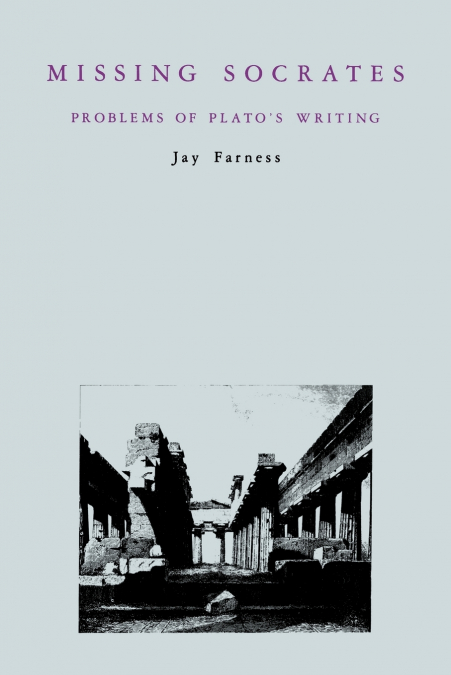

Missing Socrates

Missing Socrates

Jay Farness

58,95 €
IVA incluido
Disponible
Editorial:
Penn State University Press
Año de edición:
1991
Materia
Filosofía occidental: antigua, hasta c. 500
ISBN:
9780271026312
58,95 €
IVA incluido
Disponible

Selecciona una librería:

  • Librería Samer Atenea

  • Kálamo Books
  • Librería Elías (Asturias)
  • Librería Kolima (Madrid)
  • Librería Proteo (Málaga)

Plato’s conversations of Socrates are among the most accessible philosophical texts most of us have ever read, yet the more one pursues the art or intelligibility of this writing, the more mysterious and paradoxical the Platonic texts become. What does it mean to study Plato, not philosophically as a maker of arguments, not poetically as a maker of dialogues, but literally as a maker of texts? This is a question that Jacques Derrida has made his own, and in this book Farness creates a dialogue with Derrida on Plato’s texts.Missing Socrates also provides a dialogue between Plato and Socrates on the question of speech versus writing and a study of the materiality of Plato’s writing. Included among the various dialogues and themes developed here are rhetoric and courtroom practice in the Apology of Socrates; religion, skepticism, and the idea of transcendence in the Euthyphro; artistic practice and tradition in the Ion; education and political discipline in the Charmides; and rhetoric, writing, commemoration, and the motives of authorship in Phaedrus. In each of these discursive settings, Socrates unsuccessfully seeks a place or a mode for philosophy; Farness shows that the dialogues of Plato uncannily supply that lack.

Artículos relacionados

  • The Nature of Things
    Lucretius Lucretius
    De rerum natura (On the Nature of Things) is a 1st century BC didactic poem by the Roman poet and philosopher Lucretius with the goal of explaining Epicurean philosophy to a Roman audience. Lucretius presents the principles of atomism; the nature of the mind and soul; explanations of sensation and thought; the development of the world and its phenomena; and explains a variety o...
  • Pompeii
    Fergus Mason
    Pompeii was one of most advanced cities of its time; it had a complex water system, gymnasium, and an amphitheater. Despite it's advancements, there was one thing it wasn't ready for: Mount Vesuvius—the volcano that led to its ultimate doom.  The 79 AD eruption of Mount Vesuvius was one of the worst disasters in all of European history. In a near instant, over 15,000 p...
    Disponible

    10,36 €

  • Middle Platonism and Neoplatonism, Volume 1
    Stephen Gersh
    'It is generally agreed that those types of philosophy that are loosely called ’Platonic’ and ’Neoplatonic’ played a crucial role in the history of European culture during the centuries between antiquity and the Renaissance. However, until now no scholar has attempted to describe the evolution of these forms of thought in a single comprehensive academic study.' So writes Stephe...
  • Middle Platonism and Neoplatonism, Volume 2
    Stephen Gersh
    It is generally agreed that those types of philosophy that are loosely called 'Platonic' and 'Neoplatonic' played a crucial role in the history of European culture during the centuries between antiquity and the Middle Ages. However, until now no scholar has attempted to describe the evolution of these forms of thought in a single comprehensive academic study. Middle Platonism a...
  • Porphyry’s Commentary on Ptolemy’s Harmonics
    Andrew Barker
    ...
    Disponible

    80,87 €

  • The Roots of Platonism
    John Dillon
    ...
    Disponible

    26,54 €