
Mind-Matter Unity

Mind-Matter Unity

Kaisheng Li / Longji Li

103,07 €
IVA incluido
Disponible
Editorial:
Gradient Physics Press
Año de edición:
2026
Materia
Filosofía de la mente
ISBN:
9798996139477
103,07 €
IVA incluido
Disponible

Selecciona una librería:

  • Librería Samer Atenea

  • Kálamo Books
  • Librería Elías (Asturias)
  • Librería Kolima (Madrid)
  • Librería Proteo (Málaga)

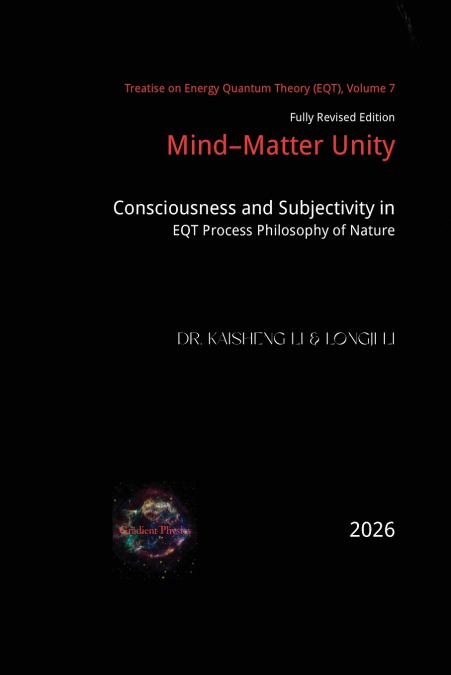
Mind--Matter Unity: Consciousness and Subjectivity in the EQT Process Philosophy of Nature develops a systematic account of consciousness within the framework of Energy Quantum Theory (EQT). The book begins from the hard problem of consciousness: why physical processes are accompanied by first-person experience, rather than remaining merely silent operations of structure, function, and information processing. Instead of claiming to dissolve this problem by definition, function, emergence, or identity alone, the book proposes a more restrained strategy: to clarify everything that can be structurally and physically explained, and to mark precisely the residual point that cannot be reduced.The central thesis is that first-person experience and specific gradient configurations of the frequency-resolved energy quantum density field, ( rho_f), are isomorphic at the strongest level: they are two aspects of the same underlying process. The structure of experience is argued to correspond to five sources of richness in ( rho_f): single-frequency gradient configurations, frequency families, master-equation evolution, resonance modes, and transient timescale spectra. These five sources are used to account for qualitative variation, differences among qualitative kinds, the stream of consciousness, unity and binding, temporal thickness, and memory.The book then distinguishes structural isomorphism from given-ness. Experience is not merely a structure; it is given from within. This given-ness is characterized as internal--external co-evolutionary freezing within a bounded interior. The boundary of life, especially the membrane as the first topological interior, becomes the gate that separates living given-ness from non-living physical interaction. This allows the book to reject both panpsychism and functionalist substrate-independence: not every coupled system has experience, and artificial systems without a genuine life-boundary do not possess the precondition of given-ness.A further part of the argument explains how sensation becomes cognized experience through memory transients, knowledge structures, comparison, language, and symbolic organization. It also develops an account of subjectivity: experience becomes 'mine' through ( mathcal{B})-demarcation, the attributional projection of dominant coherence. Disorders such as depersonalization, thought insertion, split brain, dissociation, and covert consciousness are treated as test cases for this framework.The measurable side of the theory is expressed through the projection tensor ( Psi=( tilde{A}, C, mathcal{B})), where ( tilde{A}) refers to the dissipative power required to maintain non-equilibrium co-evolution, (C) to differentiation and integration, and ( mathcal{B}) to the boundary of coherent co-evolution. The book connects these quantities to EEG/MEG, fMRI/PET, TMS-EEG, effective connectivity, and other empirical interfaces. It also presents falsifiable predictions, especially the frequency--quality correspondence and the frequency--timescale relation ( tau_{ mathrm{retain}} sim tau_0/f).Philosophically, the book defends an open-process dual-aspect monism. Mind and matter are not two substances, nor is consciousness reduced to function or eliminated as illusion. Rather, mind and matter are two directions of access to the same ( rho_f) process: externally as gradient structure and co-evolution, internally as given experience. Yet the book also preserves an irreducible final cell: why the internal side of this process is experienced at all. This residual point is not treated as failure, but as the honest boundary of physical and structural explanation.


Artículos relacionados

  • Word and World
    Patricia Hanna
    ...
  • Empower Your Mind
    SREEKUMAR V T / V T SREEKUMAR
    'Empower Your Mind: Strategies for Mental Health Empowerment' by Sreekumar V T is a transformative guide that navigates the intricate landscape of mental well-being, offering a comprehensive and empowering journey toward lasting mental health. In this insightful book, Sreekumar V T combines expertise, compassion, and practical wisdom to provide readers with a roadmap for cultiv...
  • The Bodily Self
    Jose Luis Bermudez
    ...
    Disponible

    38,74 €

  • Mental Time Travel
    Kourken Michaelian
    ...
    Disponible

    43,73 €

  • 人类哲学大纲
    定学 陈
    内容简介 本书是一本专门研究'人类'的哲学著作,全书共14章,约25万字。第一章阐述了人类哲学的定义、对象、内容、方法和主题,此后各章分别探讨人的哲学、心灵哲学、实践哲学、伦理哲学、人生哲学、社会哲学、政治哲学、经济哲学、文化哲学、科学哲学、语言哲学、宗教哲学以及历史哲学等,内容几乎涵盖了人类的方方面面。人类哲学对人类进行了深入的哲学思考与探索,揭示了人类的根本知识与奥秘,通过本书能够对人类形成全面、系统而又深入的认识。书中不仅提出了许多新问题、新观点和新理论,而且还揭示了许多新知识,所以本书是一本独具特色的人类哲学著作。 ...
    Disponible

    27,41 €

  • From Broken to Beautiful
    Sharon Cooper-Jones
    In 'The Balanced Life: Health and Wellness Coaching for the Busy Woman,' Sharon shares her expertise, offering practical insights and transformative strategies tailored to the unique needs of women navigating the complexities of both personal and professional spheres. Through her contributions, she becomes a trusted ally for those seeking to integrate health and wellness seamle...
    Disponible

    15,09 €

Otros libros del autor

  • 冻结宇宙论:能量子理论视域下的宇宙演化自然哲学
    Kaisheng Li / Longji Li
    《冻结宇宙论:能量子理论视域下的宇宙演化自然哲学》从能量子理论(Energy Quantum Theory, EQT)的视角,提出一种关于宇宙演化的自然哲学模型。本书并不试图取代标准宇宙学、广义相对论或 (( Lambda))CDM 框架,而是追问:宇宙是否可以被理解为一个频率分层的能量密度过程,其中包含梯度形成、结构稳定、残余效应以及最终的动力学退出。本书的核心概念是'冻结谱'。冻结并不意味着宇宙变成静止状态,也不意味着所有过程停止发生。它指的是:不同频段中的结构,可能在宇宙历史的不同时期退出活跃动力学演化,并以稳定结构、梯度残余、背景条件或间接可观测成分的形式保留下来。在这一视角下,宇宙历史不只是从热密初态走向稀释或热寂的单调过程,也是一种分层历史:高频过程可能较早冻结,而低频过程则继续塑造大尺度结构、引力、暗成分以及宇宙远未来。本书使用一组受限...
    Disponible

    101,94 €

  • EQT 暗物质与暗能量机制:从频率-密度-梯度到宇宙暗成分
    Kaisheng Li / Longji Li
    本书是李开生与李龙基合著的《能量量子理论》(Energy Quantum Theory, EQT)系列的第三卷,提出一种统一的机制性解释,将暗物质与暗能量视为同一个频率分辨能量量子密度场在宏观尺度上的可读出表现。本书不再将这两类暗成分作为彼此独立的难题--一者是有待发现的新粒子,一者是宇宙学常数式的拟合项--而是将其统一为一个更前置的问题:为什么某些能量结构在电磁窗口几乎沉默,却在引力与宇宙学尺度上具有决定性效应?本书给出的回答是:暗物质与暗能量对应于同一底层对象--能量量子密度场 ρ(ν,x,t)--但分别栖居于不同的频率区间,并具有不同的动力学体制。全书的推导严格依赖四条基础公设(A1-A4)与一条元规范 M(可失败性规范),不引入任何专门为暗物质或暗能量量身设置的公设。A1 设立频率分辨能量量子密度场;A2 建立频率-能量谱关系;A3 给出支配...
    Disponible

    100,73 €

  • EQT 电磁力机制:从能量子密度场到电荷、Maxwell/QED 极限与可证伪性
    Kaisheng Li / Longji Li
    《EQT 电磁力机制》是'能量子理论'(Energy Quantum Theory, EQT)系列中的电磁力卷。本书的核心问题不是电磁力如何被描述,而是电磁力如何生成。它并不把电荷、电场、磁场、光子或虚光子作为已经给定的对象出发,而是追问这些熟悉的电磁对象能否从电磁频段能量子密度场 ( rho_f^{(EM)}(x,t) ) 的频率-密度-梯度-相位动力学中推导出来。本卷遵循 EQT 统一公设 A1-A4 和元规范 M,不增加专属于电磁力的新公设。电荷不被视为原初属性,而被定义为电磁频段能量子密度相对于背景密度、在某一积分空间内形成的稳定局域偏离。电荷量子化进一步与相位拓扑、相位绕数和边界闭合条件相联系,使 (q=e_0 n) 作为推导结果出现,而不是作为预设定律出现。正负电荷则被解释为稳定相位分支与极性冻结的结果。本书提出电磁频段能量子的三种存在...
    Disponible

    79,49 €

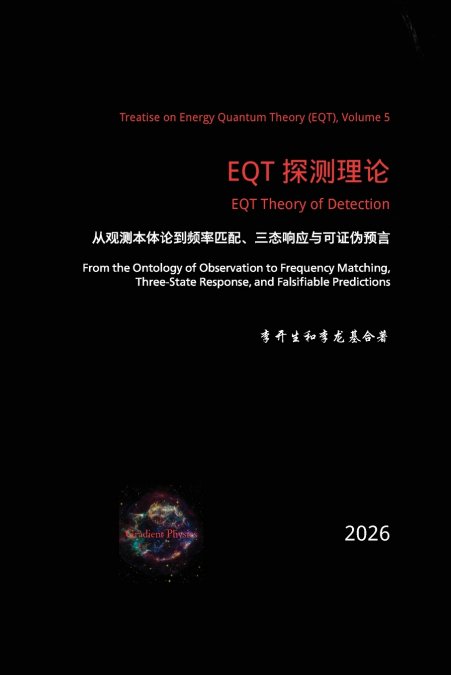
  • EQT 探测理论:从观测本体论到频率匹配、三态响应与可证伪预言
    Kaisheng Li / Longji Li
    《EQT 探测理论:从观测本体论到频率匹配、三态响应与可证伪预言》是'能量子理论'(Energy Quantum Theory, EQT)系列中的探测接口卷。本书的核心问题不是如何制造更大的望远镜、更高能量的对撞机、更低噪声的干涉仪,或更高灵敏度的粒子探测器。它追问的是一个更前置的理论问题:什么样的物理存在形式能够进入探测关系?本书认为,可探测性不能被简化为被动信号接收。某种物理结构可能参与能量密度、梯度形成或动力学演化,却不表现为自由态辐射、局域碰撞产物或通常意义上的传播信号。因此,零结果不应过快地被解释为对象不存在、相互作用太弱或灵敏度不足。它也可能反映频率失配、扰动强度不足、梯度敏感性有限,或仪器无法区分自由态、绑定态和凝聚态贡献。在 EQT 框架中,探测被重新定义为探测器与对象在同一能量子密度场中的受约束动力学关系。探测器不是外部的被动读取者...
    Disponible

    76,80 €

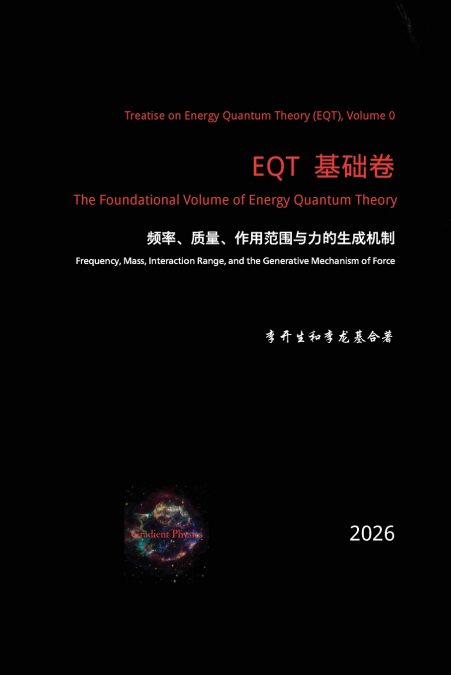
  • EQT基础卷:频率、质量、作用范围与力的生成机制
    Kaisheng Li / Longji Li
    《能量子理论基础卷》是'能量子理论'(Energy Quantum Theory, EQT)系列的开篇卷。本书的核心目标不是重述普朗克公式的历史,而是重新考察 (E=h nu) 的理论地位:它是否不仅是量子能量公式,也可能成为连接能量、质量、作用范围、场动力学以及力的生成机制的结构性原则。本书提出的问题是:既然普朗克关系已经是量子理论的基础之一,为什么它在通常理解中仍主要局限于光子能量、辐射量子和跃迁过程,而没有被系统发展为一种以频率为核心的物理实在组织框架?本书从频率-能量关系出发,并将其与爱因斯坦质能关系相结合,引入质量-频率关系 ( nu = mc^2/h )。这一关系并不被视为单纯的单位换算,而是被理解为一个理论入口:具有静质量的对象也可以被纳入频率描述。随后,本书建立频率谱,使传播模式、稳定有质量模式、过渡模式以及可能存在的更高频或更低频...
    Disponible

    72,64 €

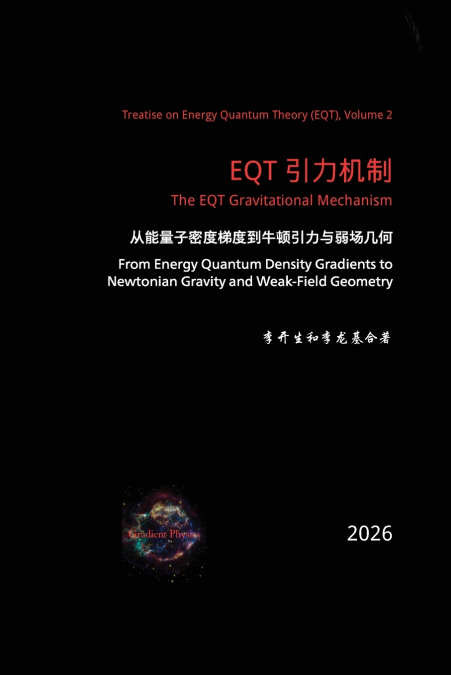
  • EQT引力机制:从能量子密度梯度到牛顿引力与弱场几何
    Kaisheng Li / Longji Li
    《EQT 引力机制:从能量子密度梯度到牛顿引力与弱场几何》是 EQT 系列中专门讨论引力生成问题的一卷。本书不把引力首先理解为既定的几何结构,也不把牛顿引力或广义相对论作为推导起点,而是在 A1-A4 与元规范 M 的约束下,追问引力是否可以由低频能量子密度场的统计性梯度机制生成。本书的核心问题不是'引力如何被描述',而是'引力如何生成'。在这一框架中,频率分辨能量子密度场 ( rho_f( mathbf{x},t) ) 被视为统一基础对象;引力则被定位为其中的低频分量 ( rho_{ rm grav} ) 在宏观、弱场、准静态极限下形成的有效现象。全书按照'公设-频率谱-低频密度场-密度梯度-传播核-交换积分-牛顿极限-GR 弱场读出'的顺序展开,试图说明密度梯度如何形成有效吸引,双源交换积分如何在远场极限中给出 ( M_1M_2/r^2 ) ...
    Disponible

    82,07 €