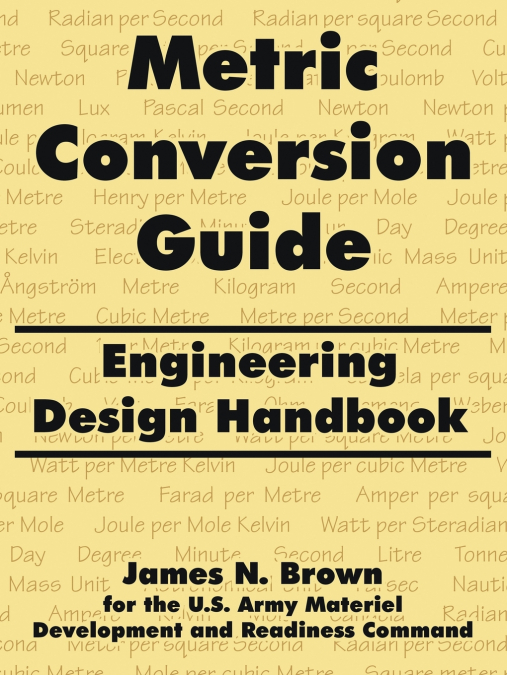
Metric Conversion Guide

Metric Conversion Guide

James N. Brown / James NBrown / US Army

18,40 €
IVA incluido
Disponible
Editorial:
Press Holdings International
Año de edición:
2004
Materia
Ingeniería: general
ISBN:
9781410216946
18,40 €
IVA incluido
Disponible

Selecciona una librería:

  • Librería Samer Atenea
  • Librería Aciertas (Toledo)
  • Kálamo Books
  • Librería Perelló (Valencia)
  • Librería Elías (Asturias)
  • Donde los libros
  • Librería Kolima (Madrid)
  • Librería Proteo (Málaga)

The general purpose of this handbook is to prepare scientists, engineers, and technicians of the U.S. Army Materiel Development and Readiness Command (DARCOM) for increasing use of the International Systems of Units (SI) or, as it is frequently referred to, the 'metric system.' The specific objectives are to give DARCOM personnel (1) the tools required to convert the units of physical quantities and equations to SI units, (2) the information needed to correctly interpret specifications and documentation using the SI, and (3) the information needed to generate specifications and prepared documentation in SI units.Chapter 1 presents a paragraph outline of the handbook to facilitate its use, and a brief history of the introduction of and increasing use of the SI in the US. Definitions, rules, and conventions fundamental to the SI and its use are to be found in Chapters 2 and 3.Methods for converting non-SI units to SI units are given in Chapter 4. The methods make use of 'unit equalities' and, if applied rigorously, will minimize or eliminate errors in unit conversions. A relatively simple method is presented for modifying equations such that equations derived for use with non-SI units can be used with SI units.Tables of unit equalities, experimentally determined constants expressed in SI units, and dimensionless quantities are given in Chapter 5. Chapter 6 is concerned with the use of SI in military engineering drawings, and covers dual dimensioning and conversion of the units of dimensions. Sample calculations illustrating methods of converting units and modifying equations are given in Chapter 7.

Artículos relacionados

  • An Engineer’s Alphabet
    Henry Petroski
    ...
  • Conduct of Vessels Underway
    Captain Mehrdad Behforouzi
    This book results from sailing for 25 years at sea at different ranks, including 15 years of command and more than 20 years of teaching in maritime universities, colleges, and simulators. Lack of knowledge and misinterpretation of the rules are the reasons for Most collisions at sea. The author tried to interpret the rules of the road practically to be understandable both in th...
    Disponible

    87,94 €

  • Robotics- An Introduction
    R Manikandan
    In this book the principles and basic concepts of Robotics and its components are briefed. The readers will understand the design and implementation of robot applications and their relationship to other automated technologies. The basis of machine vision and its application in robotics are briefed. The concept of end effectors, basic programming in Robots and a few real time ap...
    Disponible

    75,58 €

  • Nonnegative and Compartmental Dynamical Systems
    Qing Hui / VijaySekhar Chellaboina / Wassim M. Haddad
    This comprehensive book provides the first unified framework for stability and dissipativity analysis and control design for nonnegative and compartmental dynamical systems, which play a key role in a wide range of fields, including engineering, thermal sciences, biology, ecology, economics, genetics, chemistry, medicine, and sociology. Using the highest standards of exposition...
  • Steady Aircraft Flight and Performance
    N. Harris McClamroch
    This undergraduate textbook offers a unique introduction to steady flight and performance for fixed-wing aircraft from a twenty-first-century flight systems perspective. Emphasizing the interplay between mathematics and engineering, it fully explains the fundamentals of aircraft flight and develops the basic algebraic equations needed to obtain the conditions for gliding flight...
  • Capacidade Do Fungo Pleurotus Ostreatus (Cogumelo Shimeji) Na Biorremediação De Solos Contaminados Com Chumbo (Pb)
    Duilio Pereira
    O Uso De Biorremediação Está Ganhando Interesse, E O Objetivo Da Presente Investigação É Usar O Fungo Pleurotus Ostreatus Para Remediar Solos Contaminados Com Chumbo (Pb) E Serragem Como Um Complemento, Um Nutriente Que Permite Maior Eficiência E Velocidade De Crescimento. Para Delinear Esta Pesquisa, Foram Testados Três Repetições E Três Tratamentos E Unidade De Uma Placa Como...
    Disponible

    11,96 €