Inicio > > Ciencias de la computación > Inteligencia artificial > Methods and Applications of Algorithmic Complexity
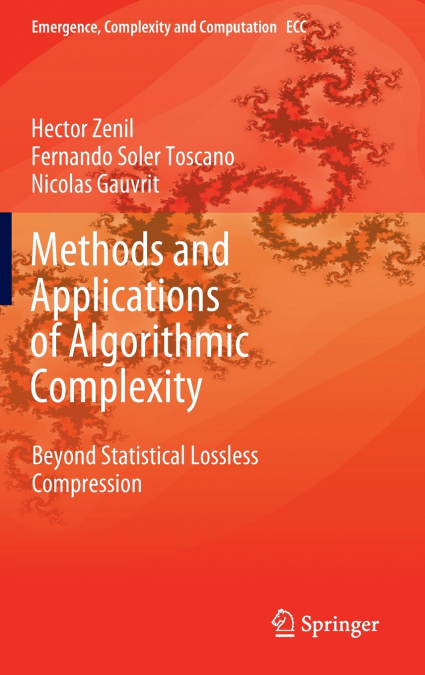
Methods and Applications of Algorithmic Complexity

Methods and Applications of Algorithmic Complexity

Fernando Soler Toscano / Hector Zenil / Nicolas Gauvrit

220,95 €
IVA incluido
Consulta disponibilidad
Editorial:
Springer Nature B.V.
Año de edición:
2022
Materia
Inteligencia artificial
ISBN:
9783662649831

Selecciona una librería:

  • Librería Samer Atenea
  • Librería Aciertas (Toledo)
  • Kálamo Books
  • Librería Perelló (Valencia)
  • Librería Elías (Asturias)
  • Donde los libros
  • Librería Kolima (Madrid)
  • Librería Proteo (Málaga)

This book explores a different pragmatic approach to algorithmic complexity rooted or motivated by the theoretical foundations of algorithmic probability and explores the relaxation of necessary and sufficient conditions in the pursuit of numerical applicability, with some of these approaches entailing greater risks than others in exchange for greater relevance and applicability.Some established and also novel techniques in the field of applications of algorithmic (Kolmogorov) complexity currently coexist for the first time, ranging from the dominant ones based upon popular statistical lossless compression algorithms (such as LZW) to newer approaches that advance, complement, and also pose their own limitations. Evidence suggesting that these different methods complement each other for different regimes is presented, and despite their many challenges, some of these methods are better grounded in or motivated by the principles of algorithmic information. The authors propose that the field can make greater contributions to science, causation, scientific discovery, networks, and cognition, to mention a few among many fields, instead of remaining either as a technical curiosity of mathematical interest only or as a statistical tool when collapsed into an application of popular lossless compression algorithms. This book goes, thus, beyond popular statistical lossless compression and introduces a different methodological approach to dealing with algorithmic complexity. For example, graph theory and network science are classic subjects in mathematics widely investigated in the twentieth century, transforming research in many fields of science from economy to medicine. However, it has become increasingly clear that the challenge of analyzing these networks cannot be addressed by tools relying solely on statistical methods. Therefore, model-driven approaches are needed. Recent advances in network science suggest that algorithmic information theory could play an increasingly important role in breaking those limits imposed by traditional statistical analysis (entropy or statistical compression) in modeling evolving complex networks or interacting networks.  Further progress on this front calls for new techniques for an improved mechanistic understanding of complex systems, thereby calling out for increased interaction between systems science, network theory, and algorithmic information theory, to which this book contributes.
Artículos relacionados

  • Artificial Cognition Systems
    ...
  • Cross-Disciplinary Applications of Artificial Intelligence and Pattern Recognition
    Vijay Kumar Mago
    The need for intelligent machines in areas such as medical diagnostics, biometric security systems, and image processing motivates researchers to develop and explore new techniques, algorithms, and applications in this evolving field. Cross-Disciplinary Applications of Artificial Intelligence and Pattern Recognition: Advancing Technologies provides a common platform for researc...
  • Emerging Applications of Natural Language Processing
    Over the last few years, the area of Natural Language Processing has drastically grown in recognition, not only within the research and development community, but also with industry professionals. As NLP continues to be discussed and researched, certain areas continue to grow and mature. As a result, the need for advanced research and information is in high demand. Emerging App...
  • Androids, Cyborgs, and Robots in Contemporary Culture and Society
    Steven John Thompson
    Mankind’s dependence on artificial intelligence and robotics is increasing rapidly as technology becomes more advanced. Finding a way to seamlessly intertwine these two worlds will help boost productivity in society and aid in a variety of ways in modern civilization. Androids, Cyborgs, and Robots in Contemporary Culture and Society is an essential scholarly resource that delve...
  • Deep Learning Innovations and Their Convergence With Big Data
    The expansion of digital data has transformed various sectors of business such as healthcare, industrial manufacturing, and transportation. A new way of solving business problems has emerged through the use of machine learning techniques in conjunction with big data analytics. Deep Learning Innovations and Their Convergence With Big Data is a pivotal reference for the latest sc...
  • Computational Psychoanalysis and Formal Bi-Logic Frameworks
    Giuseppe Iurato
    Computational psychoanalysis is a new field stemming from Freudian psychoanalysis. The new area aims to understand the primary formal structures and running mechanisms of the unconscious while implementing them into computer sciences. Computational Psychoanalysis and Formal Bi-Logic Frameworks provides emerging information on this new field which uses psychoanalysis and the unc...