
Memorial Book of Dubienka, Skryhiczyn and Dorohusk

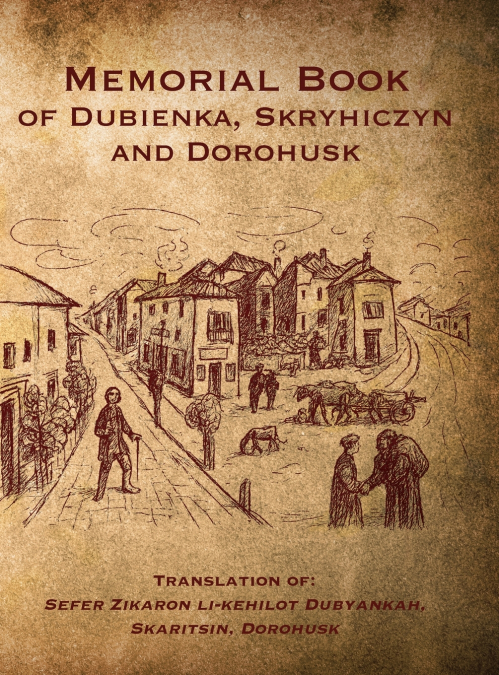
Memorial Book of Dubienka, Skryhiczyn and Dorohusk


52,54 €
IVA incluido
Consulta disponibilidad
Editorial:
JewishGen
Año de edición:
2026
Materia
Historia social y cultural
ISBN:
9781962054362

Selecciona una librería:

  • Librería Samer Atenea
  • Librería Aciertas (Toledo)
  • Kálamo Books
  • Librería Perelló (Valencia)
  • Librería Elías (Asturias)
  • Donde los libros
  • Librería Kolima (Madrid)
  • Librería Proteo (Málaga)

The Jewish Communities of Dubienka, Skryhiczyn and DorohuskThere has been a Jewish community along the Bug River in the Dubienka area since King Sigismund III granted permission for Jews to reside and operate businesses there in the late 16th century. The community’s growth in the mid-18th century was linked to the town’s economic success as a station on the Bug River grain transportation route. Residents included tradesmen, merchants, dealers, and peddlers, most of whom were poor but maintained a community life with multiple synagogues and traditions of mutual support and charity.The town of Skryhiczyn is about 5 km (3 miles) from Dubienka on the Bug River. Skryhiczyn included a special Jewish community, whose members were pious, scholarly, and descendants of Hasidic leaders. They possessed all the best features: religious study, work, Zionism, and doing good deeds. Most Polish Jews were not farmers since Polish law prohibited selling land to Jews. But the brothers Shmuel and Chayim Rottenburg were able to purchase an entire estate in Skryhiczyn. Life in the town was unique, and for many years nearly idyllic. Dorohusk lies on the banks of the Bug River about 20 km (12 miles) from Skryhiczyn. Dorohusk was a lively town with a rich Jewish life. In September 1939 Germany invaded Poland, and soon occupied the entire country. They attacked the U.S.S.R. on 22 June 1941, crossing over the Bug River bridges. The Germans intensifyed their persecution of Jews in 1942, hunting and murdering them at random. Of those that survived, most were sent to the Belzec and Sobibor death camps.This Yizkor book provides firsthand accounts of life along the Bug River and the multifaceted Jewish communities that existed for centuries. It also provides accounts of the destruction of those communities, and efforts to memorialize the martyrs of the Shoah.  
Artículos relacionados

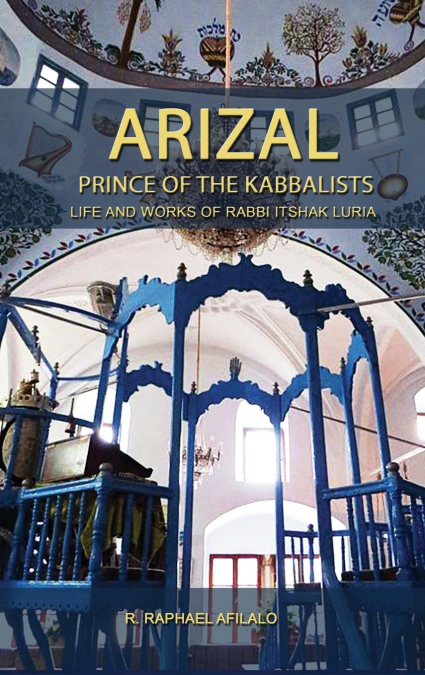
  • Arizal
    Raphael Afilalo
    The Ari overflowed with Torah. He was expert in Scripture, Mishnah, Talmud, Midrash, Maaseh Bereishit and Maaseh Merkavah. About all the different levels of prophecy, their details and from which level the prophets had their revelations.  He understood the whistling of the trees, the grass and stones, the language of the birds and other animals, the conversations of angels, the...
  • Rose-tinted Memory
    Michael S Fryer
    “Those who deny Auschwitz would be ready to remake it”.  ~ Primo Levi, Holocaust survivor and author Seventy years after the mass murder of the Jews of Europe, Holocaust denial and Holocaust revisionism are creeping into our overall perception of what actually happened.Christendom has not ‘denied’ Holocaust, but it has attempted to create a memory of Holocaust which suggests th...
    Disponible

    8,84 €

  • Pan Kapitan of Jordanow
    William Leibner
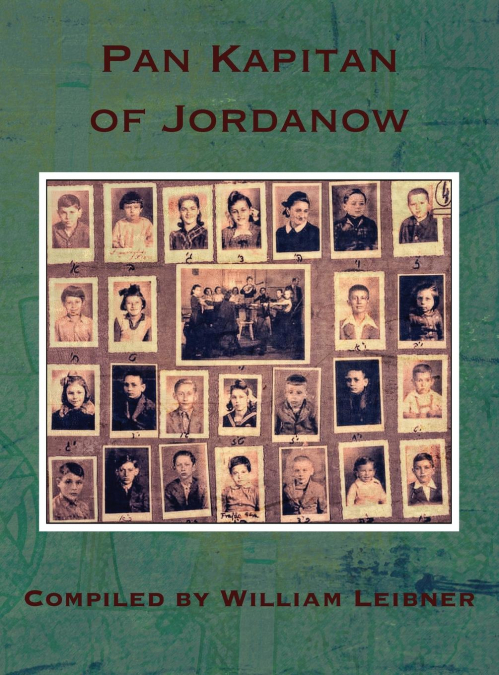
    Yeshayahu Drucker devoted a good part of his life to rescuing Jewish children from non-Jewish homes. Many parents had given their children to Polish neighbors for safekeeping during the war. Unfortunately most of the parents did not survive the Shoah. At the end of the war, there was no one to claim the children and they remained with the “adopted” Polish families. Following hi...
  • Holy Dissent
    Glenn Dynner
    BThe religious communities of early modern Eastern Europe—particularly those with a mystical bent—are typically studied in isolation. Yet the heavy Slavic imprint on Jewish popular mysticism and pervasive Judaizing tendencies among Christian dissenters call into question the presumed binary quality of Jewish-Christian interactions. In Holy Dissent: Jewish and Christian Mystics ...
  • AL-FARD
    Ali Mahdi Muhammad
    The Al-Fard, or the The Dawn, has captured the early rays of Our history. This history is essential if we are to be brought face to face with the One true and living God of the universe. The purpose of this writing is to bring the reader step by step, one degree at a time to the reality of God in person. The teachings of Our Father elevates the believer to the level of Godhood ...
  • Wild Things. Nature and the Social Imagination
    HISTORIES OF HUMAN CONSTRUCTIONS OF NATUREWild Things: Nature and the Social Imagination assembles eleven substantive and original essays on the cultural and social dimensions of environmental history. They address a global cornucopia of social and ecological systems, from Africa to Europe, North America and the Caribbean, and their temporal range extends from the 1830s into th...