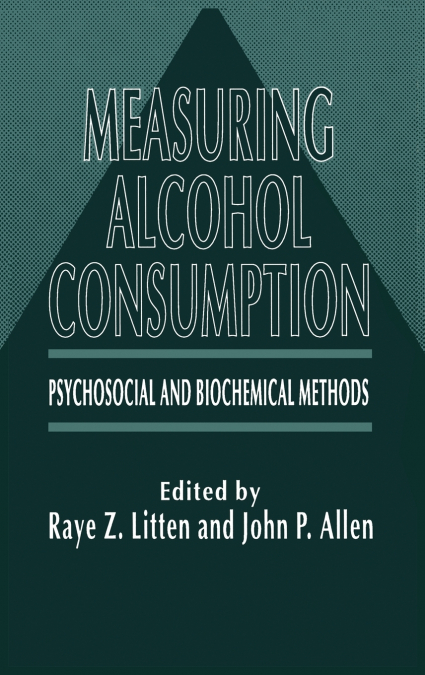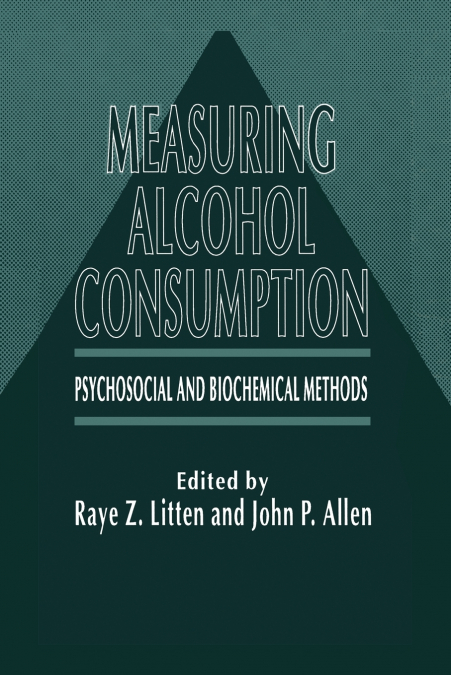
Measuring Alcohol Consumption

Measuring Alcohol Consumption

John P. Allen / Raye Z. Litten

206,70 €
IVA incluido
Disponible
Editorial:
Springer Nature B.V.
Año de edición:
2012
Materia
Bioquímica
ISBN:
9781461267232
206,70 €
IVA incluido
Disponible

Selecciona una librería:

  • Librería Samer Atenea
  • Librería Aciertas (Toledo)
  • Kálamo Books
  • Librería Perelló (Valencia)
  • Librería Elías (Asturias)
  • Donde los libros
  • Librería Kolima (Madrid)
  • Librería Proteo (Málaga)

The Importance of Measuring Alcohol Consumption To date, alcohol studies have attended far more to issues of alco­ hol dependence and the harmful consequences of drinking than to the level of alcohol consumption itself. This is, perhaps, not surprising since dependence on alcohol is believed to constitute a meaningful and distinct medical syndrome, regardless of the level of alcohol consumption associated with it (Edwards and Gross, 1976). Also, of society is generally more concerned with the adverse consequences drinking (e. g. , traffic fatalities, homelessness, health care and legal expenses, and academiclbehavioral problems in young drinkers), than with the quantity of alcohol actually consumed. Nevertheless, accurate assessment of alcohol usage is important in its own right in at least four contexts: 1. Evaluating the effectiveness of alcoholism and alcohol abuse treatment and prevention efforts. Such efforts include both applied evaluations of existing programs and formal, well-controlled efficacy studies on experimental interventions. These investigations require rigorous methodologies to assess outcomes precisely and contrast what may be quite subtle differences between programs and between pre­ treatment and posttreatment outcomes. Although these studies are usually characterized by the employment of multiple measures of success-including general improvements in social and physical functioning, reduction in degree of dependence, and resolution of problems directly resultant from drinking-it is by their assessment of changes in drinking behavior that they are potentially able to achieve the highest level of objectivity and exactitude.

Artículos relacionados

  • Implementation of Automated Urinary Sediment Analyzer UF1000
    Adriana Manuel
    Comparative work of Urinary Sediment between data obtained in automated platform, Roche UF 1000 flow cytometer versus the gold standard optical microscopy method. This work was carried out with raw data from known patients whose expected results allowed us to define the non-pathological sample parameters obtained in automated equipment. The experience was enriching, working wit...
    Disponible

    48,30 €

  • Bioprocess Technology
    I Arul Pandi / P T Kalaichelvan
    Dive into the dynamic world of Bioprocess Technology, where biology, engineering, materials science, and clinical procedures seamlessly converge to create a multidisciplinary marvel. In an era where innovation knows no bounds, Bioprocessing stands at the forefront, transcending boundaries to shape diverse facets of the biological landscape.This illuminating book is meticulously...
    Disponible

    45,13 €

  • Produção De Membrana Barreira Para Regeneração Óssea Guiada Com Zeína
    Cristiane Michele Bonadio De Oliveira
    O Presente Estudo Desenvolveu Uma Membrana Com Proteína De Origem Vegetal Conhecida Por Zeína, Com Possibilidades Biodegradáveis Para Regeneração Óssea Guiada (Rog), Sendo Suas Particularidades Discutidas Ao Longo Do Trabalho. Para Melhor Entendimento A Respeito Do Tema, Serão Discutidos Alguns Conceitos E Definições Acerca Da Proteína E Da Rog. 10 ...
    Disponible

    17,16 €

  • Hydrolysis of cashew bagasse to obtain bioethanol
    João Paulo Dantas de Carvalho
    Recently, the global demand for fuel ethanol has been expanding very rapidly, and almost all fuel ethanol is produced by fermenting sucrose in Brazil or corn glucose in the United States, but these raw materials will not be enough to satisfy international demand. Agro-industrial lignocellulosic residues, such as cashew bagasse, sugarcane bagasse, soybean hulls, etc., are abunda...
    Disponible

    54,32 €

  • Hydrolyse de la bagasse de cajou pour obtenir du bioéthanol
    João Paulo Dantas de Carvalho
    Récemment, la demande mondiale d’éthanol-carburant a augmenté très rapidement, et presque tout l’éthanol-carburant est produit par fermentation de saccharose au Brésil ou de glucose de maïs aux États-Unis, mais ces matières premières ne suffiront pas à satisfaire la demande internationale. Les résidus lignocellulosiques agro-industriels, tels que la bagasse de cajou, la bagasse...
    Disponible

    54,38 €

  • Hydrolyse von Cashew-Bagasse zur Gewinnung von Bioethanol
    João Paulo Dantas de Carvalho
    In letzter Zeit ist die weltweite Nachfrage nach Ethanol-Kraftstoff sehr schnell gestiegen, und fast der gesamte Ethanol-Kraftstoff wird durch die Fermentierung von Saccharose in Brasilien oder Maisglukose in den Vereinigten Staaten hergestellt, aber diese Rohstoffe reichen nicht aus, um die internationale Nachfrage zu decken. Agroindustrielle lignozellulosehaltige Rückstände w...
    Disponible

    54,38 €

Otros libros del autor

  • Measuring Alcohol Consumption
    John P. Allen / Raye Z. Litten
    The Importance of Measuring Alcohol Consumption To date, alcohol studies have attended far more to issues of alco­ hol dependence and the harmful consequences of drinking than to the level of alcohol consumption itself. This is, perhaps, not surprising since dependence on alcohol is believed to constitute a meaningful and distinct medical syndrome, re...