

Inicio > Matemáticas y ciencia > Ciencia: cuestiones generales > Influencia de la ciencia y la tecnología sobre la sociedad > Mathematical Undecidability, Quantum Nonlocality and the Question of the Existence of God
Mathematical Undecidability, Quantum Nonlocality and the Question of the Existence of God

Mathematical Undecidability, Quantum Nonlocality and the Question of the Existence of God


132,78 €
IVA incluido
Consulta disponibilidad
Editorial:
Springer Nature B.V.
Año de edición:
1997
Materia
Influencia de la ciencia y la tecnología sobre la sociedad
ISBN:
9780792343066

Selecciona una librería:

  • Librería Samer Atenea
  • Librería Aciertas (Toledo)
  • Kálamo Books
  • Librería Perelló (Valencia)
  • Librería Elías (Asturias)
  • Donde los libros
  • Librería Kolima (Madrid)
  • Librería Proteo (Málaga)

On January 22, 1990, the late John Bell held at CERN (European Laboratory for Particle Physics), Geneva a seminar organized by the Center of Quantum Philosophy, that at this time was an association of scientists interested in the interpretation of quantum mechanics. In this seminar Bell presented once again his famous theorem. Thereafter a discussion took place in which not only physical but also highly speculative epistemological and philosophical questions were vividly debated. The list of topics included: assumption of free will in Bell’s theorem, the understanding of mind, the relationship between the mathematical and the physical world, the existence of unobservable causes and the limits of human knowledge in mathematics and physics. Encouraged by this stimulating discussion some of the participants decided to found an Institute for Interdisciplinary Studies (lIS) to promote philosoph­ ical and interdisciplinary reflection on the advances of science. Meanwhile the lIS has associated its activities with the Swiss foundation, Fondation du Leman, and the Dutch foundation, Stichting Instudo, registered in Geneva and Amsterdam, respectively. With its activities the lIS intends to strengthen the unity between the professional activities in science and the reflection on fun­ damental philosophical questions. In addition the interdisciplinary approach is expected to give a contribution to the progress of science and the socio­ economic development. At present three working groups are active within the lIS, i. e. : - the Center for Quantum Philosophy, - the Wealth Creation and Sustainable Development Group, - the Neural Science Group.

Artículos relacionados

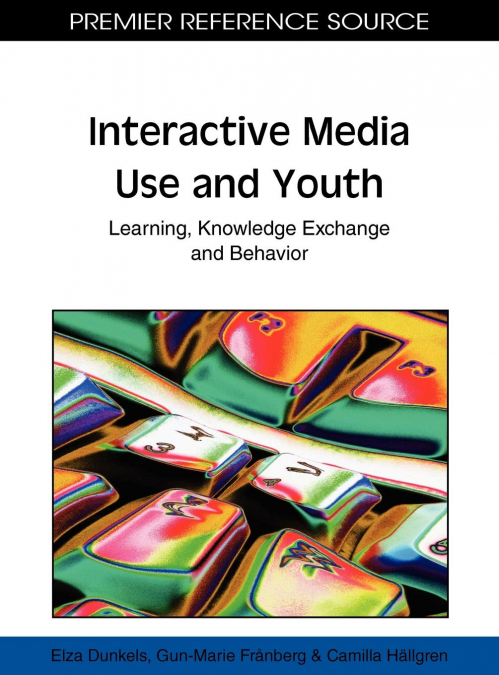
  • Interactive Media Use and Youth
    Modern advancements in technology have changed the way that young people use interactive media. Learning from such methods was not even considered until recently. It is now slowly defining the landscape of contemporary pedagogical practices. Interactive Media Use and Youth: Learning, Knowledge Exchange and Behavior provides a comprehensive collection of knowledge based on diffe...
  • Social and Economic Effects of Community Wireless Networks and Infrastructures
    Abdelaal
    It is surprising to think that in today’s rapidly evolving world of technology, over half of the globe still does not have access to high speed internet. Creating community wireless networks has in the past been a way to provide remote communities with internet and network access. Social and Economic Effects of Community Wireless Networks and Infrastructures highlights the succ...
  • The New Atlantis
    Francis Bacon
    In this work, Bacon portrayed a vision of the future of human discovery and knowledge, expressing his aspirations and ideals for humankind. The novel depicts the creation of a utopian land where 'generosity and enlightenment, dignity and splendour, piety and public spirit' are the commonly held qualities of the inhabitants of 'Bensalem'. ...
  • Sport 2.0
    Andy Miah
    ...
    Disponible

    28,86 €

  • Productivity Machines
    Corinna Schlombs
    ...
    Disponible

    48,52 €

  • Open Space
    Mariel Borowitz
    ...
    Disponible

    38,25 €