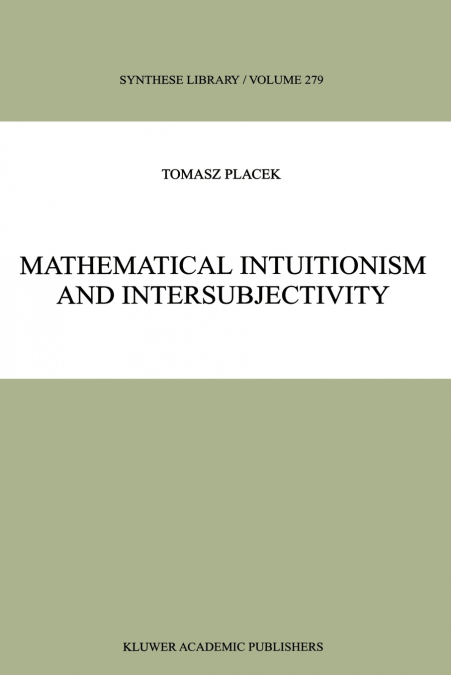

Mathematical Intuitionism and Intersubjectivity

Mathematical Intuitionism and Intersubjectivity

T. Placek / Tomasz Placek

134,19 €
IVA incluido
Disponible
Editorial:
Springer Nature B.V.
Año de edición:
2010
Materia
Influencia de la ciencia y la tecnología sobre la sociedad
ISBN:
9789048151875
134,19 €
IVA incluido
Disponible

Selecciona una librería:

  • Librería Samer Atenea
  • Librería Aciertas (Toledo)
  • Kálamo Books
  • Librería Perelló (Valencia)
  • Librería Elías (Asturias)
  • Donde los libros
  • Librería Kolima (Madrid)
  • Librería Proteo (Málaga)

In 1907 Luitzen Egbertus Jan Brouwer defended his doctoral dissertation on the foundations of mathematics and with this event the modem version of mathematical intuitionism came into being. Brouwer attacked the main currents of the philosophy of mathematics: the formalists and the Platonists. In tum, both these schools began viewing intuitionism as the most harmful party among all known philosophies of mathematics. That was the origin of the now-90-year-old debate over intuitionism. As both sides have appealed in their arguments to philosophical propositions, the discussions have attracted the attention of philosophers as well. One might ask here what role a philosopher can play in controversies over mathematical intuitionism. Can he reasonably enter into disputes among mathematicians? I believe that these disputes call for intervention by a philo­ sopher. The three best-known arguments for intuitionism, those of Brouwer, Heyting and Dummett, are based on ontological and epistemological claims, or appeal to theses that properly belong to a theory of meaning. Those lines of argument should be investigated in order to find what their assumptions are, whether intuitionistic consequences really follow from those assumptions, and finally, whether the premises are sound and not absurd. The intention of this book is thus to consider seriously the arguments of mathematicians, even if philosophy was not their main field of interest. There is little sense in disputing whether what mathematicians said about the objectivity and reality of mathematical facts belongs to philosophy, or not.

Artículos relacionados

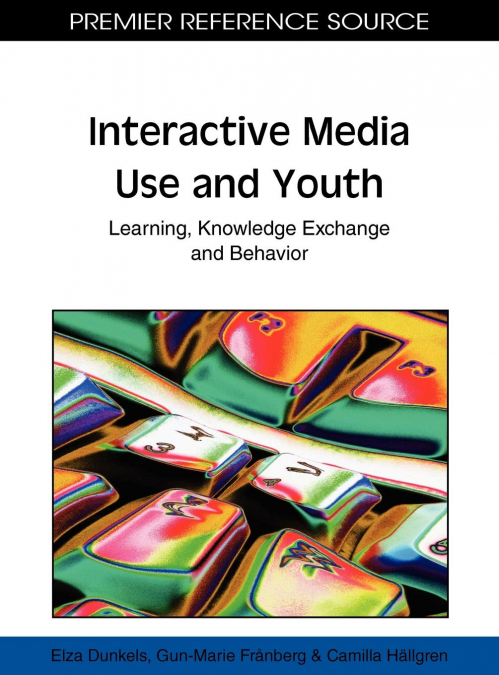
  • Interactive Media Use and Youth
    Modern advancements in technology have changed the way that young people use interactive media. Learning from such methods was not even considered until recently. It is now slowly defining the landscape of contemporary pedagogical practices. Interactive Media Use and Youth: Learning, Knowledge Exchange and Behavior provides a comprehensive collection of knowledge based on diffe...
  • Social and Economic Effects of Community Wireless Networks and Infrastructures
    Abdelaal
    It is surprising to think that in today’s rapidly evolving world of technology, over half of the globe still does not have access to high speed internet. Creating community wireless networks has in the past been a way to provide remote communities with internet and network access. Social and Economic Effects of Community Wireless Networks and Infrastructures highlights the succ...
  • The New Atlantis
    Francis Bacon
    In this work, Bacon portrayed a vision of the future of human discovery and knowledge, expressing his aspirations and ideals for humankind. The novel depicts the creation of a utopian land where 'generosity and enlightenment, dignity and splendour, piety and public spirit' are the commonly held qualities of the inhabitants of 'Bensalem'. ...
  • Sport 2.0
    Andy Miah
    ...
    Disponible

    28,86 €

  • Productivity Machines
    Corinna Schlombs
    ...
    Disponible

    48,52 €

  • Open Space
    Mariel Borowitz
    ...
    Disponible

    38,25 €