 Librería Samer Atenea
 Kálamo Books
 Librería Elías (Asturias)
 Librería Kolima (Madrid)
 Librería Proteo (Málaga)
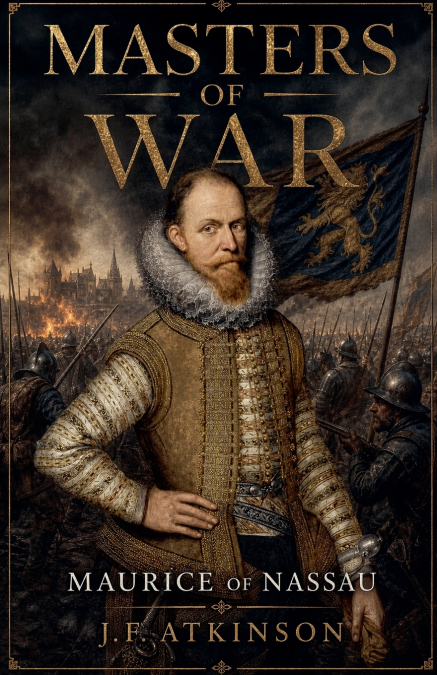
MASTERS OF WAR: MAURICE OF NASSAU He did not invent courage. He made courage sufficient, gave it system, drill, pay, and mathematics, without which individual bravery is only ever sacrifice. In the autumn of 1585, a seventeen-year-old Nassau prince inherited the stadtholderate of Holland and Zeeland and with it the command of a republic fighting for its life. The Dutch army was a collection of underpaid mercenary companies with no reliable training, no common doctrine, and no capacity for the kind of sustained offensive operations that survival required. Against it stood the Army of Flanders, the most formidable military force in the world, battle-hardened across decades, commanded by Alexander Farnese, the finest general of his generation. Over the next decade, Maurice of Nassau transformed everything. Drawing on the classical military texts he had studied at Leiden under Justus Lipsius, on the mathematical precision of his scientific advisor Simon Stevin, and on the sustained intellectual partnership of his cousin William Louis of Nassau, he rebuilt the Dutch army from its institutional foundations upward. He standardised the weapons, regularised the pay, instituted year-round drill, published the world’s first modern training manual, reduced the infantry formation to maximise firepower, and taught his soldiers the counter-march that made their musket fire continuous and unstoppable. Then he used it. In the campaign season of 1591 he captured seven fortified towns in less than five months, a feat with no contemporary parallel. He took Breda with sixty-eight soldiers hidden in a peat barge. He won the pitched battles of Turnhout and Nieuwpoort against the Spanish tercio system, validating in blood and smoke the theoretical programme he had built in the drill squares of garrison towns. He designed and constructed a fortification network that held the Republic’s frontier for forty years against the most powerful empire in the world. But Maurice of Nassau was more than a battlefield commander. He was the architect of the professional army itself, the institutional inventor whose reforms propagated across Protestant Europe and became the common foundation of modern military practice. Every drill manual, every standing army, every professional officer corps that followed him was built, knowingly or not, on the system he created. Gustavus Adolphus extended it. Vauban developed it. Frederick the Great inherited it. It is with us still. This volume examines Maurice of Nassau across the full span of his forty-year command: the reforms that made his army, the campaigns that proved it, the political crisis that tested it, and the legacy that outlasted it. It is, above all, the portrait of a man who understood that the highest military art is not the brilliant improvisation of the decisive moment but the patient creation of an institution that can outlast the moment, the commander, and the war itself.