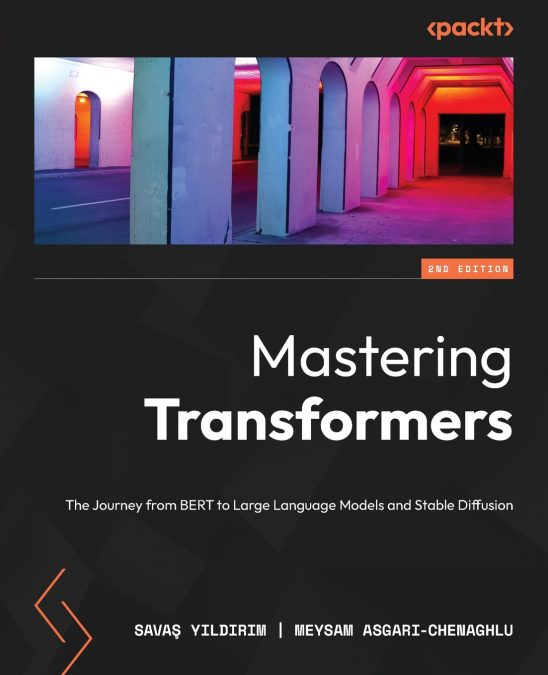
Meysam Asgari- Chenaghlu / Savaş Yıldırım
 Librería Samer Atenea
 Kálamo Books
 Librería Elías (Asturias)
 Librería Kolima (Madrid)
 Librería Proteo (Málaga)
Explore transformer-based language models from BERT to GPT, delving into NLP and computer vision tasks, while tackling challenges effectively Key Features- Understand the complexity of deep learning architecture and transformers architecture- Create solutions to industrial natural language processing (NLP) and computer vision (CV) problems- Explore challenges in the preparation process, such as problem and language-specific dataset transformation- Purchase of the print or Kindle book includes a free PDF eBookBook DescriptionTransformer-based language models such as BERT, T5, GPT, DALL-E, and ChatGPT have dominated NLP studies and become a new paradigm. Thanks to their accurate and fast fine-tuning capabilities, transformer-based language models have been able to outperform traditional machine learning-based approaches for many challenging natural language understanding (NLU) problems.Aside from NLP, a fast-growing area in multimodal learning and generative AI has recently been established, showing promising results. Mastering Transformers will help you understand and implement multimodal solutions, including text-to-image. Computer vision solutions that are based on transformers are also explained in the book. You’ll get started by understanding various transformer models before learning how to train different autoregressive language models such as GPT and XLNet. The book will also get you up to speed with boosting model performance, as well as tracking model training using the TensorBoard toolkit. In the later chapters, you’ll focus on using vision transformers to solve computer vision problems. Finally, you’ll discover how to harness the power of transformers to model time series data and for predicting.By the end of this transformers book, you’ll have an understanding of transformer models and how to use them to solve challenges in NLP and CV.What you will learn- Focus on solving simple-to-complex NLP problems with Python- Discover how to solve classification/regression problems with traditional NLP approaches- Train a language model and explore how to fine-tune models to the downstream tasks- Understand how to use transformers for generative AI and computer vision tasks- Build transformer-based NLP apps with the Python transformers library- Focus on language generation such as machine translation and conversational AI in any language- Speed up transformer model inference to reduce latencyWho this book is forThis book is for deep learning researchers, hands-on practitioners, and ML/NLP researchers. Educators, as well as students who have a good command of programming subjects, knowledge in the field of machine learning and artificial intelligence, and who want to develop apps in the field of NLP as well as multimodal tasks will also benefit from this book’s hands-on approach. Knowledge of Python (or any programming language) and machine learning literature, as well as a basic understanding of computer science, are required.Table of Contents- From Bag-of-Words to the Transformer- A Hands-On Introduction to the Subject- Autoencoding Language Models- Autoregressive Language Models- Fine-Tuning Language Model for Text Classification- Fine-Tuning Language Models for Token Classification- Text Representation- Boosting Your Model Performance- Parameter Efficient Fine-Tuning- Zero-Shot and Few-Shot Learning in NLP- Explainable AI (XAI) for NLP- Working with Efficient Transformers- Cross-Lingual Language Modeling- Serving Transformer Models(N.B. Please use the Read Sample option to see further chapters)