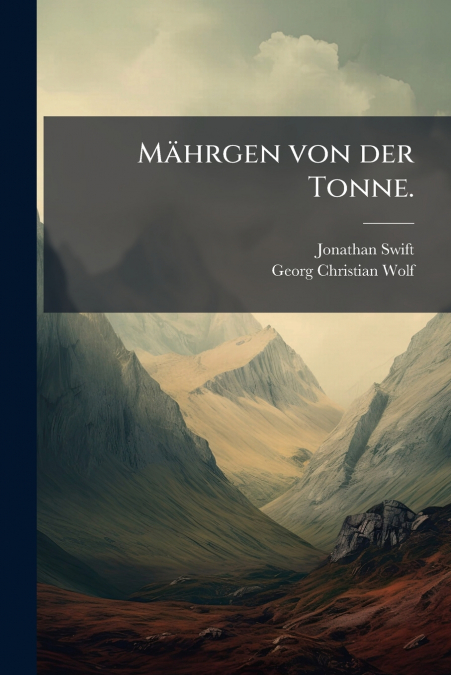
Jonathan Swift / Georg Christian Wolf
 Librería Samer Atenea
 Kálamo Books
 Librería Elías (Asturias)
 Librería Kolima (Madrid)
 Librería Proteo (Málaga)
Märchen von der Tonne is a German translation of Jonathan Swift’s satirical work, 'A Tale of a Tub.' This early 18th-century satire, presented as a story within a story, critiques religious and intellectual excesses, particularly targeting the Catholic and Presbyterian churches as well as overly academic writing. The narrative follows three brothers-Peter, Martin, and Jack-who represent the Catholic, Anglican, and Presbyterian churches, respectively, and their struggles to adhere to their father’s will (representing the Bible). Swift’s biting wit and sharp observations make this a timeless exploration of religious hypocrisy and intellectual arrogance. This German translation, 'Märchen von der Tonne,' offers readers access to Swift’s genius in a different linguistic context, providing valuable insight into the reception and interpretation of his work in 18th-century Germany.This work has been selected by scholars as being culturally important, and is part of the knowledge base of civilization as we know it. This work was reproduced from the original artifact, and remains as true to the original work as possible. Therefore, you will see the original copyright references, library stamps (as most of these works have been housed in our most important libraries around the world), and other notations in the work.This work is in the public domain in the United States of America, and possibly other nations. Within the United States, you may freely copy and distribute this work, as no entity (individual or corporate) has a copyright on the body of the work.As a reproduction of a historical artifact, this work may contain missing or blurred pages, poor pictures, errant marks, etc. Scholars believe, and we concur, that this work is important enough to be preserved, reproduced, and made generally available to the public. We appreciate your support of the preservation process, and thank you for being an important part of keeping this knowledge alive and relevant.