
Inicio > > Ciencias de la computación > Inteligencia artificial > Machine Learning and Non-volatile Memories
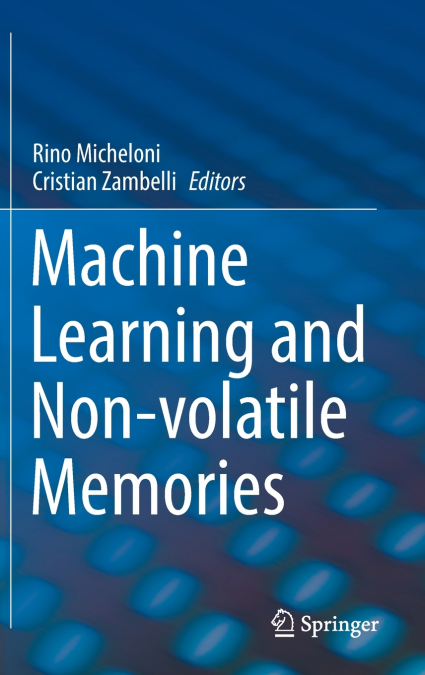
Machine Learning and Non-volatile Memories

Machine Learning and Non-volatile Memories


196,06 €
IVA incluido
Consulta disponibilidad
Editorial:
Springer Nature B.V.
Año de edición:
2022
Materia
Inteligencia artificial
ISBN:
9783031038402

Selecciona una librería:

  • Librería Samer Atenea
  • Librería Aciertas (Toledo)
  • Kálamo Books
  • Librería Perelló (Valencia)
  • Librería Elías (Asturias)
  • Donde los libros
  • Librería Kolima (Madrid)
  • Librería Proteo (Málaga)

This book presents the basics of both NAND flash storage and machine learning, detailing the storage problems the latter can help to solve. At a first sight, machine learning and non-volatile memories seem very far away from each other. Machine learning implies mathematics, algorithms and a lot of computation; non-volatile memories are solid-state devices used to store information, having the amazing capability of retaining the information even without power supply. This book will help the reader understand how these two worlds can work together, bringing a lot of value to each other. In particular, the book covers two main fields of application: analog neural networks (NNs) and solid-state drives (SSDs).After reviewing the basics of machine learning in Chapter 1, Chapter 2 shows how neural networks can mimic the human brain; to accomplish this result, neural networks have to perform a specific computation called vector-by-matrix (VbM) multiplication, which is particularly power hungry. In the digital domain, VbM is implemented by means of logic gates which dictate both the area occupation and the power consumption; the combination of the two poses serious challenges to the hardware scalability, thus limiting the size of the neural network itself, especially in terms of the number of processable inputs and outputs. Non-volatile memories (phase change memories in Chapter 3, resistive memories in Chapter 4, and 3D flash memories in Chapter 5 and Chapter 6) enable the analog implementation of the VbM (also called 'neuromorphic architecture'), which can easily beat the equivalent digital implementation in terms of both speed and energy consumption.SSDs and flash memories are strictly coupled together; as 3D flash scales, there is a significant amount of work that has to be done in order to optimize the overall performances of SSDs. Machine learning has emerged as a viable solution in many stages of this process. After introducing the main flash reliability issues, Chapter 7 shows both supervised and un-supervised machine learning techniques that can be applied to NAND. In addition, Chapter 7 deals with algorithms and techniques for a pro-active reliability management of SSDs. Last but not least, the last section of Chapter 7 discusses the next challenge for machine learning in the context of the so-called computational storage.No doubt that machine learning and non-volatile memories can help each other, but we are just at the beginning of the journey; this book helps researchers understand the basics of each field by providing real application examples, hopefully, providing a good starting point for the next level of development.


Artículos relacionados

  • Cases on Usability Engineering
    Information technologies play a significant role in modern information-driven societies, making a comprehensive understanding of digital media a fundamental requisite to success. Cases on Usability Engineering: Design and Development of Digital Products provides readers with case studies and real-life examples on usability methods and techniques to test the design and developme...
  • State-Of-The- Art Sensors Technology in France 2016
    This Special Issue aims to provide a comprehensive overview of state-of-the-art sensors technology in France. It includes research articles that consolidate our understanding of the state-of-the-art in this area and also four reviews on hot fields in sensor technology (nanomaterials, electronic tongue and optical fibre networks). ...
    Disponible

    59,78 €

  • VISIR HANDBOOK
    Gustavo R Alves / HERNANDEZ-JAYO UNAI / JAVIER GARCIA-ZUBIA / JAVIER GARCIA-ZUBIA UNAI HERNANDEZ-JAYO / Unai Hernández-Jayo
    In 2006, the Signal Processing Department at Blekinge Institute of Technology and Axiom EduTECH in Sweden worked with National Instruments Corporation in Texas, USA, to set up the Virtual Instrument Systems in Reality (VISIR) Project, which operates as a remote laboratory for electric and electronic circuits.The VISIR remote laboratory is currently the only system that delivers...
  • Neural Networks and Fuzzy Logic Control
    K. Sushita / N. Shanmugasundaram / T. R. Premila
    This textbook offers a unified engineering perspective on Neural Networks and Fuzzy Logic. The authors guide readers swiftly and succinctly through the intricate subjects of neural networks, fuzzy logic, and the mathematical modeling of Fuzzy Logic Control. The theory of fuzzy logic provides a mathematical framework to capture uncertainties related to human cognitive processes,...
    Disponible

    99,67 €

  • Tragbares System zur Messung der Außenluftqualität mit Arduino
    Mira Kartiwi / Teddy Surya Gunawan / Yasmin Mahira Saiful Munir
    Das jüngste Auftreten von Dunst in Malaysia hat die Öffentlichkeit dazu veranlasst, sich der aktuellen Luftqualität in ihrer Umgebung stärker bewusst zu werden. Denn Luftverschmutzung kann schwerwiegende Auswirkungen auf die menschliche Gesundheit und die Umwelt haben. Der Luftschadstoffindex (Air Pollutant Index, API) in Malaysia wird vom Umweltministerium (Department of Envir...
    Disponible

    61,36 €

  • Système portable de mesure de la qualité de l’air extérieur utilisant Arduino
    Mira Kartiwi / Teddy Surya Gunawan / Yasmin Mahira Saiful Munir
    L’apparition récente de la brume sèche en Malaisie a incité le public à être plus attentif à la qualité de l’air qui l’entoure. En effet, la pollution de l’air peut avoir de graves conséquences sur la santé humaine et l’environnement. L’indice des polluants atmosphériques (API) en Malaisie est mesuré par le ministère de l’environnement (DOE) à l’aide de stations de surveillance...
    Disponible

    61,42 €