
Inicio > > Ciencias de la computación > Inteligencia artificial > Linguistic Fuzzy Logic Methods in Social Sciences
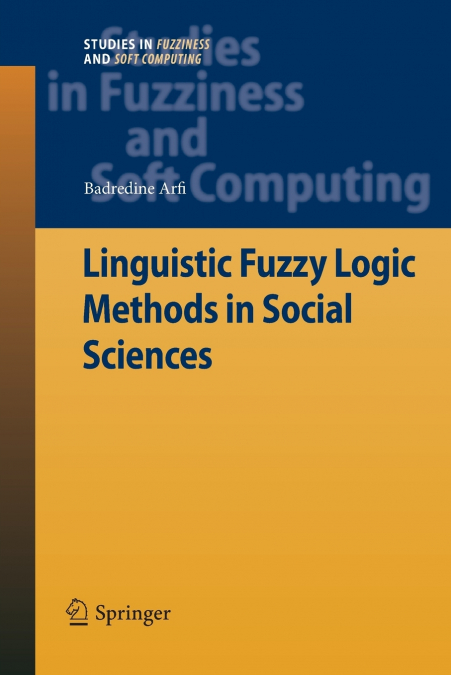
Linguistic Fuzzy Logic Methods in Social Sciences

Linguistic Fuzzy Logic Methods in Social Sciences

Badredine Arfi

132,97 €
IVA incluido
Consulta disponibilidad
Editorial:
Springer Nature B.V.
Año de edición:
2010
Materia
Inteligencia artificial
ISBN:
9783642133428

Selecciona una librería:

  • Librería Samer Atenea
  • Librería Aciertas (Toledo)
  • Kálamo Books
  • Librería Perelló (Valencia)
  • Librería Elías (Asturias)
  • Donde los libros
  • Librería Kolima (Madrid)
  • Librería Proteo (Málaga)

The modern origin of fuzzy sets, fuzzy algebra, fuzzy decision making, and 'computing with words' is conventionally traced to Lotfi Zadeh’s publication in 1965 of his path-breaking refutation of binary set theory. In a sixteen-page article, modestly titled 'Fuzzy Sets' and published in the journal Information and Control, Zadeh launched a multi-disciplinary revolution. The start was relatively slow, but momentum gathered quickly. From 1970 to 1979 there were about 500 journal publications with the word fuzzy in the title; from 2000 to 2009 there were more than 35,000. At present, citations to Zadeh’s publications are running at a rate of about 1,500-2,000 per year, and this rate continues to rise. Almost all applications of Zadeh’s ideas have been in highly technical scientific fields, not in the social sciences. Zadeh was surprised by this development. In a personal note he states: 'When I wrote my l965 paper, I expected that fuzzy set theory would be applied primarily in the realm of human sciences. Contrary to my expectation, fuzzy set theory and fuzzy logic are applied in the main in physical and engineering sciences.' In fact, the first comprehensive examination of fuzzy sets by a social scientist did not appear until 1987, a full twenty-two years after the publication of Zadeh’s seminal article, when Michael Smithson, an Australian psychologist, published Fuzzy Set Analysis for Behavioral and Social Sciences.


Artículos relacionados

  • Artificial Cognition Systems
    ...
  • Cross-Disciplinary Applications of Artificial Intelligence and Pattern Recognition
    Vijay Kumar Mago
    The need for intelligent machines in areas such as medical diagnostics, biometric security systems, and image processing motivates researchers to develop and explore new techniques, algorithms, and applications in this evolving field. Cross-Disciplinary Applications of Artificial Intelligence and Pattern Recognition: Advancing Technologies provides a common platform for researc...
  • Emerging Applications of Natural Language Processing
    Over the last few years, the area of Natural Language Processing has drastically grown in recognition, not only within the research and development community, but also with industry professionals. As NLP continues to be discussed and researched, certain areas continue to grow and mature. As a result, the need for advanced research and information is in high demand. Emerging App...
  • Androids, Cyborgs, and Robots in Contemporary Culture and Society
    Steven John Thompson
    Mankind’s dependence on artificial intelligence and robotics is increasing rapidly as technology becomes more advanced. Finding a way to seamlessly intertwine these two worlds will help boost productivity in society and aid in a variety of ways in modern civilization. Androids, Cyborgs, and Robots in Contemporary Culture and Society is an essential scholarly resource that delve...
  • Deep Learning Innovations and Their Convergence With Big Data
    The expansion of digital data has transformed various sectors of business such as healthcare, industrial manufacturing, and transportation. A new way of solving business problems has emerged through the use of machine learning techniques in conjunction with big data analytics. Deep Learning Innovations and Their Convergence With Big Data is a pivotal reference for the latest sc...
  • Computational Psychoanalysis and Formal Bi-Logic Frameworks
    Giuseppe Iurato
    Computational psychoanalysis is a new field stemming from Freudian psychoanalysis. The new area aims to understand the primary formal structures and running mechanisms of the unconscious while implementing them into computer sciences. Computational Psychoanalysis and Formal Bi-Logic Frameworks provides emerging information on this new field which uses psychoanalysis and the unc...

Otros libros del autor

  • Re-Thinking International Relations Theory via Deconstruction
    Badredine Arfi
     Questioning universally accepted presuppositions in existing IR theories, this book employs the logic of deconstruction pioneered by Derrida to explicate the consequences of taking into account the dilemmas and inconsistencies of these theories. ...
    Disponible

    63,74 €

  • Re-Thinking International Relations Theory via Deconstruction
    Badredine Arfi
    International Relations (IR) theorists have ceaselessly sought to understand, explain, and transform the experienced reality of international politics. Running through all these attempts is a persistent, yet unquestioned, quest by theorists to develop strategies to eliminate or reduce the antinomies, contradictions, paradoxes, dilemmas, and inconsistencies dogging their approac...
  • Linguistic Fuzzy Logic Methods in Social Sciences
    Badredine Arfi
    ...
    Disponible

    134,34 €