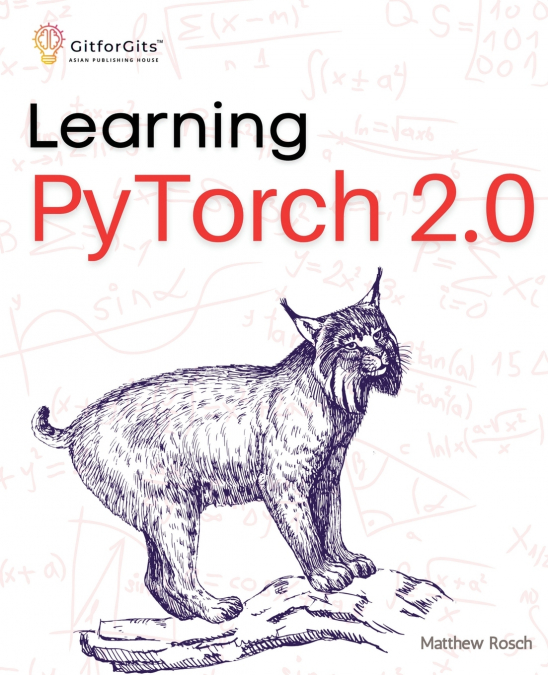

Learning PyTorch 2.0

Learning PyTorch 2.0

Matthew Rosch

52,42 €
IVA incluido
Disponible
Editorial:
GitforGits
Año de edición:
2023
Materia
Inteligencia artificial
ISBN:
9788196288372
52,42 €
IVA incluido
Disponible

Selecciona una librería:

  • Librería Samer Atenea
  • Librería Aciertas (Toledo)
  • Kálamo Books
  • Librería Perelló (Valencia)
  • Librería Elías (Asturias)
  • Donde los libros
  • Librería Kolima (Madrid)
  • Librería Proteo (Málaga)

This book is a comprehensive guide to understanding and utilizing PyTorch 2.0 for deep learning applications. It starts with an introduction to PyTorch, its various advantages over other deep learning frameworks, and its blend with CUDA for GPU acceleration. We delve into the heart of PyTorch - tensors, learning their different types, properties, and operations. Through step-by-step examples, the reader learns to perform basic arithmetic operations on tensors, manipulate them, and understand errors related to tensor shapes.A substantial portion of the book is dedicated to illustrating how to build simple PyTorch models. This includes uploading and preparing datasets, defining the architecture, training, and predicting. It provides hands-on exercises with a real-world dataset. The book then dives into exploring PyTorch’s nn module and gives a detailed comparison of different types of networks like Feedforward, RNN, GRU, CNN, and their combination.Further, the book delves into understanding the training process and PyTorch’s optim module. It explores the overview of optimization algorithms like Gradient Descent, SGD, Mini-batch Gradient Descent, Momentum, Adagrad, and Adam. A separate chapter focuses on advanced concepts in PyTorch 2.0, like model serialization, optimization, distributed training, and PyTorch Quantization API.In the final chapters, the book discusses the differences between TensorFlow 2.0 and PyTorch 2.0 and the step-by-step process of migrating a TensorFlow model to PyTorch 2.0 using ONNX. It provides an overview of common issues encountered during this process and how to resolve them.Key LearningsA comprehensive introduction to PyTorch and CUDA for deep learning.Detailed understanding and operations on PyTorch tensors.Step-by-step guide to building simple PyTorch models.Insight into PyTorch’s nn module and comparison of various network types.Overview of the training process and exploration of PyTorch’s optim module.Understanding advanced concepts in PyTorch like model serialization and optimization.Knowledge of distributed training in PyTorch.Practical guide to using PyTorch’s Quantization API.Differences between TensorFlow 2.0 and PyTorch 2.0.Guidance on migrating TensorFlow models to PyTorch using ONNX.Table of ContentIntroduction to Pytorch 2.0 and CUDA 11.8Getting Started with TensorsAdvanced Tensors OperationsBuilding Neural Networks with PyTorch 2.0Training Neural Networks in PyTorch 2.0PyTorch 2.0 AdvancedMigrating from TensorFlow to PyTorch 2.0End-to-End PyTorch Regression ModelAudienceA perfect and skillful book for every machine learning engineer, data scientist, AI engineer and data researcher who are passionately looking towards drawing actionable intelligence using PyTorch 2.0. Knowing Python and the basics of deep learning is all you need to sail through this book.
Artículos relacionados

  • Artificial Cognition Systems
    ...
  • Cross-Disciplinary Applications of Artificial Intelligence and Pattern Recognition
    Vijay Kumar Mago
    The need for intelligent machines in areas such as medical diagnostics, biometric security systems, and image processing motivates researchers to develop and explore new techniques, algorithms, and applications in this evolving field. Cross-Disciplinary Applications of Artificial Intelligence and Pattern Recognition: Advancing Technologies provides a common platform for researc...
  • Emerging Applications of Natural Language Processing
    Over the last few years, the area of Natural Language Processing has drastically grown in recognition, not only within the research and development community, but also with industry professionals. As NLP continues to be discussed and researched, certain areas continue to grow and mature. As a result, the need for advanced research and information is in high demand. Emerging App...
  • Androids, Cyborgs, and Robots in Contemporary Culture and Society
    Steven John Thompson
    Mankind’s dependence on artificial intelligence and robotics is increasing rapidly as technology becomes more advanced. Finding a way to seamlessly intertwine these two worlds will help boost productivity in society and aid in a variety of ways in modern civilization. Androids, Cyborgs, and Robots in Contemporary Culture and Society is an essential scholarly resource that delve...
  • Deep Learning Innovations and Their Convergence With Big Data
    The expansion of digital data has transformed various sectors of business such as healthcare, industrial manufacturing, and transportation. A new way of solving business problems has emerged through the use of machine learning techniques in conjunction with big data analytics. Deep Learning Innovations and Their Convergence With Big Data is a pivotal reference for the latest sc...
  • Computational Psychoanalysis and Formal Bi-Logic Frameworks
    Giuseppe Iurato
    Computational psychoanalysis is a new field stemming from Freudian psychoanalysis. The new area aims to understand the primary formal structures and running mechanisms of the unconscious while implementing them into computer sciences. Computational Psychoanalysis and Formal Bi-Logic Frameworks provides emerging information on this new field which uses psychoanalysis and the unc...

Otros libros del autor

  • Learning PyTorch 2.0, Second Edition
    Matthew Rosch
    'Learning PyTorch 2.0, Second Edition' is a fast-learning, hands-on book that emphasizes practical PyTorch scripting and efficient model development using PyTorch 2.3 and CUDA 12. This edition is centered on practical applications and presents a concise methodology for attaining proficiency in the most recent features of PyTorch. The book presents a practical program based on t...
    Disponible

    65,56 €

  • PyTorch Cookbook
    Matthew Rosch
    Starting a PyTorch Developer and Deep Learning Engineer career? Check out this ’PyTorch Cookbook,’ a comprehensive guide with essential recipes and solutions for PyTorch and the ecosystem. The book covers PyTorch deep learning development from beginner to expert in well-written chapters.The book simplifies neural networks, training, optimization, and deployment strategies chapt...
    Disponible

    62,95 €

  • Learning Pandas 2.0
    Matthew Rosch
    Mastering Data Wrangling and Analysis for Modern Data Science'Learning Pandas 2.0' is an essential guide for anyone looking to harness the power of Python’s premier data manipulation library. With this comprehensive resource, you will not only master core Pandas 2.0 concepts but also learn how to employ its advanced features to perform efficient data manipulation and analysis.T...
    Disponible

    52,72 €