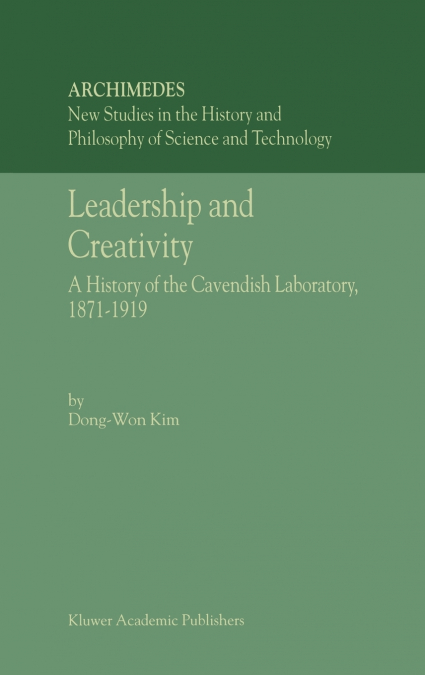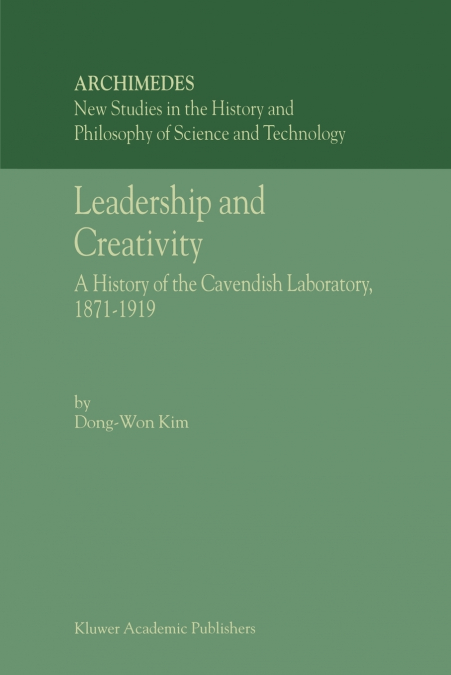

Leadership and Creativity

Leadership and Creativity

Dong-Won Kim

195,57 €
IVA incluido
Disponible
Editorial:
Springer Nature B.V.
Año de edición:
2010
Materia
Sociedad y cultura: general
ISBN:
9789048159567
195,57 €
IVA incluido
Disponible

Selecciona una librería:

  • Librería Samer Atenea
  • Librería Aciertas (Toledo)
  • Kálamo Books
  • Librería Perelló (Valencia)
  • Librería Elías (Asturias)
  • Donde los libros
  • Librería Kolima (Madrid)
  • Librería Proteo (Málaga)

Historical accounts of successful laboratories often consist primarily of reminiscences by their directors and the eminent people who studied or worked in these laboratories. Such recollections customarily are delivered at the celebration of a milestone in the history of the laboratory, such as the institution’s fiftieth or one­ hundredth anniversary. Three such accounts of the Cavendish Laboratory at the University of Cambridge have been recorded. The first of these, A History of the Cavendish Laboratory, 1871-1910, was published in 1910 in honor of the twenty­ fifth anniversary of Joseph John Thomson’s professorship there. The second, The Cavendish Laboratory, 1874-1974, was published in 1974 to commemorate the one­ hundredth anniversary of the Cavendish. The third, A Hundred Years and More of Cambridge Physics, is a short pamphlet, also published at the centennial of the 1 Cavendish. These accounts are filled with the names of great physicists (such as James Clerk Maxwell, Lord Rayleigh, J. J. Thomson, Ernest Rutherford, and William Lawrence Bragg), their glorious achievements (for example, the discoveries of the electron, the neutron, and DNA) and interesting anecdotes about how these achievements were reached. But surely a narrative that does justice to the history of a laboratory must recount more than past events. Such a narrative should describe a living entity and provide not only details of the laboratory’s personnel, organization, tools, and tool kits, but should also explain how these components interacted within 2 their wider historical, cultural, and social contexts.

Artículos relacionados

  • The Gandhian Iceberg
    Chris D Moore-Backman
    The Gandhian Iceberg presents a bold, new interpretation of Gandhian nonviolence from the rare perspective of an author who is equal parts writer, scholar, and frontlines practitioner. The book faces the current crisis of climate change and the intensification of social unrest around the world, and calls for a new convergence of serious, spiritually-rooted US nonviolence activi...
    Disponible

    11,52 €

  • Contemporary Developments in Child Protection
    Nigel Parton
    Volume 1 "Policy Changes and Challenges" takes as its central theme the ongoing and challenging issues which child protection agencies have to address and the policy and practice initiatives that are developed to try and address these. The volume includes papers on: the relationship between the decline in the rate of ‘unnatural’ deaths and the growth of concern about child abus...
  • Diversity in Information Technology Education
    Goran Trajkovski
    ...
  • Model-Driven Software Development
    Model-driven software development (MDSD) drastically alters the software development process, characterized by a high degree of innovation and productivity. However, quality assurance application in the domain of software models and model-driven software development is still in an emergent phase. Model-Driven Software Development: Integrating Quality Assurance provides in-depth...
  • Evidence-Based Practice in Nursing Informatics
    Andrew Chasin
    Because of the constant advances and dynamics within the nascent field of nursing informatics, many nurses struggle in practice as they continue to try and apply habitual communication practices in the new environment without any critical reflection on, and adaptation of, those practices. Evidence-Based Practice in Nursing Informatics: Concepts and Applications serves as a valu...
  • Actor-Network Theory and Technology Innovation
    Arthur Tatnall
    About 25 years ago, the first developments of ANT (Actor-Network Theory) took place, but it wasn’t until much later that researchers began to take it seriously. In the late 1990s, ANT began to take hold in the scientific community as a new and exciting approach to socio-technical research and social theory. Actor-Network Theory and Technology Innovation: Advancements and New Co...

Otros libros del autor

  • Making a Semiconductor Superpower
    Dong-Won Kim
    This book provides the readers with real stories of the South Korean semiconductor community. It explores the lives of seven influential semiconductor engineers that all worked or studied at KAIST in South Korea, under the mentorship of Dr. Kim Choong-Ki and became known as Kim’s Mafia. ...
    Disponible

    90,78 €

  • Making a Semiconductor Superpower
    Dong-Won Kim
    This book provides the readers with real stories of the South Korean semiconductor community. It explores the lives of seven influential semiconductor engineers that all worked or studied at KAIST in South Korea, under the mentorship of Dr. Kim Choong-Ki and became known as Kim’s Mafia. ...
  • Leadership and Creativity
    Dong-Won Kim
    Historical accounts of successful laboratories often consist primarily of reminiscences by their directors and the eminent people who studied or worked in these laboratories. Such recollections customarily are delivered at the celebration of a milestone in the history of the laboratory, such as the institution’s fiftieth or one­ hundredth anniversary....