 Librería Samer Atenea
 Kálamo Books
 Librería Elías (Asturias)
 Librería Kolima (Madrid)
 Librería Proteo (Málaga)
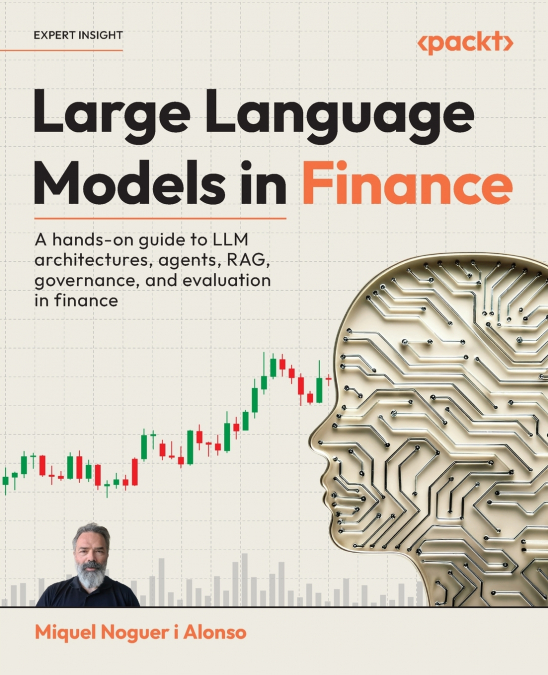
Build production-grade Large Language Model systems for finance. Learn how to design, fine-tune, evaluate, govern, and deploy LLMs, Retrieval-Augmented Generation (RAG), and AI agents for trading, banking, risk management, compliance, and financial research using rigorous mathematics, practical code, and real-world case studies.Key Features:- Build production-ready financial LLM systems with RAG, fine-tuning, AI agents, and MCP- Apply LLMs to trading, investment research, banking, risk, fraud, compliance, and documents- Explore reasoning models, multimodal AI, time-series LLMs, and autonomous financial agents- Purchase of the print or Kindle book includes a free PDF eBookBook Description:Large language models are reshaping finance, but production use demands far more than prompt engineering. Financial AI must reason over numbers, work with time-sensitive data, avoid leakage, support auditability, and operate within strict regulatory and model-risk controls.LLMs in Finance provides an end-to-end guide to designing, evaluating, governing, and deploying language-model systems for financial workflows. You will learn the foundations of transformers, embeddings, attention, prompting, retrieval-augmented generation, and fine-tuning, then apply them to investment research, trading support, banking operations, fraud detection, credit, KYC, AML, compliance, and document intelligence.The book also shows how to design financial agents that use tools, memory, retrieval, orchestration, and human oversight to complete complex tasks safely. Coverage of time-series applications, backtesting contamination, hallucination control, temporal validation, model risk, monitoring, and regulatory expectations helps you avoid the mistakes that make financial AI unreliable.Practical Python examples, case studies, and a companion GitHub repository help you move from theory to implementation. By the end, you will be able to build scalable, auditable, production-ready LLM systems aligned with real business and regulatory constraints.What You Will Learn:- Understand LLM foundations for financial applications- Build financial LLM systems from ingestion to deployment- Fine-tune models with LoRA, QLoRA, RLHF, and DPO- Create RAG pipelines for financial documents and knowledge- Design autonomous agents and multi-agent finance workflows- Integrate LLMs securely with MCP and enterprise systems- Apply LLMs to trading, banking, risk, fraud, KYC, and AML- Evaluate and govern auditable financial AI with rigorous metricsWho this book is for:This book is written for data scientists, quantitative analysts, portfolio managers, traders, fintech developers, AI engineers, software architects, banking professionals, compliance specialists, regulators, researchers, and graduate students who want to apply Large Language Models to finance.Readers should have a fundamental understanding of Python programming, machine learning, and financial markets. The book is equally suitable for practitioners building production AI systems and researchers interested in the mathematical foundations of financial LLMs.Table of Contents- Introduction to Large Language Models- Foundations and System Design of Financial LLMs- Fine-Tuning LLMs for Finance- Retrieval-Augmented Generation for Financial Tasks- Architectures and Applications of LLM Agents in Finance- Model Context Protocol and Hardened Tool Invocation in Financial Systems- Applications of LLMs in Finance- Financial Documents and Advisory- Reinforcement Learning in LLMs- Infrastructure and Performance(N.B. Please use the Read Sample option to see further chapters)