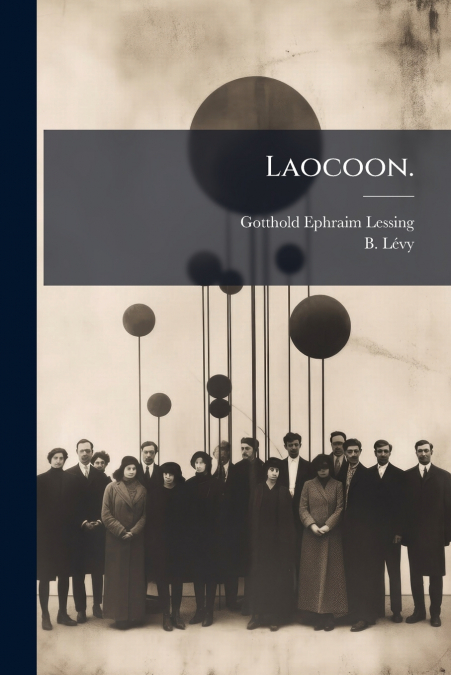
B. Lévy / Gotthold Ephraim Lessing
 Librería Samer Atenea
 Kálamo Books
 Librería Elías (Asturias)
 Librería Kolima (Madrid)
 Librería Proteo (Málaga)
Laokoon oder über die Grenzen der Mahlerey und Poesie (Laocoon: An Essay on the Limits of Painting and Poetry) is a treatise on aesthetics by Gotthold Ephraim Lessing, published in 1766. In it, Lessing explores the differences between visual and literary art by analyzing the statue of Laocoon and His Sons. He argues against the prevailing view that art should strive to imitate nature perfectly, asserting instead that each art form has its own unique strengths and limitations. Lessing champions the power of poetry to express action and emotion over time, while acknowledging the capacity of visual art to capture a single, pregnant moment. 'Laocoon' remains a seminal work in the fields of aesthetics and art criticism, influencing generations of artists and scholars.This work has been selected by scholars as being culturally important, and is part of the knowledge base of civilization as we know it. This work was reproduced from the original artifact, and remains as true to the original work as possible. Therefore, you will see the original copyright references, library stamps (as most of these works have been housed in our most important libraries around the world), and other notations in the work.This work is in the public domain in the United States of America, and possibly other nations. Within the United States, you may freely copy and distribute this work, as no entity (individual or corporate) has a copyright on the body of the work.As a reproduction of a historical artifact, this work may contain missing or blurred pages, poor pictures, errant marks, etc. Scholars believe, and we concur, that this work is important enough to be preserved, reproduced, and made generally available to the public. We appreciate your support of the preservation process, and thank you for being an important part of keeping this knowledge alive and relevant.