Inicio > > Ciencias de la computación > Inteligencia artificial > Knowledge Representation and Organization in Machine Learning
Knowledge Representation and Organization in Machine Learning

Knowledge Representation and Organization in Machine Learning

Katharina Morik

66,06 €
IVA incluido
Disponible
Editorial:
Springer Nature B.V.
Año de edición:
1989
Materia
Inteligencia artificial
ISBN:
9783540507680
66,06 €
IVA incluido
Disponible

Selecciona una librería:

  • Librería Samer Atenea
  • Librería Aciertas (Toledo)
  • Kálamo Books
  • Librería Perelló (Valencia)
  • Librería Elías (Asturias)
  • Donde los libros
  • Librería Kolima (Madrid)
  • Librería Proteo (Málaga)

Machine learning has become a rapidly growing field of Artificial Intelligence. Since the First International Workshop on Machine Learning in 1980, the number of scientists working in the field has been increasing steadily. This situation allows for specialization within the field. There are two types of specialization: on subfields or, orthogonal to them, on special subjects of interest. This book follows the thematic orientation. It contains research papers, each of which throws light upon the relation between knowledge representation, knowledge acquisition and machine learning from a different angle. Building up appropriate representations is considered to be the main concern of knowledge acquisition for knowledge-based systems throughout the book. Here machine learning is presented as a tool for building up such representations. But machine learning itself also states new representational problems. This book gives an easy-to-understand insight into a new field with its problems and the solutions it offers. Thus it will be of good use to both experts and newcomers to the subject.

Artículos relacionados

  • Artificial Cognition Systems
    ...
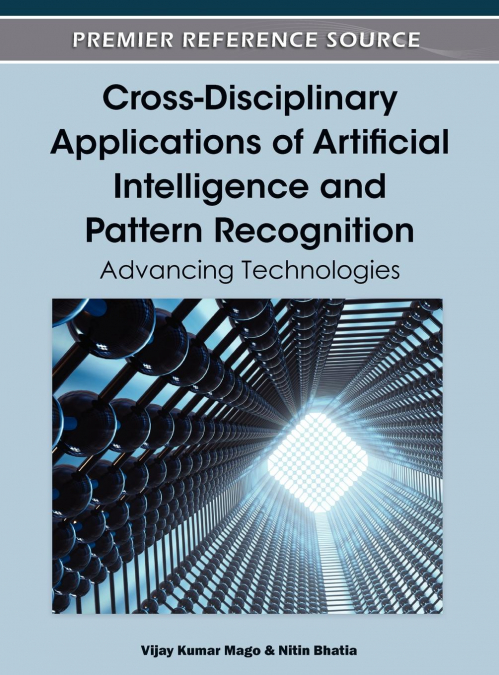
  • Cross-Disciplinary Applications of Artificial Intelligence and Pattern Recognition
    Vijay Kumar Mago
    The need for intelligent machines in areas such as medical diagnostics, biometric security systems, and image processing motivates researchers to develop and explore new techniques, algorithms, and applications in this evolving field. Cross-Disciplinary Applications of Artificial Intelligence and Pattern Recognition: Advancing Technologies provides a common platform for researc...
  • Emerging Applications of Natural Language Processing
    Over the last few years, the area of Natural Language Processing has drastically grown in recognition, not only within the research and development community, but also with industry professionals. As NLP continues to be discussed and researched, certain areas continue to grow and mature. As a result, the need for advanced research and information is in high demand. Emerging App...
  • Androids, Cyborgs, and Robots in Contemporary Culture and Society
    Steven John Thompson
    Mankind’s dependence on artificial intelligence and robotics is increasing rapidly as technology becomes more advanced. Finding a way to seamlessly intertwine these two worlds will help boost productivity in society and aid in a variety of ways in modern civilization. Androids, Cyborgs, and Robots in Contemporary Culture and Society is an essential scholarly resource that delve...
  • Deep Learning Innovations and Their Convergence With Big Data
    The expansion of digital data has transformed various sectors of business such as healthcare, industrial manufacturing, and transportation. A new way of solving business problems has emerged through the use of machine learning techniques in conjunction with big data analytics. Deep Learning Innovations and Their Convergence With Big Data is a pivotal reference for the latest sc...
  • Computational Psychoanalysis and Formal Bi-Logic Frameworks
    Giuseppe Iurato
    Computational psychoanalysis is a new field stemming from Freudian psychoanalysis. The new area aims to understand the primary formal structures and running mechanisms of the unconscious while implementing them into computer sciences. Computational Psychoanalysis and Formal Bi-Logic Frameworks provides emerging information on this new field which uses psychoanalysis and the unc...

Otros libros del autor

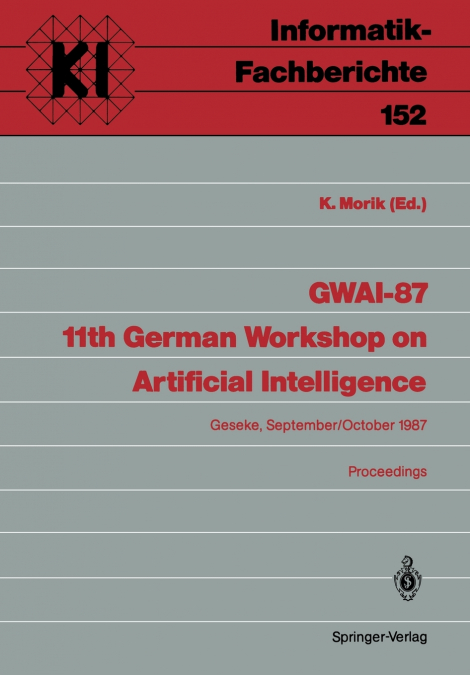
  • Gwai-87 11th German Workshop on Artificial Intelligence
    Katharina Morik
    Es wurde gezeigt, daß das Bootstrap-Problem bei der geometrischen Szenenrekonstruktion eine wichtige Rolle spielt und daß das Problem der physikalischen Korrespondenz als eine spezielle Sichtweise des Rekonstruktionsproblems gesehen werden kann. Weiterhin wurde ein wissensbasier­ ter Ansatz vorgestellt, um das Bootstrap-Problem zu umgehen. Literatur B...
    Disponible

    65,68 €