Kinesin Protocols

Kinesin Protocols

Isabelle Vernos

207,95 €
IVA incluido
Disponible
Editorial:
Springer Nature B.V.
Año de edición:
2010
Materia
Biología molecular
ISBN:
9781617371783
207,95 €
IVA incluido
Disponible

Selecciona una librería:

  • Librería Samer Atenea
  • Librería Aciertas (Toledo)
  • Kálamo Books
  • Librería Perelló (Valencia)
  • Librería Elías (Asturias)
  • Donde los libros
  • Librería Kolima (Madrid)
  • Librería Proteo (Málaga)

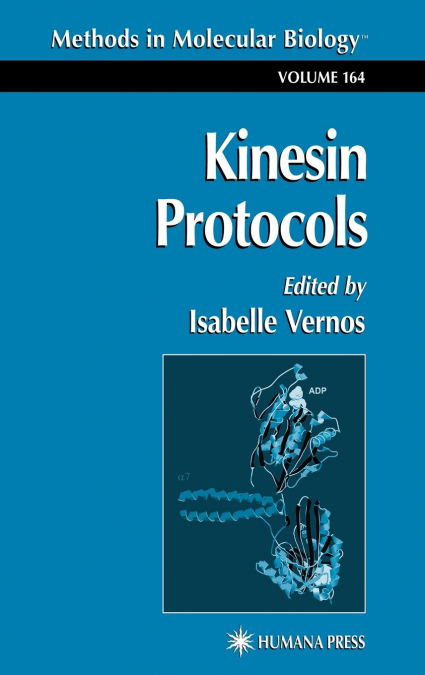
By the end of the 1980s only two microtubule-dependent motors, the plus end-directed kinesin and the minus end-directed cytoplasmic dynein, had been identified. At the time, these two motors seemed almost sufficient to explain directional motility events on polar microtubule tracks in the cell. No- theless, shortly after, the tip of the iceberg began to emerge with the identi- cation of proteins containing in their sequences a domain found in kinesin. This domain, called the 'motor domain,' conferred on these proteins the essential property of moving on microtubules, using the energy derived from ATP hydro- sis. Since then, the identification of new proteins belonging to the kinesin superfamily of microtubule-dependent motors has gone at such a pace that nowadays more than 200 entries with motor domain sequences are deposited in the database. Kinesin family members are found in all eukaryotic org- isms tested. They present a wide range of domain organizations with a motor domain located at different positions in the molecule. Their motility prop- ties are also variable in directionality, velocity, and such other characteristics as bundling activity and processivity. Finally, and most important, they p- ticipate in a multitude of cellular functions. Our understanding of many cel- lar events, such as mitotic spindle assembly and neuronal transport, to cite only two, has progressed substantially in the last few years thanks to the id- tification of these motors.

Artículos relacionados

  • DNA LOGIC DESIGN
    BABU HAFIZ MD. HASAN / Hafiz Md. Hasan Babu
    A DNA computer is a collection of specially selected DNA strands, which when encoded into specific combinations are then subjected to bio-molecular manipulation in order to solve computational problems. Rather than storing information in the 1s and 0s of the binary number system, it is now stored in the form of the bases adenine (A), thymine (T), cytosine (C) and guanine (G). T...
  • Vitamin Receptors
    Krishnamurti Dakshinamurti
    ...
    Disponible

    60,38 €

  • Regulación de la expresión génica de eucariotas
    Yenny Yolanda Lozano Jiménez
    En el amplio escenario de la biología celular, la regulación de la expresión génica emerge como un proceso vital que rige la vida de los organismos. Por ello, este libro sumerge al lector en el fascinante mundo donde cada célula coordina la activación y desactivación de genes para asegurar su funcionamiento y adaptación al entorno. Desde la interacción de factores de transcripc...
    Disponible

    26,00 €

  • Three-Dimensional Electron Microscopy of Macromolecular Assemblies
    Joachim Frank
    ...
    Disponible

    272,39 €

  • The Biochemistry of Inorganic Compounds of Sulphur
    A. B. Roy / ABRoy / P. A. Trudinger / PATrudinger
    ...
    Disponible

    77,03 €

  • Annotated Catalogue of African Grasshoppers
    H. B. Johnston / HBJohnston
    ...
    Disponible

    80,25 €

Otros libros del autor

  • Kinesin Protocols
    Isabelle Vernos
    By the end of the 1980s only two microtubule-dependent motors, the plus end-directed kinesin and the minus end-directed cytoplasmic dynein, had been identified. At the time, these two motors seemed almost sufficient to explain directional motility events on polar microtubule tracks in the cell. No- theless, shortly after, the tip of the iceberg began ...