 Librería Samer Atenea
 Kálamo Books
 Librería Elías (Asturias)
 Librería Kolima (Madrid)
 Librería Proteo (Málaga)
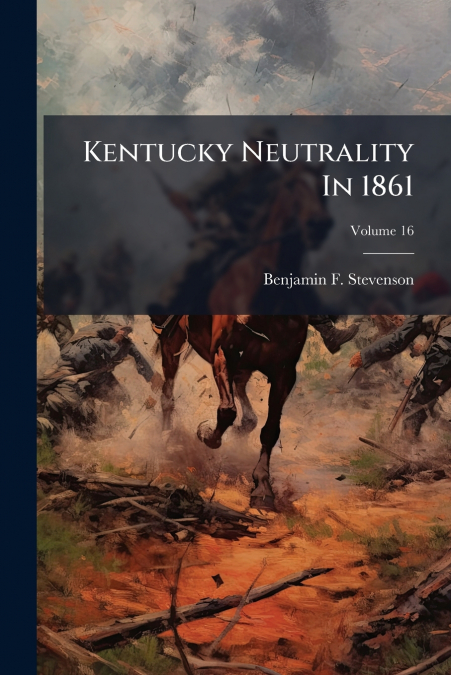
'Kentucky Neutrality In 1861' explores the pivotal stance Kentucky took at the onset of the American Civil War. Penned by Benjamin F. Stevenson, this paper, originally presented before the Ohio Commandery of the Military Order of the Loyal Legion of the United States, delves into the intricate political maneuvering and local sentiments that led Kentucky to initially declare neutrality. Stevenson meticulously examines the delicate balance Kentucky sought to maintain between the Union and the Confederacy, detailing the internal divisions and external pressures that shaped the state’s decision. This historical account offers valuable insights into the complexities of the era, shedding light on the challenges faced by border states during one of the nation’s most tumultuous periods. Readers gain a deeper understanding of Kentucky’s strategic importance and the internal debates that ultimately influenced its alignment in the conflict.This work has been selected by scholars as being culturally important, and is part of the knowledge base of civilization as we know it. This work was reproduced from the original artifact, and remains as true to the original work as possible. Therefore, you will see the original copyright references, library stamps (as most of these works have been housed in our most important libraries around the world), and other notations in the work.This work is in the public domain in the United States of America, and possibly other nations. Within the United States, you may freely copy and distribute this work, as no entity (individual or corporate) has a copyright on the body of the work.As a reproduction of a historical artifact, this work may contain missing or blurred pages, poor pictures, errant marks, etc. Scholars believe, and we concur, that this work is important enough to be preserved, reproduced, and made generally available to the public. We appreciate your support of the preservation process, and thank you for being an important part of keeping this knowledge alive and relevant.