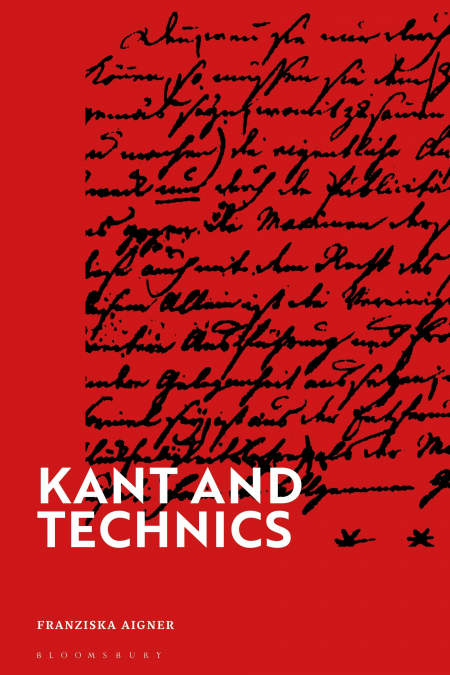

Kant and Technics

Kant and Technics

Franziska Aigner

50,93 €
IVA incluido
Disponible
Editorial:
Bloomsbury Publishing plc
Año de edición:
2026
Materia
Influencia de la ciencia y la tecnología sobre la sociedad
ISBN:
9781350299078
50,93 €
IVA incluido
Disponible

Selecciona una librería:

  • Librería Samer Atenea
  • Kálamo Books
  • Librería Elías (Asturias)
  • Librería Kolima (Madrid)
  • Librería Proteo (Málaga)

Martin Heidegger, Gilbert Simondon, and Bernard Stiegler each argued in their own way that, ever since its inception in ancient Greece, western philosophy is incapable of thinking technics, which reaches its clearest expression in the philosophy of Immanuel Kant.According to Heidegger, Kant articulated the essence of modern technics as enframing (Gestell) without understanding the nature of his own insight, while Simondon claimed that transcendental philosophy is structurally incapable of thinking technics as its answer to the question of technics either comes too early (a priori) or too later (a posteriori). Stiegler synthesized both positions in his claim that Kant was incapable of acknowledging the technical constitution of his own consciousness. All three thinkers thus argue, in one way or another, that Kant was essentially incapable of seeing, understanding, let alone thinking, technics. The intention of this book is two-fold. On the one hand, it argues that, despite Heidegger, Simondon, and Stiegler’s inability of recognizing it, there is an explicit concept of technics at work in Kant’s philosophy. This technics is however not a technics that was overlooked by Heidegger, Simondon, and Stiegler. Instead, this book shows that, from the Critique of Pure Reason (1780) until the posthumously published Opus Postumum (1796-1803), transcendental philosophy is at once constituted against, while at the same time relying upon, and proceeding from technics. On the other hand, this book engages with the broader relation between philosophy and technics. If there is indeed such a thing as a Kantian thought on technics, then Kant can no longer be considered philosophy’s most prominent ’techno-oblivious’ thinker. The question about the relation between Kant and technics is thus nothing less than a question about the relation between philosophy and technics as a whole. 6


Artículos relacionados

  • Interactive Media Use and Youth
    Modern advancements in technology have changed the way that young people use interactive media. Learning from such methods was not even considered until recently. It is now slowly defining the landscape of contemporary pedagogical practices. Interactive Media Use and Youth: Learning, Knowledge Exchange and Behavior provides a comprehensive collection of knowledge based on diffe...
  • Social and Economic Effects of Community Wireless Networks and Infrastructures
    Abdelaal
    It is surprising to think that in today’s rapidly evolving world of technology, over half of the globe still does not have access to high speed internet. Creating community wireless networks has in the past been a way to provide remote communities with internet and network access. Social and Economic Effects of Community Wireless Networks and Infrastructures highlights the succ...
  • The New Atlantis
    Francis Bacon
    In this work, Bacon portrayed a vision of the future of human discovery and knowledge, expressing his aspirations and ideals for humankind. The novel depicts the creation of a utopian land where 'generosity and enlightenment, dignity and splendour, piety and public spirit' are the commonly held qualities of the inhabitants of 'Bensalem'. ...
  • Sport 2.0
    Andy Miah
    ...
    Disponible

    28,86 €

  • Productivity Machines
    Corinna Schlombs
    ...
    Disponible

    48,52 €

  • Open Space
    Mariel Borowitz
    ...
    Disponible

    38,25 €

Otros libros del autor

  • Kant and Technics
    Franziska Aigner
    Martin Heidegger, Gilbert Simondon, and Bernard Stiegler each argued in their own way that, ever since its inception in ancient Greece, western philosophy is incapable of thinking technics, which reaches its clearest expression in the philosophy of Immanuel Kant.According to Heidegger, Kant articulated the essence of modern technics as enframing (Gestell) without understanding ...