 Librería Samer Atenea
 Kálamo Books
 Librería Elías (Asturias)
 Librería Kolima (Madrid)
 Librería Proteo (Málaga)
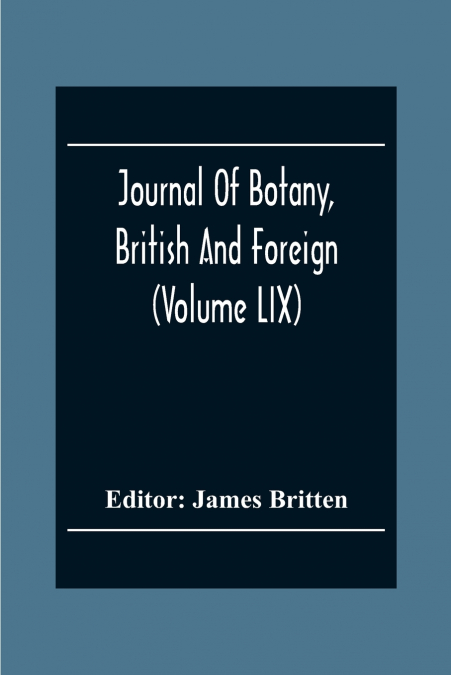
A nineteenth-century laboratory of leaves and names. Nature speaks in careful detail. Volume LIX of Journal of Botany, British and Foreign, edited by James Britten, assembles the careful field observations, species descriptions and taxonomic notes that underpin Victorian plant studies. As both a botanical journal anthology and a botanical magazine compendium, it presents articles and short communications that map United Kingdom flora alongside vivid accounts of foreign flora exploration. Readers encounter working science: the slow accumulation of specimen records, the sharpening of diagnostic characters, and the dialogues that led to formal taxonomy and plant identification. That combination makes the volume useful on multiple levels - a readable botany enthusiasts guide for armchair naturalists and a primary historical botany resource for professionals tracing nomenclature and distribution. The language remains clear, the attention to locality and habit remains precise, and the balance between readable field prose and technical commentary reflects why this periodical was central to British botany research in its day.As a scientific periodical collection, Volume LIX functions as an academic reference for botanists, libraries and collectors who prize original sources from nineteenth century science. Its pages chart how species were debated and settled, how explorers described unfamiliar plants, and how metropolitan herbaria and provincial botanists knitted a living map of flora. Out of print for decades and now republished by Alpha Editions. Restored for today’s and future generations. More than a reprint - a collector’s item and a cultural treasure. For casual readers it offers fascination and narrative: field anecdotes, clear identification notes and an evocative portrait of Victorian curiosity. For classic-literature collectors and historians of science it supplies provenance, context and the kind of primary material that rewards close study. Whether you use it as a reference for research or a companion for curious reading, Volume LIX stands as an essential witness to a formative era in botanical study.