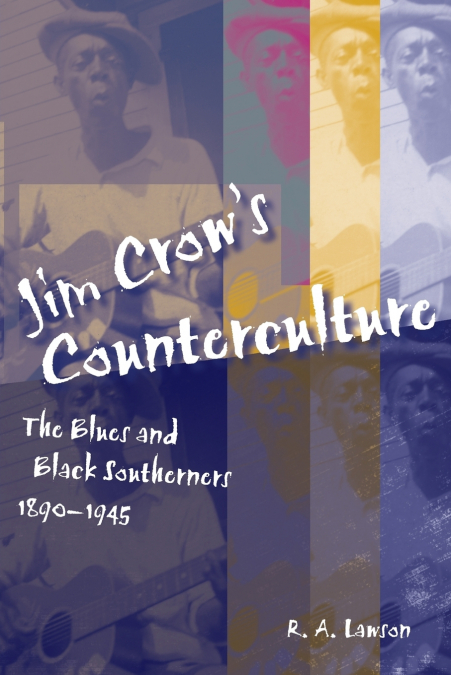

Jim Crow’s Counterculture

Jim Crow’s Counterculture

R A Lawson

50,89 €
IVA incluido
Disponible
Editorial:
Longleaf on behalf of LSU Press
Año de edición:
2013
Materia
Historia de América
ISBN:
9780807152270
50,89 €
IVA incluido
Disponible

Selecciona una librería:

  • Librería Samer Atenea
  • Librería Aciertas (Toledo)
  • Kálamo Books
  • Librería Perelló (Valencia)
  • Librería Elías (Asturias)
  • Donde los libros
  • Librería Kolima (Madrid)
  • Librería Proteo (Málaga)

In the late nineteenth century, black musicians in the lower Mississippi Valley, chafing under the social, legal, and economic restrictions of Jim Crow, responded with a new musical form the blues. In Jim Crow's Counterculture, R. A. Lawson offers a cultural history of blues musicians in the segregation era, explaining how by both accommodating and resisting Jim Crow life, blues musicians created a counterculture to incubate and nurture ideas of black individuality and citizenship. These individuals, Lawson shows, collectively demonstrate the African American struggle during the early twentieth century. Derived from the music of the black working class and popularized by commercially successful songwriter W. C. Handy, early blues provided a counterpoint to white supremacy by focusing on an anti-work ethic that promoted a culture of individual escapism even hedonism and by celebrating the very culture of sex, drugs, and violence that whites feared. According to Lawson, blues musicians such as Charley Patton and Muddy Waters drew on traditions of southern black music, including call and response forms, but they didn't merely sing of a folk past. Instead, musicians saw blues as a way out of economic subservience. Lawson chronicles the major historical developments that changed the Jim Crow South and thus the attitudes of the working-class blacks who labored in that society. The Great Migration, the Great Depression and New Deal, and two World Wars, he explains, shaped a new consciousness among southern blacks as they moved north, fought overseas, and gained better-paid employment. The "me"-centered mentality of the early blues musicians increasingly became "we"-centered as these musicians sought to enter mainstream American life by promoting hard work and patriotism. Originally drawing the attention of only a few folklorists and music promoters, popular black musicians in the 1940s such as Huddie Ledbetter and Big Bill Broonzy played music that increasingly reached across racial lines, and in the process gained what segregationists had attempted to deny them: the identity of American citizenship. By uncovering the stories of artists who expressed much in their music but left little record in traditional historical sources, Jim Crow's Counterculture offers a fresh perspective on the historical experiences of black Americans and provides a new understanding of the blues: a shared music that offered a message of personal freedom to repressed citizens."

Artículos relacionados

  • Pan-Africanism and Education
    Kenneth J. King / Kenneth JKing
    This is an analysis of the complex links between Black America and Africa in the period of 1880 to 1945. It examines an extended white attempt to pattern politics and education in colonial Africa upon the example of the U.S. South. This export of United States race relations to Africa was resisted by Black intellectuals in the United States and many of the early nationalists in...
    Disponible

    24,60 €

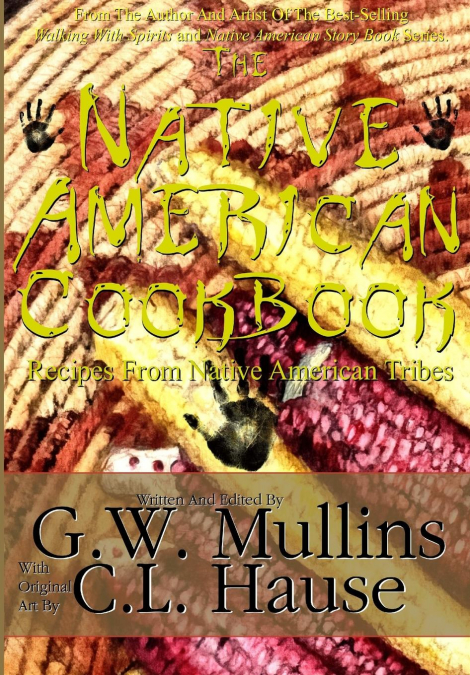
  • The Native American Cookbook Recipes From Native American Tribes
    G.W. Mullins
    Light Of The Moon Publishing along with Author G.W. Mullins and Illustrator / Artist C.L. Hause have joined together to explore Native American Indian Cooking.  More than just a cookbook, this Native American recipe collection offers a look into a forgotten past.  'The Native American Cookbook Recipes From Native American Tribes,' offers a large collection of recipes from and i...
    Disponible

    24,56 €

  • A Public Spirit
    George H. Atkinson
    George Henry Atkinson (1819-89) was a son of New England who arrived in the Oregon Territory in 1848, sent by the American Home Missionary Society. Although his commission from the Society specified that his work was to be ecclesiastical and educational, he took an approach to that assignment which went well beyond his mandate. Well-informed and energetic, he made an impact on ...
    Disponible

    10,45 €

  • North Carolina Women of the Confederacy
    Lucy London Anderson
    Long out of print, this volume of recollections, stories, and verse provides a glimpse of women's lives on the home front-and sometimes in the thick of battle-during the War between the States. Nearly fifty years after the American Civil War, Lucy Worth London Anderson (Mrs. John Huske Anderson) of Fayetteville, N.C., compiled one of the first memorial collections honoring the...
    Disponible

    17,20 €

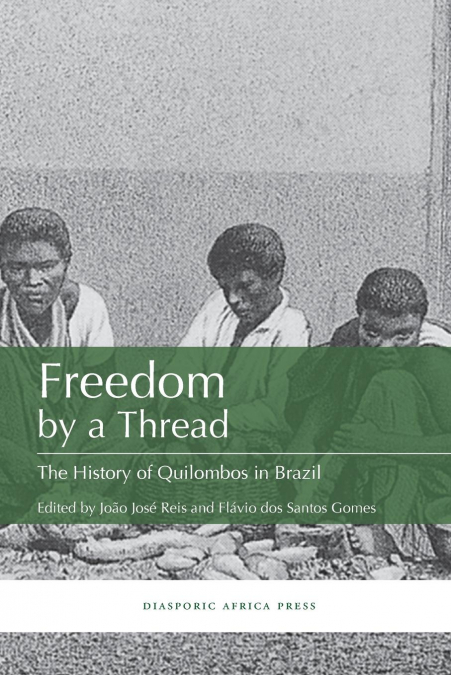
  • Freedom by a Thread
    Freedom by a Thread: The History of Quilombos in Brazil brings together some of the best scholars in the world working on the history of quilombos (maroon societies) in Brazil from a variety of perspectives and approaches. Over 40 percent of the total volume of captive Africans arrived in Brazil during a 400-year period of legal and contraband transatlantic slaving. If slavery ...
    Disponible

    36,71 €

  • Nashville Baseball History
    Bill Traughber
    Nashville is a Big League city despite never having been home to a major league team. From the Civil War era, to star-studded exhibitions, to outstanding Negro Leagues teams, to some of the great minor league franchises of all time, few cities have as rich a baseball tradition as Nashville, Tennessee.Nashville sports historian Bill Traughber, who has been writing about baseball...
    Disponible

    13,15 €