
Inicio > Sociedad y ciencias sociales > Sociedad y cultura: general > Is the use of force obsolete after the end of the cold war?
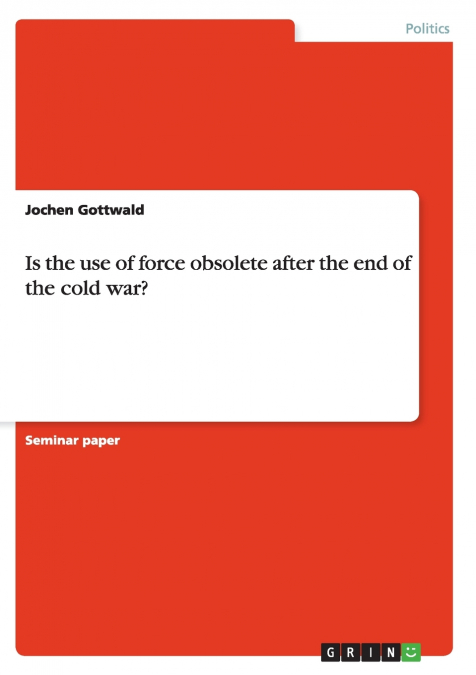
Is the use of force obsolete after the end of the cold war?

Is the use of force obsolete after the end of the cold war?

Jochen Gottwald

19,65 €
IVA incluido
Disponible
Editorial:
GRIN Verlag
Año de edición:
2007
Materia
Sociedad y cultura: general
ISBN:
9783638788496
19,65 €
IVA incluido
Disponible

Selecciona una librería:

  • Librería Samer Atenea
  • Librería Aciertas (Toledo)
  • Kálamo Books
  • Librería Perelló (Valencia)
  • Librería Elías (Asturias)
  • Donde los libros
  • Librería Kolima (Madrid)
  • Librería Proteo (Málaga)

Seminar paper from the year 2003 in the subject Politics - International Politics - Topic: Peace and Conflict Studies, Security, grade: 1.0 (A), National University of Singapore (Faculty of Arts and Social Sciences), course: International Security Issues, language: English, abstract: This essay will ask about the future role of force in international politics by challenging the widely acknowledged perception that the end of Cold War gave impact to an essential paradigm shift of International Relations. It aims to explain why the scholars of International Relations, as well as the actors of global politics, face a widening gap between an accelerated implementation of international institutions and an increasingly troubled world, hit by the violent outbreak of ethnic and national conflicts, the rise of global terrorism and a new cultural and religious conservatism. Today we are in the really paradox situation that the bipolarity of the Cold War - long perceived as the most frightening constellation of the international system - can be seen as its stabilizing factor. To find the origins of the resulting disillusion it is necessary to ask for the reasons that made the western actors in the 1990′s believe that they succeeded. What made them believe that the end of Cold War meant the extermination of the use of force? Did the end of the Cold War really impose a paradigm shift! Did it really change the nature of International Relations?The thesis provided in this essay will be: no! It didn′t! It has to be shown that Cold War only represented a common constellation of the international system, which can be often found throughout history; that the contemporary confusion exists because the paradigms of International Relations are based on a misinterpretation of Hobbes′ state of nature; and that the use of force is the only continuous variable and therefore can be seen as a paradigm of international relations. This approach aims to lead the debate back to an actorcentered mo
Artículos relacionados

  • The Gandhian Iceberg
    Chris D Moore-Backman
    The Gandhian Iceberg presents a bold, new interpretation of Gandhian nonviolence from the rare perspective of an author who is equal parts writer, scholar, and frontlines practitioner. The book faces the current crisis of climate change and the intensification of social unrest around the world, and calls for a new convergence of serious, spiritually-rooted US nonviolence activi...
    Disponible

    11,52 €

  • Contemporary Developments in Child Protection
    Nigel Parton
    Volume 1 "Policy Changes and Challenges" takes as its central theme the ongoing and challenging issues which child protection agencies have to address and the policy and practice initiatives that are developed to try and address these. The volume includes papers on: the relationship between the decline in the rate of ‘unnatural’ deaths and the growth of concern about child abus...
  • Diversity in Information Technology Education
    Goran Trajkovski
    ...
  • Model-Driven Software Development
    Model-driven software development (MDSD) drastically alters the software development process, characterized by a high degree of innovation and productivity. However, quality assurance application in the domain of software models and model-driven software development is still in an emergent phase. Model-Driven Software Development: Integrating Quality Assurance provides in-depth...
  • Evidence-Based Practice in Nursing Informatics
    Andrew Chasin
    Because of the constant advances and dynamics within the nascent field of nursing informatics, many nurses struggle in practice as they continue to try and apply habitual communication practices in the new environment without any critical reflection on, and adaptation of, those practices. Evidence-Based Practice in Nursing Informatics: Concepts and Applications serves as a valu...
  • Actor-Network Theory and Technology Innovation
    Arthur Tatnall
    About 25 years ago, the first developments of ANT (Actor-Network Theory) took place, but it wasn’t until much later that researchers began to take it seriously. In the late 1990s, ANT began to take hold in the scientific community as a new and exciting approach to socio-technical research and social theory. Actor-Network Theory and Technology Innovation: Advancements and New Co...

Otros libros del autor

  • A story of ethics - how sex creates order
    Jochen Gottwald
    Seminar paper from the year 2003 in the subject Politics - Political Theory and the History of Ideas Journal, grade: 2.0 (B), National University of Singapore (Faculty of Arts and Social Sciences), course: Comparative Political Thought: East and West, language: English, abstract: In this essay I will try to draw an analogy to the State of Nature as it is mentioned by Hobbes, st...
    Disponible

    17,53 €

  • Is rational choice the best choice for understanding the peasant? A constructivist reading of the rational choice controversy
    Jochen Gottwald
    Seminar paper from the year 2003 in the subject Politics - International Politics - Region: South Asia, grade: 1,0, University of Heidelberg (Südasieninstitut Abteilung Politische Wissenschaft), course: Rationalität und Politik in Südasien: Kultur, Kontext und vergleichende Politikwissenschaft, language: English, abstract: In this essay I will try on the one hand to critically ...
    Disponible

    19,43 €