
 Librería Samer Atenea
 Kálamo Books
 Librería Elías (Asturias)
 Librería Kolima (Madrid)
 Librería Proteo (Málaga)
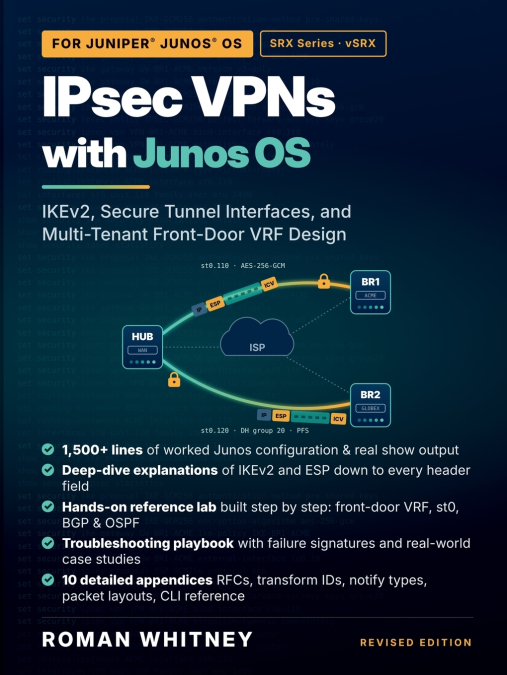
IPsec VPNs with Junos OSWhen a site-to-site tunnel goes down, 'the VPN is broken' is not a diagnosis. IPsec VPNs with Junos OS teaches you to say exactly which layer failed (underlay reachability, the IKEv2 exchange, the Child SA, or the routing that steers tenant traffic into the tunnel) and to fix it on SRX Series and vSRX devices without guessing.Written for network engineers who build and troubleshoot IPsec on Junos OS, the book treats a site-to-site VPN as two separate designs that happen to run on the same routers. One is reachability: which routing instance holds the underlay, which holds the tenant, and which route sends a packet into the tunnel. The other is cryptography: which IKE SA authenticated the peer, which Child SA protects the packet, and which algorithms it uses. Keeping those two stories apart is what makes troubleshooting fast.The book moves from foundations to production in six parts:- VPN and IPsec foundations, including the RFC 4301 security architecture- The cryptography IPsec actually uses: AES and AES-GCM, public-key cryptography, Diffie-Hellman, and HMAC with SHA-256- IKEv2 in depth: key generation, authentication, traffic selectors, Child SA lifetimes and rekey, Dead Peer Detection, NAT traversal, fragmentation, and DoS protection- The data plane: ESP and AH, transport and tunnel modes, anti-replay, MTU, and QoS- Route-based VPNs with secure tunnel interfaces (st0), GRE over IPsec, multi-tenant front-door VRF design, BGP and OSPF over tunnels, high availability, IPv6, and cryptographic hardening- Operations and troubleshooting: a repeatable methodology, packet capture, IKEv2 debugging, the signatures of common failures, and full case studiesEvery concept is explained vendor-neutrally first, then grounded in a clearly marked Junos Implementation section that shows how Junos names the object, which show command displays it, and what correct output looks like. JUNOS DIFFERENCE boxes flag where Junos departs from the standards or from other implementations, which is exactly where interoperability problems start. Each chapter closes with the governing RFCs and why they matter.A single hands-on reference lab runs through the whole book: a hub and two branches serving two tenants with deliberately overlapping address space, kept apart by virtual-router instances and a front-door WAN instance. You build it step by step, and Appendix H provides complete base configurations for every router, with both BGP and OSPF options.The appendices are built to stay on your desk: IKEv2 transform IDs, notify message types, packet layouts for AH, ESP, NAT-T, and GRE over ESP, overhead tables that explain why the tunnel MTU is 1400, a Junos command reference, an interoperability checklist, and a glossary.You should be comfortable with IPv4 routing and the idea of a VRF. No prior IPsec or PKI experience is required. The lab uses a conservative, modern suite (AES-GCM-256 with Diffie-Hellman group 20 and perfect forward secrecy), and the text explains the reasoning behind each choice.Whether you are deploying your first route-based VPN, building multi-tenant WAN services, or working out why a tunnel that was up yesterday is down today, this book gives you the architecture, the protocol detail, and the Junos commands to do it with confidence.