
 Librería Samer Atenea
 Kálamo Books
 Librería Elías (Asturias)
 Librería Kolima (Madrid)
 Librería Proteo (Málaga)
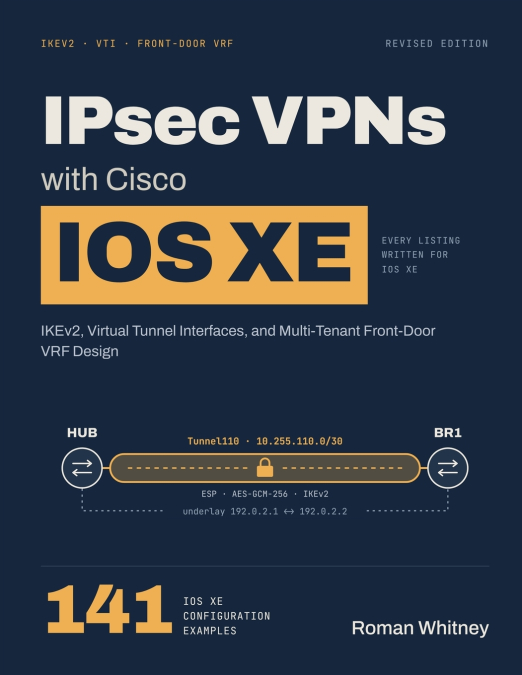
IPsec VPNs with Cisco IOS XEIKEv2, Virtual Tunnel Interfaces, and Multi-Tenant Front-Door VRF DesignSite-to-site IPsec still carries much of the world’s private traffic: branch to hub, data center to cloud, partner to partner. But most engineers learned it from fragments. A Phase 1 here, a crypto map there, a debug they couldn’t decode at 2 a.m. This book replaces those fragments with one complete, tested picture of how IKEv2 and IPsec really work on Cisco IOS XE, and how to build them for today’s threats.Every example builds on the one before. The book follows a single realistic lab from start to finish: a hub, a second hub, branches and a cloud gateway, carrying two tenants, ACME and GLOBEX, across a shared WAN. Every configuration is printed in full: proposal, policy, keyring, IKEv2 profile, transform set, IPsec profile and tunnel. You see what IKE_SA_INIT actually negotiates and what IKE_AUTH actually checks. Then you see the show and debug output that proves it worked, or shows exactly why it didn’t.Built for today’s security. You will configure and verify:Modern cryptography: AES-GCM-256, PRF SHA-512, ECDH group 20 (P-384) and perfect forward secrecy. The book explains why weak defaults like group 5 must stay off the wire, and why CNSA guidance points where it does.Post-quantum readiness: what RFC 9370 multiple key exchanges and ML-KEM change in IKEv2, and what they mean for your design today.Multi-tenant isolation: front-door VRF and inside-VRF design that keeps one customer’s traffic from ever reaching another’s routing table.Route-based VPNs at scale: static VTIs, dynamic VTIs with virtual templates, GRE over IPsec, dual-hub high availability, and OSPF and BGP over encrypted tunnels.Real-world networks: NAT traversal, carrier-grade NAT, IPv6, fragmentation, MTU and MSS clamping, and connecting to third-party and cloud VPN gateways.Hardening: pre-shared keys and certificate (RSA and ECDSA) authentication, cookie challenges, admission limits and other DoS protection, dead peer detection, and anti-replay.Troubleshooting you can use tomorrow. A whole part of the book covers operations: a repeatable method, packet capture, and line-by-line readings of IKEv2 debugs. It catalogs common failures by their signatures: NO_PROPOSAL_CHOSEN, AUTHENTICATION_FAILED, swapped keys, the wrong keyring address, and NAT bindings that silently expire overnight. The case studies follow real incidents from symptom to root cause, including traffic leaking into the wrong VRF, a tunnel through CGNAT, and certificates expiring across both tenants at once.Theory where it matters. Chapters on symmetric and asymmetric cryptography, Diffie-Hellman, hashing and HMAC, IKEv2 key generation, and ESP packet layouts give you the reasoning behind every command. That’s what lets you design with confidence instead of guessing.The reference you’ll keep on your desk. The appendices include an RFC map, IKEv2 transform IDs, notify message types, packet layouts, overhead tables, an IOS XE command reference, full lab base configurations, a glossary, and an interoperability checklist for third-party peers.