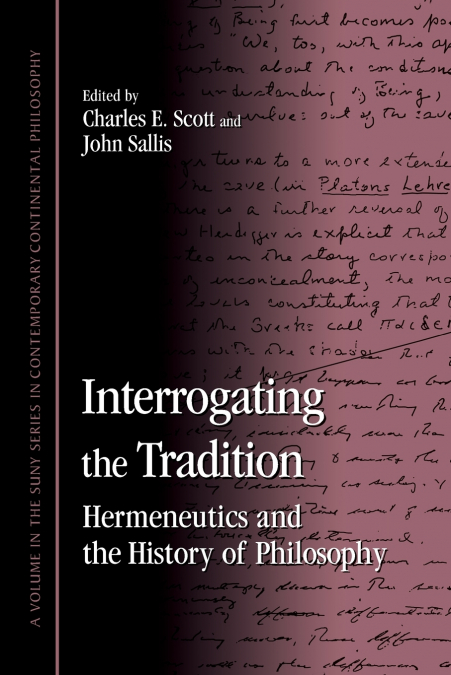

Interrogating the Tradition

Interrogating the Tradition


49,66 €
IVA incluido
Disponible
Editorial:
State University of New York Press
Año de edición:
2000
Materia
Filosofía occidental: antigua, hasta c. 500
ISBN:
9780791444023
49,66 €
IVA incluido
Disponible

Selecciona una librería:

  • Librería Samer Atenea

  • Kálamo Books
  • Librería Elías (Asturias)
  • Librería Kolima (Madrid)
  • Librería Proteo (Málaga)

Constitutes a thoughtful survey of contemporary hermeneutics in its historical context.Interrogating the Tradition interprets figures in the history of Western thought from a broad, 'continental' perspective. Divided into three major sections-hermeneutical thought, Heidegger and the Greeks, and the question of nature in German Idealism-the question of origins is central throughout and takes various shapes, all within the context of the history of Western philosophy. Addressed are the form inquiries take into manners by which we receive our philosophical tradition, the originary force of Plato and Aristotle in the formation of philosophical interpretations of time and human life, and inceptional concepts of nature in the nineteenth century.The philosophers treated here are primarily ancient Greek and nineteenth-century German, but also included are careful discussions of Heidegger and Gadamer. Coming from both sides of the Atlantic and representing various approaches to the issues, the contributors showcase their work on one of the major cutting edges of philosophy.Contributors to this book include Robert Bernasconi, Walter Brogan, Tina Chanter, Françoise Dastur, John Ellis, Günter Figal, Rodolphe Gasché, Jean Grondin, David Farrell Krell, Michael Naas, James Risser, John Russon, John Sallis, Charles E. Scott, Ben Vedder, and Jason M. Wirth.

Artículos relacionados

  • The Nature of Things
    Lucretius Lucretius
    De rerum natura (On the Nature of Things) is a 1st century BC didactic poem by the Roman poet and philosopher Lucretius with the goal of explaining Epicurean philosophy to a Roman audience. Lucretius presents the principles of atomism; the nature of the mind and soul; explanations of sensation and thought; the development of the world and its phenomena; and explains a variety o...
  • Pompeii
    Fergus Mason
    Pompeii was one of most advanced cities of its time; it had a complex water system, gymnasium, and an amphitheater. Despite it's advancements, there was one thing it wasn't ready for: Mount Vesuvius—the volcano that led to its ultimate doom.  The 79 AD eruption of Mount Vesuvius was one of the worst disasters in all of European history. In a near instant, over 15,000 p...
    Disponible

    10,36 €

  • Middle Platonism and Neoplatonism, Volume 1
    Stephen Gersh
    'It is generally agreed that those types of philosophy that are loosely called ’Platonic’ and ’Neoplatonic’ played a crucial role in the history of European culture during the centuries between antiquity and the Renaissance. However, until now no scholar has attempted to describe the evolution of these forms of thought in a single comprehensive academic study.' So writes Stephe...
  • Middle Platonism and Neoplatonism, Volume 2
    Stephen Gersh
    It is generally agreed that those types of philosophy that are loosely called 'Platonic' and 'Neoplatonic' played a crucial role in the history of European culture during the centuries between antiquity and the Middle Ages. However, until now no scholar has attempted to describe the evolution of these forms of thought in a single comprehensive academic study. Middle Platonism a...
  • Porphyry’s Commentary on Ptolemy’s Harmonics
    Andrew Barker
    ...
    Disponible

    80,87 €

  • The Roots of Platonism
    John Dillon
    ...
    Disponible

    26,54 €