 Librería Samer Atenea
 Kálamo Books
 Librería Elías (Asturias)
 Librería Kolima (Madrid)
 Librería Proteo (Málaga)
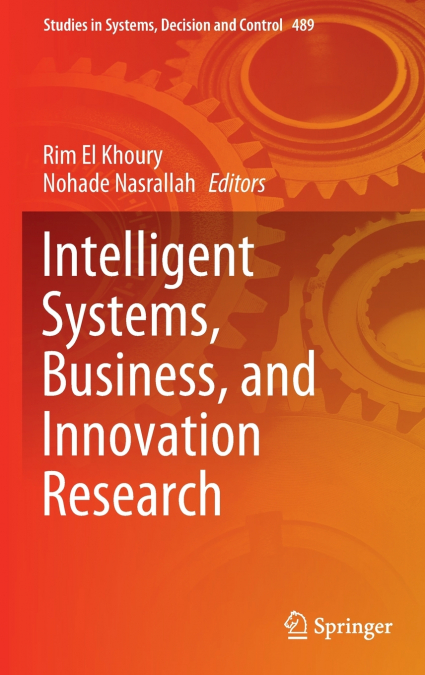
Intelligent systems research is a multidisciplinary field that focuses on the development of systems that can perceive, reason, and act autonomously. This can include areas such as machine learning, artificial intelligence, natural language processing, and robotics. The goal of intelligent systems research is to develop systems that can understand, learn from, and adapt to their environment, to perform tasks that would typically require human intelligence.Business and innovation research is an interdisciplinary field that examines how organizations can create, develop, and implement new ideas, products, and services. This can include areas such as organizational behaviour, strategic management, and marketing. The goal of business and innovation research is to understand how organizations can foster an environment that encourages creativity and innovation, and how they can develop and implement new ideas in a way that leads to success.Intelligent Systems, Business and Innovation Research is a research area that brings together these two fields to study the use of intelligent systems and technologies in the business context to drive innovation, improve operational efficiency and effectiveness of the organization. The book aims to understand how intelligent systems can be used in business applications, how to design and implement them, how to manage the associated challenges, and how to leverage them to foster innovation, create new business models, and gain competitive advantage. It offers guidance on how to navigate potential conflicts and challenges that may arise during multidisciplinary research in areas such as Industry 4.0, Internet of Things, modern machine learning, software agent applications, and data science. The book focuses on the various fields in which intelligent systems play a critical role in enabling the development of advanced technologies that can perform tasks that would typically require human intelligence. For example, in smart/control systems, intelligent algorithms can be used to optimize the performance of machines and devices, while in cyber security, they can be used to protect networks and data from cyber-attacks. In bioinformatics, intelligent systems can be used to analyse large amounts of biological data, while in virtual reality and robotics, they can be used to create realistic and responsive simulations and automatons. Additionally, the book also highlights the rapidly advancing theoretical foundations of fuzzy sets, mathematical logic, and non-classical logic. These are important theoretical frameworks for the development of intelligent systems, as they provide the foundation for the representation and manipulation of uncertainty, complexity, and imprecision. These theoretical foundations are essential in the development of intelligent systems that can make decisions and perform tasks in uncertain, complex, and dynamic environments.