 Librería Samer Atenea
 Kálamo Books
 Librería Elías (Asturias)
 Librería Kolima (Madrid)
 Librería Proteo (Málaga)
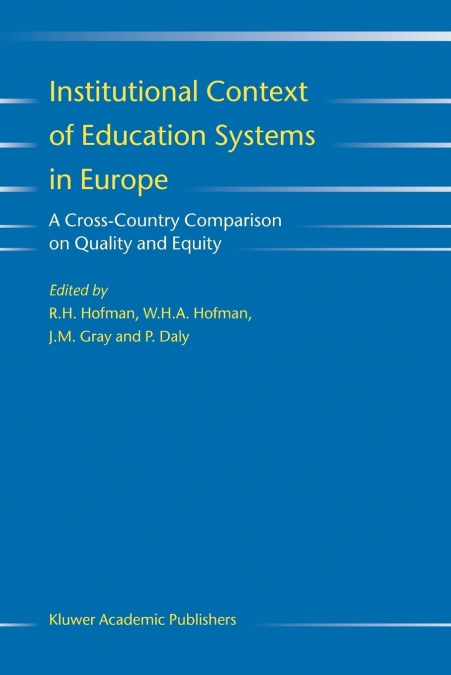
Preface.- About the editors.- Chapter 1 Institutional contexts and effectiveness of schooling.- 1.1 Introduction. 1.2 A conceptual presentation of assumed relationships. 1.3 Institutional contexts of education systems. 1.3.1 Public/private sector effects. 1.3.2 Type of funding of public and private education. 1.3.3 Governance of public and private education. 1.3.4 Choice and community in public and private education. 1.4 The within-country public/private sector model. 1.5 Objectives and design of the international project. 1.6 Acknowledgements. Chapter 2 Selection and definition of indicators.- 2.1 Introduction. 2.2 Selection and description of six indicators of institutional context. 2.2.1 Funding of schools. 2.2.2 Indicators of types of governance. 2.2.3 Indicators of freedom of school choice. Chapter 3 Country reports: education systems in Europe.- 3.1 Introduction. 3.2 Spain. 3.2.1 Country profile. 3.2.2 Characteristics of Spanish compulsory education. 3.2.3 Public and private schools: key characteristics. 3.3 Scotland. 3.3.1 Country profile.- 3.3.2 Characteristics of Scottish compulsory education. 3.3.3 Public and private schools: key characteristics. 3.4 Sweden. 3.4.1 Country profile. 3.4.2 Characteristics of Swedish compulsory education. 3.4.3 Public and private schools: key characteristics. 3.5 Portugal. 3.5.1. Country profile. 3.5.2 Characteristics of Portuguese compulsory education. 3.5.3 Public and private schools: key characteristics. 3.6 The Netherlands. 3.6.1 Country profile. 3.6.2 Characteristics of Dutch compulsory education. 3.6.3 Public and private education: key characteristics. 3.7 Ireland. 3.7.1 Country profile. 3.7.2 Characteristics of Irish compulsory education. 3.7.3 Public and private schools: key characteristics. 3.8 Germany. 3.8.1 Country profile. 3.8.2 Characteristics of German compulsory education. 3.8.3 Public and private schools: key characteristics. 3.9 France. 3.9.1 Country profile3.9.2 Characteristics of French compulsory education. 3.9.3 Public and private schools: key characteristics. 3.10 England. 3.10.1 Country profile. 3.10.2 Characteristics of compulsory education in England. 3.10.3 Public and private education: key characteristics. 3.11 Denmark. 3.11.1 Country profile. 3.11.2 Characteristics of Danish compulsory education. 3.11.3 Public and private schools: key characteristics. 3.12 Belgium (French).- 3.12.1 Country profile. 3.12.2 Characteristics of Belgium (French) compulsory education. 3.12.3 Public and private schools: key characteristics. 3.13 Belgium (Flemish). 3.13.1 Country profile. 3.13.2 Characteristics of Belgium (Flemish) compulsory education. 3.13.3 Public and private schools: key characteristics. 3.14 Austria. 3.14.1 Country profile. 3.14.2 Characteristics of Austrian compulsory education. 3.14.3 Public and private schools: key characteristics. Chapter 4 Quality and equity of European education.- 4.1 Introduction. 4.2 Distribution of public and private education. 4.3 Fair comparisons of public and private schools’ performance. 4.4 Choice of quality assessment criteria. 4.5 International comparison. 4.6 Overview of TIMSS mathematics assessment. 4.7 Methodology. 4.8 Comparison of quality and equity across European countries. 4.9 The outcomes within a broader perspective. 4.10 Interpreting our results in comparison to PISA outcomes. 4.11 Educational expenditure. Chapter 5 Configurations of institutional contexts.- 5.1 Introduction. 5.2 Configuration theory and multidimensional scaling. 5.3 Towards dimensions of institutional contexts. 5.4 Interpretation of configurations. 5.5 Four configurations of institutional contexts. 5.6 Public and private schools. Chapter 6 Reflections and explanations.- 6.1 Introduction. 6.2 Size and funding of public and private education. 6.2.1 Grant-aided private versus ’truly’ private education. 6.2.2 Selectivity of the country’s