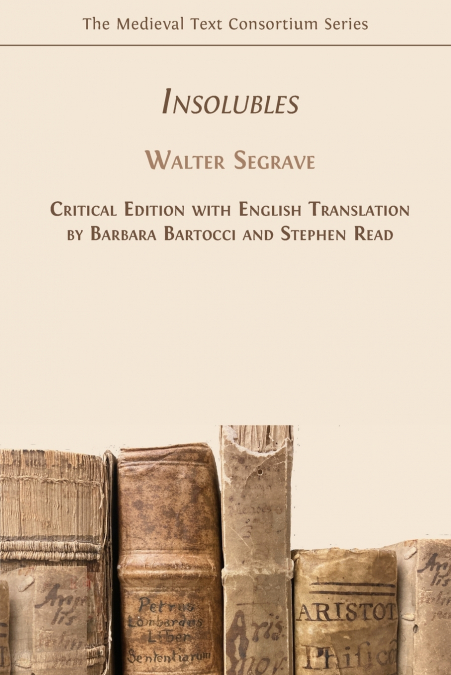

Insolubles

Insolubles

Walter Segrave

26,90 €
IVA incluido
Disponible
Editorial:
Open Book Publishers
Año de edición:
2024
Materia
Filosofía occidental: medieval y renacentista, c. 500-c. 1600
ISBN:
9781805110903
26,90 €
IVA incluido
Disponible

Selecciona una librería:

  • Librería Samer Atenea
  • Librería Aciertas (Toledo)
  • Kálamo Books
  • Librería Perelló (Valencia)
  • Librería Elías (Asturias)
  • Donde los libros
  • Librería Kolima (Madrid)
  • Librería Proteo (Málaga)

Paradoxes, such as the Liar (’What I am saying is false’), fascinated medieval thinkers. What I said can’t be true, for if it were, it would be false. So it must be false-but then it would be true after all. Attempts at a solution to this contradiction led such thinkers to develop their theories of meaning, reference and truth. A popular response, until it was attacked at length by Thomas Bradwardine in the early 1320s, was to dismiss such self-reference as impossible: no term (here, ’false’) could refer to (or in medieval terms, 'supposit for') a whole, e.g., a proposition, of which it is part. In light of Bradwardine’s criticisms, Walter Segrave, writing around 1330, defended so-called restrictivism (restrictio) by claiming that such paradoxes exhibited a fallacy of accident. The classic example of this fallacy, the first of Aristotle’s fallacies independent of language, is the Hidden Man puzzle: you know Coriscus, Coriscus is the one approaching, but you don’t know the one approaching since, e.g., he is wearing a mask. But Aristotle’s account is unclear and Segrave, building on ideas of Giles of Rome and Walter Burley, shows how the fallacy turns on an equivocation over the supposition of the middle term or one of the extremes in a syllogism. Thereby, Segrave is able to counter Bradwardine’s arguments one by one and defend the restrictivist solution. In this volume, Segrave’s text is edited from the three extant manuscripts, is translated into English, and is preceded by a substantial Introduction.
Artículos relacionados

  • Thomas Aquinas on Virtue
    Thomas M. Osborne Jr
    ...
    Disponible

    39,47 €

  • Aquinas on Efficient Causation and Causal Powers
    Gloria Frost
    ...
    Disponible

    39,43 €

  • The Prophet
    Khalil Gibran
    'You talk when you cease to be at peace with your thoughts.' ― Kahlil Gibran, The ProphetExperience the timeless wisdom and profound beauty of Kahlil Gibran’s masterpiece, The Prophet, in this special edition with illustrations from the original publication. The Prophet is not just a book; it is a spiritual journey that has captivated readers for generations, making it one of t...
  • The Prophet
    Khalil Gibran
    'You talk when you cease to be at peace with your thoughts.' ― Kahlil Gibran, The ProphetExperience the timeless wisdom and profound beauty of Kahlil Gibran’s masterpiece, The Prophet, in this special edition with illustrations from the original publication. The Prophet is not just a book; it is a spiritual journey that has captivated readers for generations, making it one of t...
    Disponible

    5,64 €

  • Unvollständig und unvollkommen
    Lidiane Alves de Souza
    Das Buch untersucht die Darstellungen des weiblichen Körpers im medizinischen Diskurs des 13. Jahrhunderts, indem es drei Gattungen medizinischer Literatur aus dieser Zeit analysiert: den medizinischen Kommentar des portugiesischen Physikers Pedro Hispano zur Isagoge des Johannitius, den Albert dem Großen zugeschriebenen Traktat De secretis mulierum und das ebenfalls von Pedro ...
    Disponible

    75,57 €

  • Incomplete and imperfect
    Lidiane Alves de Souza
    The book investigates the representations of women’s bodies produced by medical discourse in the 13th century by analysing three genres of medical literature produced in the period: the medical commentary on Johannitius’ Isagoge by the Portuguese physicist Pedro Hispano, the treatise attributed to Albert the Great entitled De secretis mulierum, and the prescription book Thesaur...
    Disponible

    75,62 €

Otros libros del autor

  • Insolubles
    Walter Segrave
    Paradoxes, such as the Liar (’What I am saying is false’), fascinated medieval thinkers. What I said can’t be true, for if it were, it would be false. So it must be false-but then it would be true after all. Attempts at a solution to this contradiction led such thinkers to develop their theories of meaning, reference and truth. A popular response, until it was attacked at lengt...