
Infrared Spectral Interpretation

Infrared Spectral Interpretation

Brian C. Smith

359,35 €
IVA incluido
Consulta disponibilidad
Editorial:
Taylor & Francis Ltd
Año de edición:
1998
Materia
Química industrial
ISBN:
9780849324635

Selecciona una librería:

  • Librería Samer Atenea
  • Librería Aciertas (Toledo)
  • Kálamo Books
  • Librería Perelló (Valencia)
  • Librería Elías (Asturias)
  • Donde los libros
  • Librería Kolima (Madrid)
  • Librería Proteo (Málaga)

Infrared Spectral Interpretation introduces the basic principles of interpreting infrared spectral data, teaching readers to make sense of the data axquired from an infrared spectrometer. Contents include spectra and diagnostic bands for the more common functional groups as well as details on over 30 unknown spectra, polyester spectra, and interpretation aids. Each chapter contains an introduction to the nomenclature and structure of a specific functional group and presents the important diagnostic bands for each group. With extensive illustrations, references, and a comprehensive glossary, this book serves both novices and experienced practitioners.

Artículos relacionados

  • Quantitative Structure-Activity Relationships in Drug Design, Predictive Toxicology, and Risk Assessment
    Kunal Roy
    Quantitative structure-activity relationships (QSARs) represent predictive models derived from the application of statistical tools correlating biological activity or other properties of chemicals with descriptors representative of molecular structure and/or property. Quantitative Structure-Activity Relationships in Drug Design, Predictive Toxicology, and Risk Assessment discus...
  • Chemical Compound Structures and the Higher Dimension of Molecules
    Gennadiy Vladimirovich Zhizhin
    Originally, scientists believed that molecules were three-dimensional; however, studies have proven that geometric dimensions are continuous. Therefore, molecules are able to have higher dimensions which influences how they interact with other molecules leading to advances in various fields including nanomedicine, nanotoxicology and quantum biology. Chemical Compound Structures...
  • CHEMICAL THERMODYNAMICS, 2ND EDITION
    Byung Chan Eu / BYUNG CHAN EU & MAZEN AL-GHOUL / EU BYUNG CHAN / Mazen Al-Ghoul
    This book enables the reader to learn, in a single volume, equilibrium and nonequilibrium thermodynamics as well as generalized forms of hydrodynamics for linear and nonlinear processes applied to various hydrodynamic flow processes — including chemical oscillation phenomena and pattern formations, shock wave phenomena, sound wave propagations, and Liesegang pattern formation, ...
  • CARBOHYDRATE CHEMISTRY
    ALEN RAIMO / Raimo Alen
     This book presents a comprehensive approach to the versatile and fascinating field of carbohydrate chemistry. It covers, besides the colorful historical perspective within the utilization of carbohydrates and their derivatives, all modern aspects on their properties, nomenclature, uses, and natural occurrence as such or as residues in a variety of biologically active molecules...
  • Recent Developments in Geopolymers and Alkali-Activated Materials
    Sujeong Lee
    We are compiling and publishing a collection of the latest research papers in the fields of Geopolymer and Alkali-Activated Materials (AAM). This compilation includes eight original research and two review papers covering a diverse range of topics, including various raw materials, manufacturing processes, and applications in the realms of Geopolymer and AAM. The publication aim...
  • Introduction to Chemical Engineering Fluid Mechanics
    William M. Deen
    ...

Otros libros del autor

  • Decentralization
    Brian C. Smith
    First published in 1985, Decentralization provides an analytical framework for the comparative study of decentralization in contemporary systems of government. ...
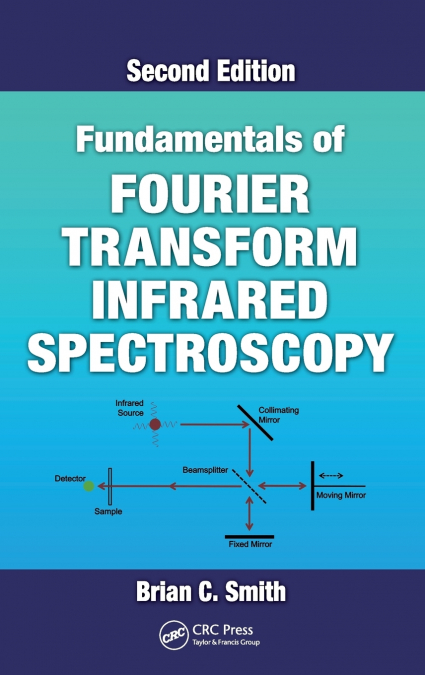
  • Fundamentals of Fourier Transform Infrared Spectroscopy
    Brian C. Smith
    Reflecting the myriad changes and advancements in the technologies involved in FTIR, particularly the development of diamond ATRs, this second edition is designed for those new to FTIR, but with enough reference material to appeal to journeymen and expert spectroscopists. It reviews the history, strengths, and weaknesses of FTIR as a chemical analysis technique, describes how a...