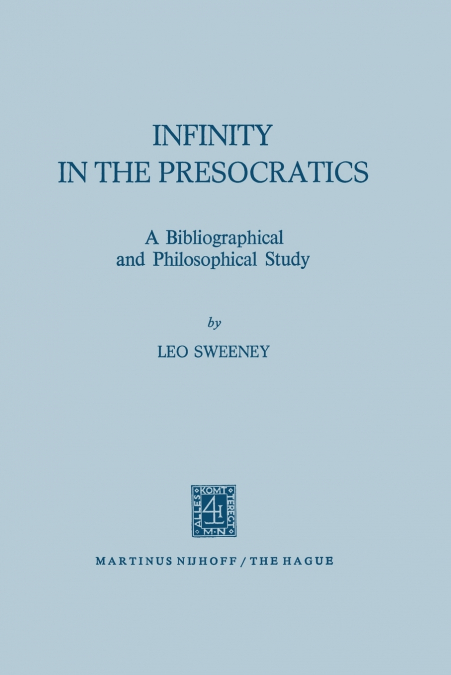

Infinity in the Presocratics

Infinity in the Presocratics

L. Sweeney

121,76 €
IVA incluido
Disponible
Editorial:
Springer Nature B.V.
Año de edición:
1972
Materia
Filosofía occidental: antigua, hasta c. 500
ISBN:
9789024711703
121,76 €
IVA incluido
Disponible

Selecciona una librería:

  • Librería Samer Atenea
  • Librería Aciertas (Toledo)
  • Kálamo Books
  • Librería Perelló (Valencia)
  • Librería Elías (Asturias)
  • Donde los libros
  • Librería Kolima (Madrid)
  • Librería Proteo (Málaga)

Throughout the long centuries of western metaphysics the problem of the infinite has kept surfacing in different but important ways. It had confronted Greek philosophical speculation from earliest times. It appeared in the definition of the divine attributed to Thales in Diogenes Laertius (I, 36) under the description 'that which has neither beginning nor end. ' It was presented on the scroll of Anaximander with enough precision to allow doxographers to transmit it in the technical terminology of the unlimited (apeiron) and the indeterminate (aoriston). The respective quanti­ tative and qualitative implications of these terms could hardly avoid causing trouble. The formation of the words, moreover, was clearly negative or privative in bearing. Yet in the philosophical framework the notion in its earliest use meant something highly positive, signifying fruitful content for the first principle of all the things that have positive status in the universe. These tensions could not help but make themselves felt through the course of later Greek thought. In one extreme the notion of the infinite was refined in a way that left it appropriated to the Aristotelian category of quantity. In Aristotle (Phys. III 6-8) it came to appear as essentially re­ quiring imperfection and lack. It meant the capacity for never-ending increase. It was always potential, never completely actualized.
Artículos relacionados

  • The Nature of Things
    Lucretius Lucretius
    De rerum natura (On the Nature of Things) is a 1st century BC didactic poem by the Roman poet and philosopher Lucretius with the goal of explaining Epicurean philosophy to a Roman audience. Lucretius presents the principles of atomism; the nature of the mind and soul; explanations of sensation and thought; the development of the world and its phenomena; and explains a variety o...
  • Pompeii
    Fergus Mason
    Pompeii was one of most advanced cities of its time; it had a complex water system, gymnasium, and an amphitheater. Despite it's advancements, there was one thing it wasn't ready for: Mount Vesuvius—the volcano that led to its ultimate doom.  The 79 AD eruption of Mount Vesuvius was one of the worst disasters in all of European history. In a near instant, over 15,000 p...
    Disponible

    10,36 €

  • Middle Platonism and Neoplatonism, Volume 1
    Stephen Gersh
    'It is generally agreed that those types of philosophy that are loosely called ’Platonic’ and ’Neoplatonic’ played a crucial role in the history of European culture during the centuries between antiquity and the Renaissance. However, until now no scholar has attempted to describe the evolution of these forms of thought in a single comprehensive academic study.' So writes Stephe...
  • Middle Platonism and Neoplatonism, Volume 2
    Stephen Gersh
    It is generally agreed that those types of philosophy that are loosely called 'Platonic' and 'Neoplatonic' played a crucial role in the history of European culture during the centuries between antiquity and the Middle Ages. However, until now no scholar has attempted to describe the evolution of these forms of thought in a single comprehensive academic study. Middle Platonism a...
  • Porphyry’s Commentary on Ptolemy’s Harmonics
    Andrew Barker
    ...
    Disponible

    77,17 €

  • The Roots of Platonism
    John Dillon
    ...
    Disponible

    25,29 €