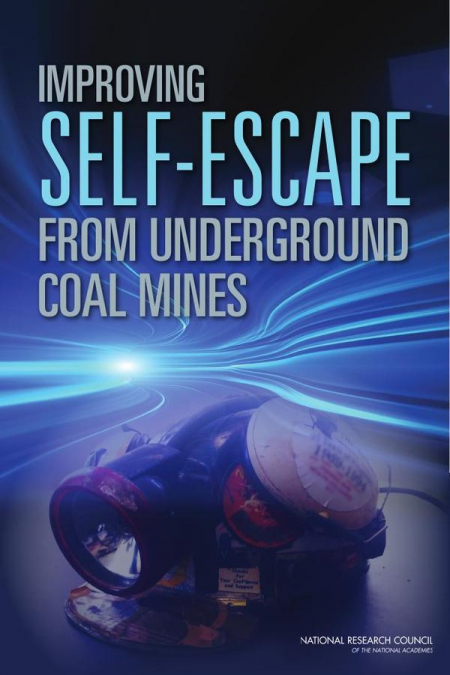

Improving Self-Escape from Underground Coal Mines

Improving Self-Escape from Underground Coal Mines

AA.VV

41,08 €
IVA incluido
Disponible
Editorial:
National Academies Press
Año de edición:
2013
Materia
Sociología del trabajo y el esfuerzo
ISBN:
9780309282765
41,08 €
IVA incluido
Disponible

Selecciona una librería:

  • Librería Samer Atenea
  • Librería Aciertas (Toledo)
  • Kálamo Books
  • Librería Perelló (Valencia)
  • Librería Elías (Asturias)
  • Donde los libros
  • Librería Kolima (Madrid)
  • Librería Proteo (Málaga)

Coal mine disasters in the United States are relatively rare events; many of the roughly 50,000 miners underground will never have to evacuate a mine in an emergency during their careers. However, for those that do, the consequences have the potential to be devastating. U.S. mine safety practices have received increased attention in recent years because of the highly publicized coal mine disasters in 2006 and 2010. Investigations have centered on understanding both how to prevent or mitigate emergencies and what capabilities are needed by miners to self-escape to a place of safety successfully. This report focuses on the latter - the preparations for self-escape. In the wake of 2006 disasters, the U.S. Congress passed the Mine Improvement and New Emergency Response Act of 2006 (MINER Act), which was designed to strengthen existing mine safety regulations and set forth new measures aimed at improving accident preparedness and emergency response in underground coal mines. Since that time, the efforts of the National Institute of Occupational Safety and Health (NIOSH) and the Mine Safety and Health Administration (MSHA) have contributed to safety improvements in the mining industry. However, the Upper Big Branch mine explosion in 2010 served as a reminder to remain ever vigilant on improving the prevention of mine disasters and preparations to help miners survive in the event of emergencies. This study was set in the context of human-systems integration (HSI), a systems approach that examines the interaction of people, tasks, and equipment and technology in the pursuit of a goal. It recognizes this interaction occurs within, and is influenced by, the broader environmental context. A key premise of human-systems integration is that much important information is lost when the various tasks within a system are considered individually or in isolation rather than in interaction with the whole system. Improving Self-Escape from Underground Coal Mines, the task of self-escape is part of the mine safety system.

Artículos relacionados

  • Les comptes des pauvres
    Jean-François Laé
    Bien avant la publication de L’Argent des pauvres aux éditions du Seuil, en 1985, une réception relativement élogieuse et consensuelle sur la vie quotidienne d’anciens habitants de bidonvilles relogés en cité de transit dans les années 1975/1982, une longue enquête fut nécessaire. Soit un ensemble de récits de terrain, des comptes mensuels en solde négatif, des acrobaties et se...
    Disponible

    24,44 €

  • Improving Measures of Science, Technology, and Innovation
    The National Center for Science and Engineering Statistics (NCSES), at the U.S. National Foundation, is 1 of 14 major statistical agencies in the federal government, of which at least 5 collect relevant information on science, technology, and innovation activities in the United States and abroad. The America COMPETES Reauthorization Act of 2010 expanded and codified NCSES’s rol...
    Disponible

    28,03 €

  • Blueprint for the Future
    The scientific work of women is often viewed through a national or regional lens, but given the growing worldwide connectivity of most, if not all, scientific disciplines, there needs to be recognition of how different social, political, and economic mechanisms impact women’s participation in the global scientific enterprise. Although these complex sociocultural factors often o...
    Disponible

    35,31 €

  • Building the U.S. Battery Industry for Electric Drive Vehicles
    Since 1991, the National Research Council, under the auspices of the Board on Science, Technology, and Economic Policy, has undertaken a program of activities to improve policymakers’ understandings of the interconnections of science, technology, and economic policy and their importance for the American economy and its international competitive position. The Board’s activities ...
    Disponible

    44,67 €

  • Intangible Assets
    Intangible assets—which include computer software, research and development (R&D), intellectual property, workforce training, and spending to raise the efficiency and brand identification of firms—comprise a subset of services, which, in turn, accounts for three-quarters of all economic activity. Increasingly, intangibles are a principal driver of the competitiveness of U.S.-ba...
    Disponible

    36,35 €

  • Rising Above the Gathering Storm
    In a world where advanced knowledge is widespread and low-cost labor is readily available, U.S. advantages in the marketplace and in science and technology have begun to erode. A comprehensive and coordinated federal effort is urgently needed to bolster U.S. competitiveness and pre-eminence in these areas. This congressionally requested report by a pre-eminent committee makes f...
    Disponible

    58,76 €