
Imagining the Witch

Imagining the Witch

Laura Kounine

147,56 €
IVA incluido
Consulta disponibilidad
Editorial:
Oxford University Press
Año de edición:
2019
Materia
Historia social y cultural
ISBN:
9780198799085

Selecciona una librería:

  • Librería Samer Atenea
  • Librería Aciertas (Toledo)
  • Kálamo Books
  • Librería Perelló (Valencia)
  • Librería Elías (Asturias)
  • Donde los libros
  • Librería Kolima (Madrid)
  • Librería Proteo (Málaga)

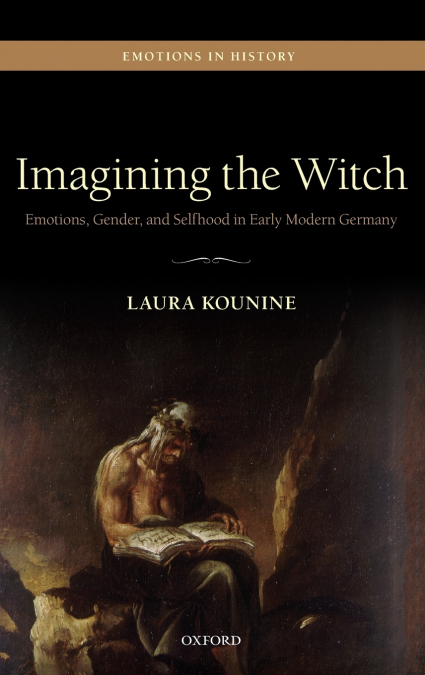
Imagining the Witch explores emotions, gender, and selfhood through the lens of witch-trials in early modern Germany. Witch-trials were clearly a gendered phenomenon, but witchcraft was not a uniquely female crime. While women constituted approximately three quarters of those tried for witchcraft in the Holy Roman Empire, a significant minority were men. Witchcraft was also a crime of unbridled passion: it centred on the notion that one person’s emotions could have tangible and deadly physical consequences. Yet it is also true that not all suspicions of witchcraft led to a formal accusation, and not all witch-trials led to the stake. Indeed, just over half the total number put on trial for witchcraft in early modern Europe were executed. In order to understand how early modern people imagined the witch, we must first begin to understand how people understood themselves and each other; this can help us to understand how the witch could be a member of the community, living alongside their accusers, yet inspire such visceral fear. Through an examination of case studies of witch-trials that took place in the early modern Lutheran duchy of Wurttemberg in southwestern Germany, Laura Kounine examines how the community, church, and the agents of the law sought to identify the witch, and the ways in which ordinary men and women fought for their lives in an attempt to avoid the stake. The study further explores the visual and intellectual imagination of witchcraft in this period in order to piece together why witchcraft could be aligned with such strong female stereotypes on the one hand, but also be imagined as a crime that could be committed by any human, whether young or old, male or female. By moving beyond stereotypes of the witch, Imagining the Witch argues that understandings of what constituted witchcraft and the ’witch’ appear far more contested and unstable than has previously been suggested. It also suggests new ways of thinking about early modern selfhood which moves beyond teleological arguments about the development of the ’modern’ self. Indeed, it is the trial process itself that created the conditions for a diverse range of people to reflect on, and give meaning, to emotions, gender, and the self in early modern Lutheran Germany.


Artículos relacionados

  • Arizal
    Raphael Afilalo
    The Ari overflowed with Torah. He was expert in Scripture, Mishnah, Talmud, Midrash, Maaseh Bereishit and Maaseh Merkavah. About all the different levels of prophecy, their details and from which level the prophets had their revelations.  He understood the whistling of the trees, the grass and stones, the language of the birds and other animals, the conversations of angels, the...
  • Rose-tinted Memory
    Michael S Fryer
    “Those who deny Auschwitz would be ready to remake it”.  ~ Primo Levi, Holocaust survivor and author Seventy years after the mass murder of the Jews of Europe, Holocaust denial and Holocaust revisionism are creeping into our overall perception of what actually happened.Christendom has not ‘denied’ Holocaust, but it has attempted to create a memory of Holocaust which suggests th...
    Disponible

    8,84 €

  • Pan Kapitan of Jordanow
    William Leibner
    Yeshayahu Drucker devoted a good part of his life to rescuing Jewish children from non-Jewish homes. Many parents had given their children to Polish neighbors for safekeeping during the war. Unfortunately most of the parents did not survive the Shoah. At the end of the war, there was no one to claim the children and they remained with the “adopted” Polish families. Following hi...
  • Holy Dissent
    Glenn Dynner
    BThe religious communities of early modern Eastern Europe—particularly those with a mystical bent—are typically studied in isolation. Yet the heavy Slavic imprint on Jewish popular mysticism and pervasive Judaizing tendencies among Christian dissenters call into question the presumed binary quality of Jewish-Christian interactions. In Holy Dissent: Jewish and Christian Mystics ...
  • AL-FARD
    Ali Mahdi Muhammad
    The Al-Fard, or the The Dawn, has captured the early rays of Our history. This history is essential if we are to be brought face to face with the One true and living God of the universe. The purpose of this writing is to bring the reader step by step, one degree at a time to the reality of God in person. The teachings of Our Father elevates the believer to the level of Godhood ...
  • Wild Things. Nature and the Social Imagination
    HISTORIES OF HUMAN CONSTRUCTIONS OF NATUREWild Things: Nature and the Social Imagination assembles eleven substantive and original essays on the cultural and social dimensions of environmental history. They address a global cornucopia of social and ecological systems, from Africa to Europe, North America and the Caribbean, and their temporal range extends from the 1830s into th...