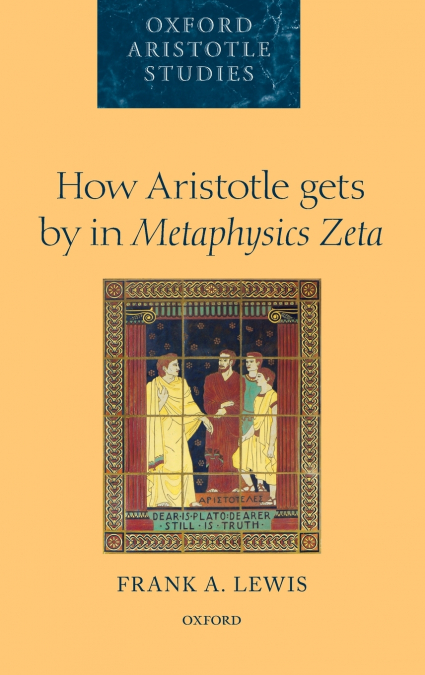

How Aristotle Gets by in Metaphysics Zeta

How Aristotle Gets by in Metaphysics Zeta

Frank A Lewis

186,51 €
IVA incluido
Disponible
Editorial:
Oxford University Press
Año de edición:
2013
Materia
Filosofía occidental: antigua, hasta c. 500
ISBN:
9780199664016
186,51 €
IVA incluido
Disponible

Selecciona una librería:

  • Librería Samer Atenea
  • Librería Aciertas (Toledo)
  • Kálamo Books
  • Librería Perelló (Valencia)
  • Librería Elías (Asturias)
  • Donde los libros
  • Librería Kolima (Madrid)
  • Librería Proteo (Málaga)

Frank A. Lewis presents a closely argued exposition of Metaphysics Zeta--one of Aristotle’s most dense and controversial texts. It is commonly understood to contain Aristotle’s deepest thoughts on the definition of substance and surrounding metaphysical issues. But people have increasingly come to recognize how little Aristotle says in Zeta about his own theory of (Aristotelian) form and matter. Instead, he spends the bulk of the book examining ’received opinions’, often as filtered through his own Organon, but including above all the views of Plato, who is at times friend, and at times foe. For much of the time, we are left to reconstruct Aristotle’s finished views, subject to the constraint that they survive the critique he directs in Zeta at the philosophical tradition. In this book, Lewis argues that in giving his actual conclusion to Zeta in its final chapter, 17, Aristotle drops his earlier, largely critical engagement with received views, and turns approvingly to his own Posterior Analytics. The result is a causal view of (primary) substance, representing the property of being a (primary) substance (or the substance of a thing) as, in modern dress, the second-order functional property of (Aristotelian) forms, that they be the cause of being for different compound material substances. The property of being the cause of being for a thing is a role property, and it is realized in different forms and the sets of causal powers associated with them, matching the variety of things that have a form as their substance. Meanwhile, the failure of previous attempts at definition in earlier chapters leaves Aristotle’s own definition standing as the ’best explanation’ for the views proprietary to the theory of form and matter. The point that (Aristotelian) forms are the primary substances is not the main conclusion to Zeta, but rather a result his definition must give, if the definition is to be acceptable.

Artículos relacionados

  • The Nature of Things
    Lucretius Lucretius
    De rerum natura (On the Nature of Things) is a 1st century BC didactic poem by the Roman poet and philosopher Lucretius with the goal of explaining Epicurean philosophy to a Roman audience. Lucretius presents the principles of atomism; the nature of the mind and soul; explanations of sensation and thought; the development of the world and its phenomena; and explains a variety o...
    Disponible

    36,76 €

  • Pompeii
    Fergus Mason
    Pompeii was one of most advanced cities of its time; it had a complex water system, gymnasium, and an amphitheater. Despite it's advancements, there was one thing it wasn't ready for: Mount Vesuvius—the volcano that led to its ultimate doom.  The 79 AD eruption of Mount Vesuvius was one of the worst disasters in all of European history. In a near instant, over 15,000 p...
    Disponible

    10,36 €

  • Middle Platonism and Neoplatonism, Volume 1
    Stephen Gersh
    'It is generally agreed that those types of philosophy that are loosely called ’Platonic’ and ’Neoplatonic’ played a crucial role in the history of European culture during the centuries between antiquity and the Renaissance. However, until now no scholar has attempted to describe the evolution of these forms of thought in a single comprehensive academic study.' So writes Stephe...
    Disponible

    179,17 €

  • Middle Platonism and Neoplatonism, Volume 2
    Stephen Gersh
    It is generally agreed that those types of philosophy that are loosely called 'Platonic' and 'Neoplatonic' played a crucial role in the history of European culture during the centuries between antiquity and the Middle Ages. However, until now no scholar has attempted to describe the evolution of these forms of thought in a single comprehensive academic study. Middle Platonism a...
    Disponible

    215,18 €

  • Porphyry’s Commentary on Ptolemy’s Harmonics
    Andrew Barker
    ...
    Disponible

    77,17 €

  • The Roots of Platonism
    John Dillon
    ...
    Disponible

    25,29 €