
Inicio > Sociedad y ciencias sociales > Educación pedagogía > Higher Education in the BRICS Countries
Higher Education in the BRICS Countries

Higher Education in the BRICS Countries


132,86 €
IVA incluido
Disponible
Editorial:
Springer Nature B.V.
Año de edición:
2016
Materia
Educación pedagogía
ISBN:
9789402400144
132,86 €
IVA incluido
Disponible

Selecciona una librería:

  • Librería Samer Atenea
  • Librería Aciertas (Toledo)
  • Kálamo Books
  • Librería Perelló (Valencia)
  • Librería Elías (Asturias)
  • Donde los libros
  • Librería Kolima (Madrid)
  • Librería Proteo (Málaga)

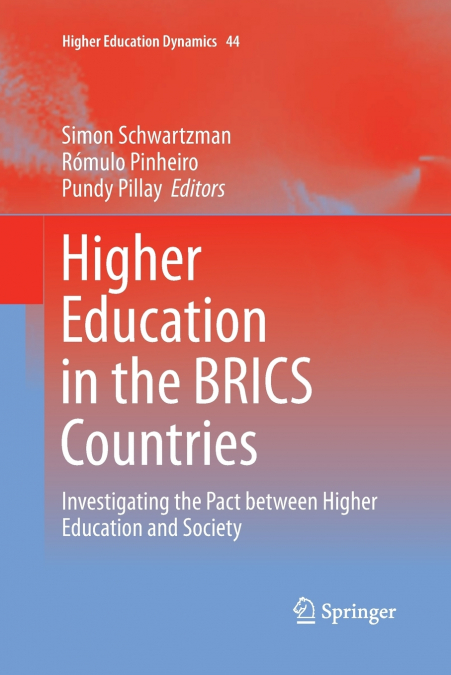
In spite of the increasing attention attributed to the rise in prominence of the BRICS (Brazil, Russia, India, China and South Africa) countries, few studies have looked at the ways in which broader social expectations with respect to the role of higher education across the BRICS have changed, or not, in recent years. Our point of departure is that, contrary to the conventional wisdom focusing on functionalistic perspectives, higher education systems are not just designed by governments to fulfill certain functions, but have a tendency for evolving in a rather unpredictable fashion as a result of the complex interplay between a number of internal and external factors. In reality, national higher education systems develop and change according to a complex process that encompasses the expectations of governmental agencies, markets, the aspirations of the population for the benefits of education, the specific institutional traditions and cultures of higher education institutions, and, increasingly so, the interests and strategies of the private firms entering and offering services in the higher education market. This basically means that it is of outmost importance to move away from conceiving of 'universities' or 'higher education' as single, monolithic actors or sector. One way of doing this is by investigating a selected number of distinct, but nonetheless interrelated factors or drivers, which, taken together, help determine the nature and scope of the social compact between higher education (its core actors and institutions) and society at large (government, industry, local communities, professional associations).

Artículos relacionados

  • Beekeeping At The End Of The Earth
    Mark David Leech
    Beekeeping at the End of the Earth, an essential read for learning about beekeeping in a cool temperate climate with a focus on Tasmania our island home.  One hundred beekeepers one hundred different ways to keep bees.Beekeeping At The End Of The Earth is a practical insight into cool climate beekeeping with a focus on Tasmania, our island home.Richly illustrated with unique di...
    Disponible

    45,16 €

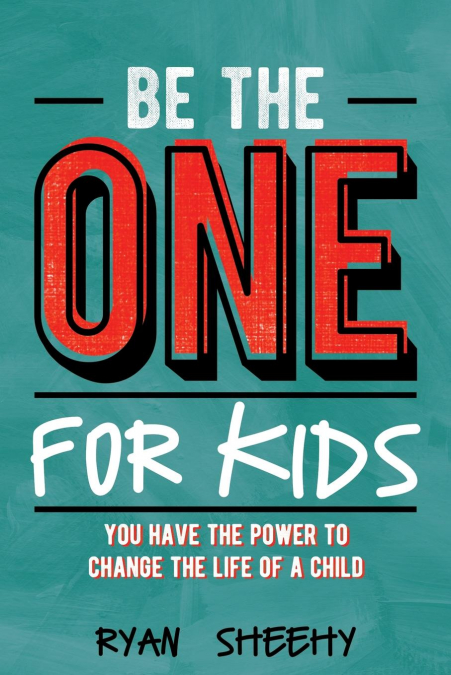
  • Be the One for Kids
    Ryan Sheehy
    One person can make a difference.That person can be you. “I want to show others that one person can make the difference in a child’s life. I want all educators, parents, coaches, and everyone in between to know they have power to Be the One for Kids.” —Ryan Sheehy If you ever feel like you’re all alone or think that no one gets you, just imagine how your students feel. Kids wan...
    Disponible

    27,99 €

  • Handbook of Research on E-Learning Standards and Interoperability
    As the e-learning industry continues to expand and the methods and tools necessary to create and maintain content and infrastructure applications become more complicated, there is an inherent need for these applications to interoperate and exchange data in order to better support the needs of learners and educators. Handbook of Research on E-Learning Standards and Interoperabil...
  • Teaching in the Knowledge Society
    Antonio Cartelli
    ...
  • Enhancing Learning Through Human Computer Interaction
    Elspeth McKay
    ...
  • Learning Objects for Instruction
    Pamela Taylor Northrup
    ...