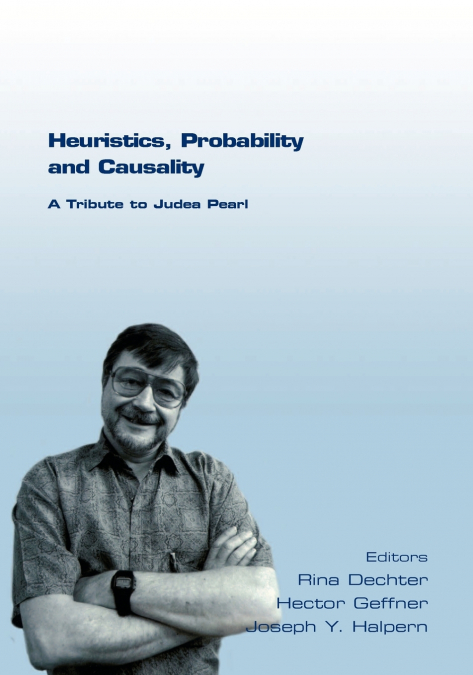

Inicio > > Ciencias de la computación > Inteligencia artificial > Heuristics, Probability and Causality. a Tribute to Judea Pearl
Heuristics, Probability and Causality. a Tribute to Judea Pearl

Heuristics, Probability and Causality. a Tribute to Judea Pearl


41,18 €
IVA incluido
Disponible
Editorial:
College Publications
Año de edición:
2010
Materia
Inteligencia artificial
ISBN:
9781904987659
41,18 €
IVA incluido
Disponible

Selecciona una librería:

  • Librería Samer Atenea
  • Librería Aciertas (Toledo)
  • Kálamo Books
  • Librería Perelló (Valencia)
  • Librería Elías (Asturias)
  • Donde los libros
  • Librería Kolima (Madrid)
  • Librería Proteo (Málaga)

The field of Artificial Intelligence has changed a great deal sincethe 80s, and arguably no one has played a larger role in thatchange than Judea Pearl. Judea Pearl’s work made probabilitythe prevailing language of modern AI and, perhaps moresignificantly, it placed the elaboration of crisp and meaningfulmodels, and of effective computational mechanisms, at thecenter of AI research. This book is a collection of articles inhonor of Judea Pearl, written by close colleagues and formerstudents. Its three main parts, heuristics, probabilisticreasoning, and causality, correspond to the titles of the threeground-breaking books authored by Judea, and are followed bya section of short reminiscences.In this volume, leading authors look at the state of the art inthe fields of heuristic, probabilistic, and causal reasoning, inlight of Judea’s seminal contributors. The authors list includeBlai Bonet, Eric Hansen, Robert Holte, Jonathan Schaeffer,Ariel Felner, Richard Korf, Austin Parker, Dana Nau, V. S.Subrahmanian, Hector Geffner, Ira Pohl, Adnan Darwiche,Thomas Dean, Rina Dechter, Bozhena Bidyuk, RobertMatescu, Emma Rollon, Michael I. Jordan, Michael Kearns,Daphne Koller, Brian Milch, Stuart Russell, Azaria Paz, DavidPoole, Ingrid Zukerman, Carlos Brito, Philip Dawid, Felix Elwert,Christopher Winship, Michael Gelfond, Nelson Rushton,Moises Goldszmidt, Sander Greenland, Joseph Y. Halpern,Christopher Hitchcock, David Heckerman, Ross Shachter,Vladimir Lifschitz, Thomas Richardson, James Robins, YoavShoham, Peter Spirtes, Clark Glymour, Richard Scheines,Robert Tillman, Wolfgang Spohn, Jian Tian, Ilya Shpitser, NilsNilsson, Edward T. Purcell, and David Spiegelhalter.
Artículos relacionados

  • Artificial Cognition Systems
    ...
  • Cross-Disciplinary Applications of Artificial Intelligence and Pattern Recognition
    Vijay Kumar Mago
    The need for intelligent machines in areas such as medical diagnostics, biometric security systems, and image processing motivates researchers to develop and explore new techniques, algorithms, and applications in this evolving field. Cross-Disciplinary Applications of Artificial Intelligence and Pattern Recognition: Advancing Technologies provides a common platform for researc...
  • Emerging Applications of Natural Language Processing
    Over the last few years, the area of Natural Language Processing has drastically grown in recognition, not only within the research and development community, but also with industry professionals. As NLP continues to be discussed and researched, certain areas continue to grow and mature. As a result, the need for advanced research and information is in high demand. Emerging App...
  • Androids, Cyborgs, and Robots in Contemporary Culture and Society
    Steven John Thompson
    Mankind’s dependence on artificial intelligence and robotics is increasing rapidly as technology becomes more advanced. Finding a way to seamlessly intertwine these two worlds will help boost productivity in society and aid in a variety of ways in modern civilization. Androids, Cyborgs, and Robots in Contemporary Culture and Society is an essential scholarly resource that delve...
  • Deep Learning Innovations and Their Convergence With Big Data
    The expansion of digital data has transformed various sectors of business such as healthcare, industrial manufacturing, and transportation. A new way of solving business problems has emerged through the use of machine learning techniques in conjunction with big data analytics. Deep Learning Innovations and Their Convergence With Big Data is a pivotal reference for the latest sc...
  • Computational Psychoanalysis and Formal Bi-Logic Frameworks
    Giuseppe Iurato
    Computational psychoanalysis is a new field stemming from Freudian psychoanalysis. The new area aims to understand the primary formal structures and running mechanisms of the unconscious while implementing them into computer sciences. Computational Psychoanalysis and Formal Bi-Logic Frameworks provides emerging information on this new field which uses psychoanalysis and the unc...