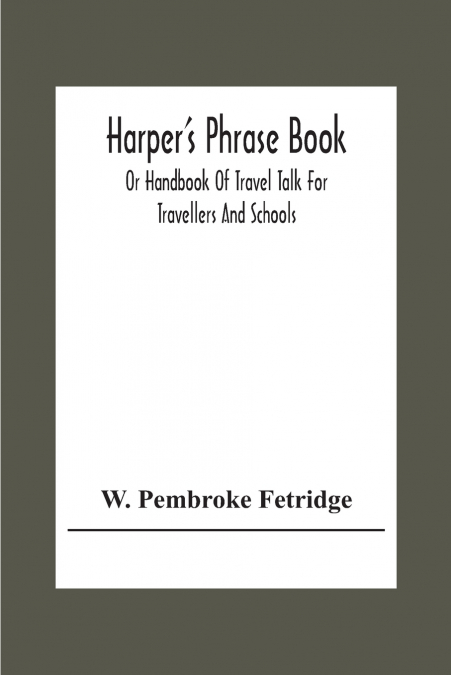
W. Pembroke Fetridge / WPEMBROKE FETRIDGE
 Librería Samer Atenea
 Kálamo Books
 Librería Elías (Asturias)
 Librería Kolima (Madrid)
 Librería Proteo (Málaga)
Speak with confidence across borders.Harper’s Phrase Book is an enduring multilingual phrasebook and travel conversation guide by Pembroke Fetridge, prepared for travellers and schools who needed clear, usable language in English, French, German and Italian. Essential phrases for every journey. Practical travel phrases are presented with economy and care so that a few lines can lift a conversation or settle a small misunderstanding; the tone is plain, the instruction direct. Designed as a language learning aid and a school language resource as well as a classic travel companion, it offers travellers and students an efficient bridge between tongues - the sort of vintage language reference that rewards both quick consultation and slow study. Read in its own historical light, the phrase book also captures how social politeness and practical necessity shaped speech in nineteenth-century Europe.Republished by Alpha Editions in a careful modern edition, this volume preserves the spirit of the original while making it effortless to enjoy today - a heritage title prepared for readers and collectors alike. As a Victorian language handbook and classic travel companion, Harper’s stands at the meeting point of education and movement: a plain-speaking mirror of an age when European travel was becoming commonplace and conversation a travel essential. Rendered with respect for original phrasing and idiom, the modern edition invites both everyday use and thoughtful study. Casual readers and modern travellers will appreciate its immediate, pragmatic usefulness; classic-literature collectors and cultural historians will prize it as a vintage language reference and evocative school language resource. Bibliophiles assembling shelves of nineteenth-century Europe will recognise it among their european travel essentials; newcomers to classic travel literature will encounter a living record of how ordinary people managed conversation across borders. Whether used as a practical primer before a trip or kept as part of a curated library of nineteenth-century Europe, it restores an accessible piece of linguistic history.