
Handbuch des Museumsrechts 4

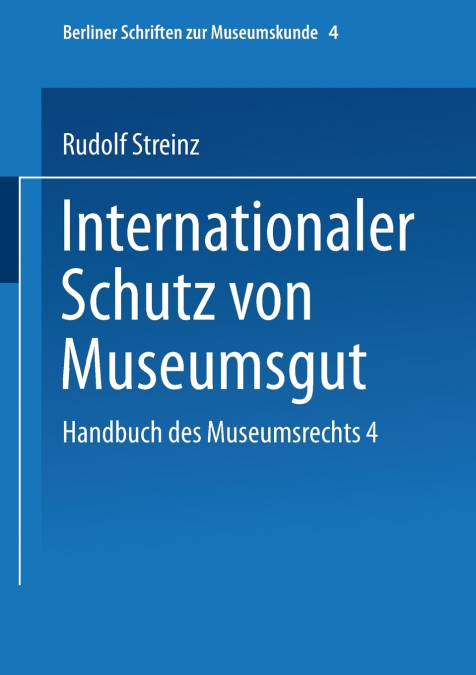
Handbuch des Museumsrechts 4

Rudolf Streinz

71,84 €
IVA incluido
Disponible
Editorial:
Springer Nature B.V.
Año de edición:
1998
Materia
Sociedad y cultura: general
ISBN:
9783810011749
71,84 €
IVA incluido
Disponible

Selecciona una librería:

  • Librería Samer Atenea
  • Librería Aciertas (Toledo)
  • Kálamo Books
  • Librería Perelló (Valencia)
  • Librería Elías (Asturias)
  • Donde los libros
  • Librería Kolima (Madrid)
  • Librería Proteo (Málaga)

Das vorliegende Buch 'Internationaler Schutz von Museumsgut' ist ein Band aus der Reihe 'Handbuch des Museumsrechts'. Die Reihe wird vom Institut für Museumskunde der Staatlichen Museen zu Ber­ lin - Preußischer Kulturbesitz - herausgegeben. Sie war auf sechs Bände angelegt, die u.a. folgende Rechtsbereiche abhandeln: Arbeitsrecht Privatrecht Zivilrecht Sozialrecht Internationales Recht und Öffentliches Recht. Die Reihe wendet sich an die Museumsmitarbeiter, denen damit ein Nachschlagewerk an die Hand gegeben wird, das die juristischen Pro­ bleme der Praxis in verständlicher Form darstellt. Berücksichtigt wurde vor allem, daß es sich bei den Mitarbeitern der Museen in der Regel nicht um juristisch vorgebildete Personen handelt, die bei ihrer täglichen Arbeit jedoch mit einer Fülle rechtlicher Fragen konfrontiert werden. Die Reihe legt daher besonderen Wert auf eine anschauliche und didaktisch klare Aufbereitung der relevanten Rechtsfragen. Zu diesem Zwecke werden die juristischen Inhalte jeweils an Hand von einfachen und gängigen Beispielen der Museumspraxis erläutert. Auf eine wissenschaftliche Diskussion wurde bewußt verzichtet. Ziel der Reihe ist es, das Problembewußtsein zu schärfen und Ver­ ständnis für juristische Zusammenhänge zu wecken, ohne dabei den Anspruch zu erheben, eine juristische Ausbildung ersetzen zu können. Die einzelnen Teilbände dieser Reihe sollen den nicht juristisch vor­ gebildeten Museumspraktiker in die Lage versetzen, typische und ein­ fach gelagerte Fragen selbst zu entscheiden, gleichzeitig aber auch zu erkennen, wo qualifizierter Rechtsrat eingeholt werden muß.

Artículos relacionados

  • The Gandhian Iceberg
    Chris D Moore-Backman
    The Gandhian Iceberg presents a bold, new interpretation of Gandhian nonviolence from the rare perspective of an author who is equal parts writer, scholar, and frontlines practitioner. The book faces the current crisis of climate change and the intensification of social unrest around the world, and calls for a new convergence of serious, spiritually-rooted US nonviolence activi...
    Disponible

    11,52 €

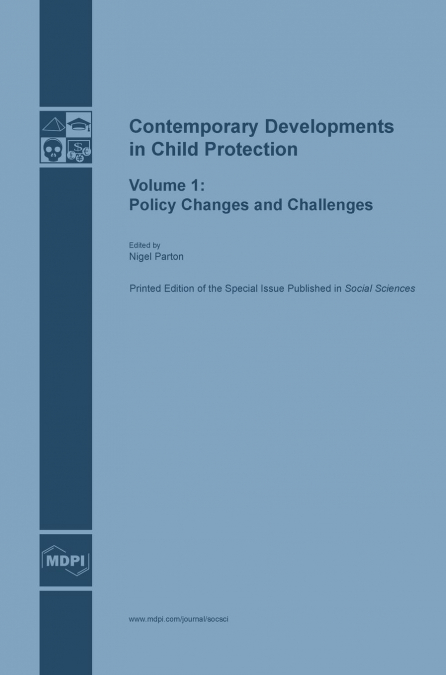
  • Contemporary Developments in Child Protection
    Nigel Parton
    Volume 1 "Policy Changes and Challenges" takes as its central theme the ongoing and challenging issues which child protection agencies have to address and the policy and practice initiatives that are developed to try and address these. The volume includes papers on: the relationship between the decline in the rate of ‘unnatural’ deaths and the growth of concern about child abus...
  • Diversity in Information Technology Education
    Goran Trajkovski
    ...
  • Model-Driven Software Development
    Model-driven software development (MDSD) drastically alters the software development process, characterized by a high degree of innovation and productivity. However, quality assurance application in the domain of software models and model-driven software development is still in an emergent phase. Model-Driven Software Development: Integrating Quality Assurance provides in-depth...
  • Evidence-Based Practice in Nursing Informatics
    Andrew Chasin
    Because of the constant advances and dynamics within the nascent field of nursing informatics, many nurses struggle in practice as they continue to try and apply habitual communication practices in the new environment without any critical reflection on, and adaptation of, those practices. Evidence-Based Practice in Nursing Informatics: Concepts and Applications serves as a valu...
  • Actor-Network Theory and Technology Innovation
    Arthur Tatnall
    About 25 years ago, the first developments of ANT (Actor-Network Theory) took place, but it wasn’t until much later that researchers began to take it seriously. In the late 1990s, ANT began to take hold in the scientific community as a new and exciting approach to socio-technical research and social theory. Actor-Network Theory and Technology Innovation: Advancements and New Co...