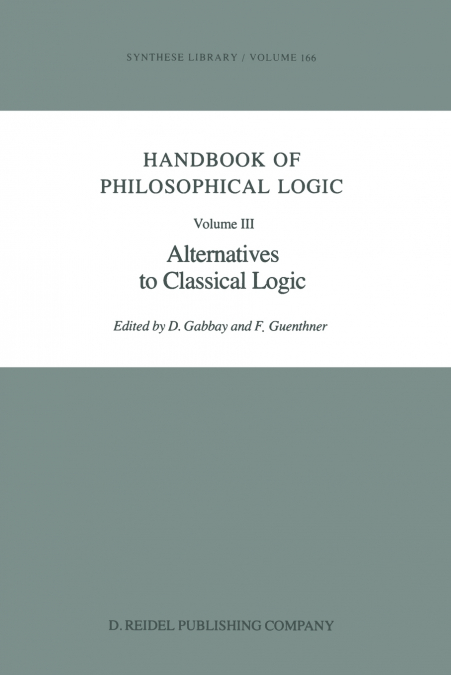

Handbook of Philosophical Logic

Handbook of Philosophical Logic


65,10 €
IVA incluido
Disponible
Editorial:
Springer Nature B.V.
Año de edición:
2011
Materia
Influencia de la ciencia y la tecnología sobre la sociedad
ISBN:
9789401088015
65,10 €
IVA incluido
Disponible

Selecciona una librería:

  • Librería Samer Atenea
  • Librería Aciertas (Toledo)
  • Kálamo Books
  • Librería Perelló (Valencia)
  • Librería Elías (Asturias)
  • Donde los libros
  • Librería Kolima (Madrid)
  • Librería Proteo (Málaga)

This volume presents a number of systems of logic which can be considered as alternatives to classical logic. The notion of what counts as an alternative is a somewhat problematic one. There are extreme views on the matter of what is the ’correct’ logical system and whether one logical system (e. g. classical logic) can represent (or contain) all the others. The choice of the systems presented in this volume was guided by the following criteria for including a logic as an alternative: (i) the departure from classical logic in accepting or rejecting certain theorems of classical logic following intuitions arising from significant application areas and/or from human reasoning; (ii) the alternative logic is well-established and well-understood mathematically and is widely applied in other disciplines such as mathematics, physics, computer science, philosophy, psychology, or linguistics. A number of other alternatives had to be omitted for the present volume (e. g. recent attempts to formulate so-called ’non-monotonic’ reason­ ing systems). Perhaps these can be included in future extensions of the Handbook of Philosophical Logic. Chapter 1 deals with partial logics, that is, systems where sentences do not always have to be either true or false, and where terms do not always have to denote. These systems are thus, in general, geared towards reasoning in partially specified models. Logics of this type have arisen mainly from philo­ sophical and linguistic considerations; various applications in theoretical computer science have also been envisaged.
Artículos relacionados

  • Interactive Media Use and Youth
    Modern advancements in technology have changed the way that young people use interactive media. Learning from such methods was not even considered until recently. It is now slowly defining the landscape of contemporary pedagogical practices. Interactive Media Use and Youth: Learning, Knowledge Exchange and Behavior provides a comprehensive collection of knowledge based on diffe...
  • Social and Economic Effects of Community Wireless Networks and Infrastructures
    Abdelaal
    It is surprising to think that in today’s rapidly evolving world of technology, over half of the globe still does not have access to high speed internet. Creating community wireless networks has in the past been a way to provide remote communities with internet and network access. Social and Economic Effects of Community Wireless Networks and Infrastructures highlights the succ...
  • The New Atlantis
    Francis Bacon
    In this work, Bacon portrayed a vision of the future of human discovery and knowledge, expressing his aspirations and ideals for humankind. The novel depicts the creation of a utopian land where 'generosity and enlightenment, dignity and splendour, piety and public spirit' are the commonly held qualities of the inhabitants of 'Bensalem'. ...
  • Sport 2.0
    Andy Miah
    ...
    Disponible

    28,86 €

  • Productivity Machines
    Corinna Schlombs
    ...
    Disponible

    48,52 €

  • Open Space
    Mariel Borowitz
    ...
    Disponible

    38,25 €