
GWAI-84

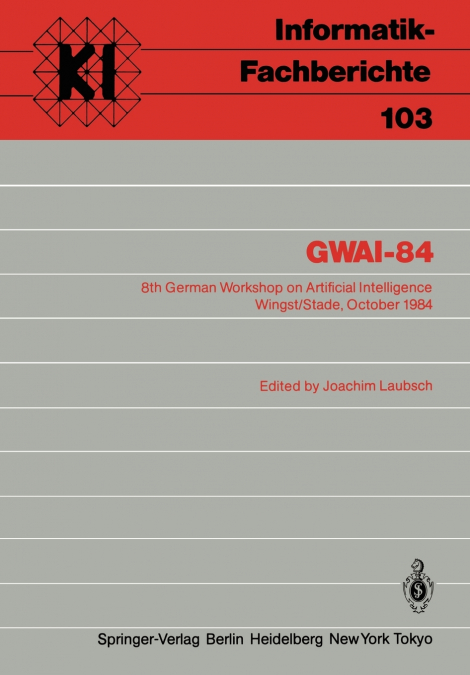
GWAI-84

Joachim Laubsch

133,89 €
IVA incluido
Disponible
Editorial:
Springer Nature B.V.
Año de edición:
1985
Materia
Inteligencia artificial
ISBN:
9783540156697
133,89 €
IVA incluido
Disponible

Selecciona una librería:

  • Librería Samer Atenea
  • Librería Aciertas (Toledo)
  • Kálamo Books
  • Librería Perelló (Valencia)
  • Librería Elías (Asturias)
  • Donde los libros
  • Librería Kolima (Madrid)
  • Librería Proteo (Málaga)

GWAI-84, die achte deutsche Fachtagung iiber Kiinstliche InteIligenz, fand yom 8. bis 12. Oktober 1984 im Wikings Inn in Wingst/Stade statt. Sie wurde von etwa 130 Teilnehmern besucht. Der vorliegende Band enthalt 19 Beitrage (darunter fiinf eingeladene Ubersichtsbeitriige) aus verschiedenen Bereichen der Kiinstlichen InteIligenz-Forschung (KI). Vertreten sind diesmal die Bereiche Wissensbasierte Systeme, natiirlichsprachliche Systeme, Bildverstehen, KI-Pro­ grammierung, Logik, Lernen und Heuristik. Uber den in der Bundesrepublik Deutschland innerhalb der KI bisher wenig beachteten Bereich der kognitiven Modellierung (Cognitive Science) informiert ein eingeladener Ubersichtsbeitrag. Wir hoffen, daB hierdurch ein AnstoB zu intensiverer Forschung auf diesem interdiszipliniir ausgerichteten Bereich gegeben wird. Es reflektiert wohl auch den Entwicklungsstand der deutschen KI, daB die meisten Beitriige aus dem Bereich der natiirlichsprachlichen Systeme kommen. Hier hat sich die zunehmend engere Beziehung zwischen theoretischer Linguistik und KI als sehr fruchtbar erwiesen. Dieses VerhiUtnis zu durchleuchten, war Thema eines Panels. Die Beitriige der Teilnehmer sowie eine Zusammenfassung der Diskussion wurden in den Tagungsband aufgenommen. Erfreulich ist die relativ groBe internationale Beteiligung an der GWAI-84. Die Anzahl der deutschen KI-Forscher ist immer noch relativ klein. Es scheint, daB diese wenigen auBerdem so stark mit Management-Aufgaben fiir Verbund-, ESPRIT -und andere Projekte belastet sind, daB in der eher grundlagenorientierten KI-Forschung eine Liicke zu entstehen droht.
Artículos relacionados

  • Artificial Cognition Systems
    ...
  • Cross-Disciplinary Applications of Artificial Intelligence and Pattern Recognition
    Vijay Kumar Mago
    The need for intelligent machines in areas such as medical diagnostics, biometric security systems, and image processing motivates researchers to develop and explore new techniques, algorithms, and applications in this evolving field. Cross-Disciplinary Applications of Artificial Intelligence and Pattern Recognition: Advancing Technologies provides a common platform for researc...
  • Emerging Applications of Natural Language Processing
    Over the last few years, the area of Natural Language Processing has drastically grown in recognition, not only within the research and development community, but also with industry professionals. As NLP continues to be discussed and researched, certain areas continue to grow and mature. As a result, the need for advanced research and information is in high demand. Emerging App...
  • Androids, Cyborgs, and Robots in Contemporary Culture and Society
    Steven John Thompson
    Mankind’s dependence on artificial intelligence and robotics is increasing rapidly as technology becomes more advanced. Finding a way to seamlessly intertwine these two worlds will help boost productivity in society and aid in a variety of ways in modern civilization. Androids, Cyborgs, and Robots in Contemporary Culture and Society is an essential scholarly resource that delve...
  • Deep Learning Innovations and Their Convergence With Big Data
    The expansion of digital data has transformed various sectors of business such as healthcare, industrial manufacturing, and transportation. A new way of solving business problems has emerged through the use of machine learning techniques in conjunction with big data analytics. Deep Learning Innovations and Their Convergence With Big Data is a pivotal reference for the latest sc...
  • Computational Psychoanalysis and Formal Bi-Logic Frameworks
    Giuseppe Iurato
    Computational psychoanalysis is a new field stemming from Freudian psychoanalysis. The new area aims to understand the primary formal structures and running mechanisms of the unconscious while implementing them into computer sciences. Computational Psychoanalysis and Formal Bi-Logic Frameworks provides emerging information on this new field which uses psychoanalysis and the unc...