 Librería Samer Atenea
 Kálamo Books
 Librería Elías (Asturias)
 Librería Kolima (Madrid)
 Librería Proteo (Málaga)
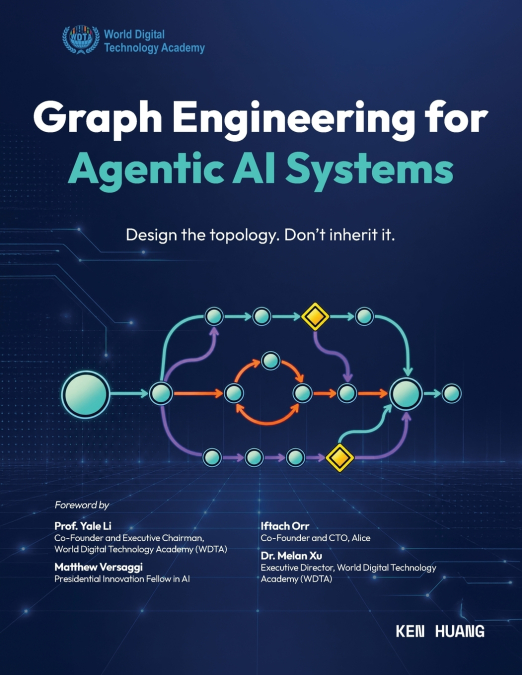
Design reliable agentic AI systems with explicit graph topology, controlled multi-agent orchestration, knowledge graph memory, and verifiable execution pathsKey Features:- Choose agent orchestration patterns that justify their complexity and cost- Apply graph design through worked examples, chapter exercises, and companion code- Test workflow paths, recovery behavior, and approval gates before agents take actionBook Description:Agentic AI systems need more than capable models: they need clear rules for how work runs. Graph Engineering for Agentic AI Systems helps you design that structure, starting with when a single-agent loop is enough and when multi-agent orchestration earns its complexity. Distinguish execution graphs, knowledge graphs, and learned graphs, then explore typed state, routing, parallel fan-out and joins, and human approval gates. Compare runtimes including LangGraph, Google ADK, Microsoft Agent Framework, and the OpenAI Agents SDK.Worked examples, chapter exercises, and companion code connect architecture to implementation. Explore knowledge graph memory and GraphRAG, checkpointing, bounded retries, idempotency, and production observability. Examine permissions and authorization boundaries, then evaluate execution traces, node contracts, and stop conditions. By the end, you’ll be equipped to design, test, and operate agent workflows with explicit topology, controlled side effects, and traceable decisions.What You Will Learn:- Choose when to keep an agent loop or introduce a graph- Design typed state, routing, parallel fan-out, and joins- Compare agent runtimes for orchestration and persistence- Build knowledge graph memory with typed, traceable facts- Operate workflows with checkpoints, retries, and idempotency- Verify execution paths, permissions, and human approval gatesWho this book is for:This book is for AI engineers, LLM application developers, software architects, and platform engineers building agent workflows beyond the prototype stage. Security engineers will also benefit from its treatment of agent identity, authorization, and approval boundaries. Familiarity with Python, LLM applications, and software architecture will help you engage with the code examples and exercises.Table of Contents- Graph Engineering Is Topology You Own- Execution Graphs and Memory Graphs- The Graph Under the Harness- Anatomy of an Agent Graph- When Not to Build a Graph- Patterns That Earn Their Nodes- Frameworks You Can Ship an Agent Graph On- Knowledge Graphs as Memory- Operating Graphs in Production- The Computer Science of Agent Graphs- Security, Identity, and Governance of Agent Graphs- Graph Intelligence Is Not the Runtime- Testing, Evaluation, and Verification of Agent Graphs- Keep the Graph After the Name Fades