 Librería Samer Atenea
 Kálamo Books
 Librería Elías (Asturias)
 Librería Kolima (Madrid)
 Librería Proteo (Málaga)
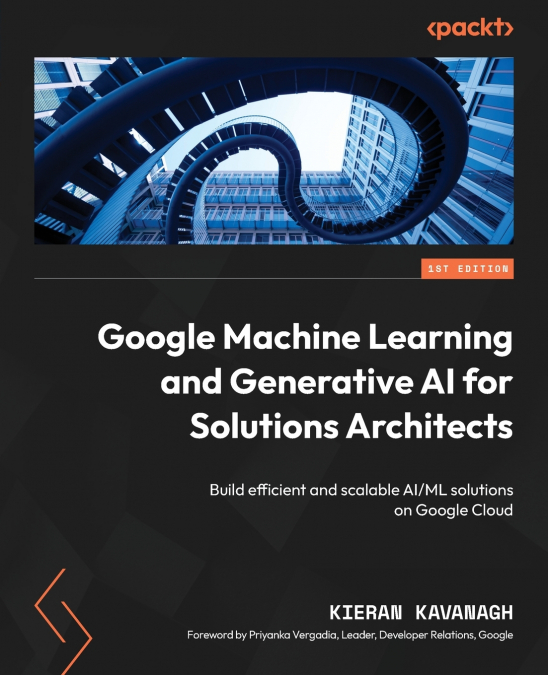
Architect and run real-world AI/ML solutions at scale on Google Cloud, and discover best practices to address common industry challenges effectivelyKey Features:- Understand key concepts, from fundamentals through to complex topics, via a methodical approach- Build real-world end-to-end MLOps solutions and generative AI applications on Google Cloud- Get your hands on a code repository with over 20 hands-on projects for all stages of the ML model development lifecycle- Purchase of the print or Kindle book includes a free PDF eBookBook Description:Most companies today are incorporating AI/ML into their businesses. Building and running apps utilizing AI/ML effectively is tough. This book, authored by a principal architect with about two decades of industry experience, who has led cross-functional teams to design, plan, implement, and govern enterprise cloud strategies, shows you exactly how to design and run AI/ML workloads successfully using years of experience from some of the world’s leading tech companies.You’ll get a clear understanding of essential fundamental AI/ML concepts, before moving on to complex topics with the help of examples and hands-on activities. This will help you explore advanced, cutting-edge AI/ML applications that address real-world use cases in today’s market. You’ll recognize the common challenges that companies face when implementing AI/ML workloads, and discover industry-proven best practices to overcome these. The chapters also teach you about the vast AI/ML landscape on Google Cloud and how to implement all the steps needed in a typical AI/ML project. You’ll use services such as BigQuery to prepare data; Vertex AI to train, deploy, monitor, and scale models in production; as well as MLOps to automate the entire process.By the end of this book, you will be able to unlock the full potential of Google Cloud’s AI/ML offerings.What You Will Learn:- Build solutions with open-source offerings on Google Cloud, such as TensorFlow, PyTorch, and Spark- Source, understand, and prepare data for ML workloads- Build, train, and deploy ML models on Google Cloud- Create an effective MLOps strategy and implement MLOps workloads on Google Cloud- Discover common challenges in typical AI/ML projects and get solutions from experts- Explore vector databases and their importance in Generative AI applications- Uncover new Gen AI patterns such as Retrieval Augmented Generation (RAG), agents, and agentic workflowsWho this book is for:This book is for aspiring solutions architects looking to design and implement AI/ML solutions on Google Cloud. Although this book is suitable for both beginners and experienced practitioners, basic knowledge of Python and ML concepts is required. The book focuses on how AI/ML is used in the real world on Google Cloud. It briefly covers the basics at the beginning to establish a baseline for you, but it does not go into depth on the underlying mathematical concepts that are readily available in academic material.Table of Contents- AI/ML Concepts, Real-World Applications, and Challenges- Understanding the ML Model Development Lifecycle- AI/ML Tooling and the Google Cloud AI/ML Landscape- Utilizing Google Cloud’s High-Level AI Services- Building Custom ML Models on Google Cloud- Diving Deeper-Preparing and Processing Data for AI/ML Workloads on Google Cloud- Feature Engineering and Dimensionality Reduction- Hyperparameters and Optimization- Neural Networks and Deep Learning- Deploying, Monitoring, and Scaling in Production- Machine Learning Engineering and MLOps with GCP(N.B. Please use the Read Sample option to see further chapters)