
Inicio > > Ciencias de la computación > Inteligencia artificial > Geophysical Applications of Artificial Neural Networks and Fuzzy Logic
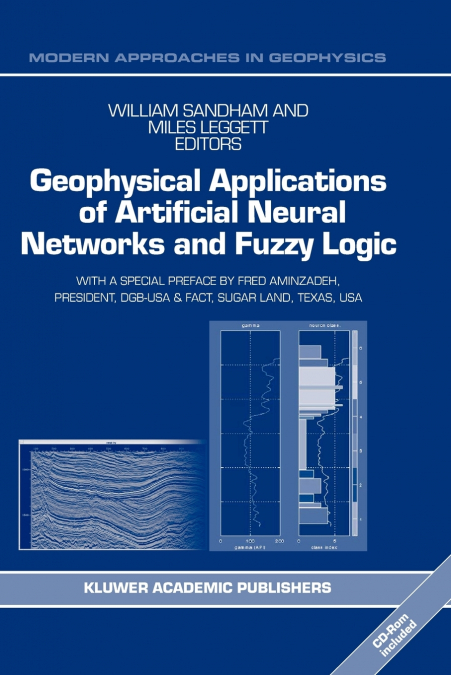
Geophysical Applications of Artificial Neural Networks and Fuzzy Logic

Geophysical Applications of Artificial Neural Networks and Fuzzy Logic


133,62 €
IVA incluido
Disponible
Editorial:
Springer Nature B.V.
Año de edición:
2010
Materia
Inteligencia artificial
ISBN:
9789048164769
133,62 €
IVA incluido
Disponible

Selecciona una librería:

  • Librería Samer Atenea
  • Librería Aciertas (Toledo)
  • Kálamo Books
  • Librería Perelló (Valencia)
  • Librería Elías (Asturias)
  • Donde los libros
  • Librería Kolima (Madrid)
  • Librería Proteo (Málaga)

The past fifteen years has witnessed an explosive growth in the fundamental research and applications of artificial neural networks (ANNs) and fuzzy logic (FL). The main impetus behind this growth has been the ability of such methods to offer solutions not amenable to conventional techniques, particularly in application domains involving pattern recognition, prediction and control. Although the origins of ANNs and FL may be traced back to the 1940s and 1960s, respectively, the most rapid progress has only been achieved in the last fifteen years. This has been due to significant theoretical advances in our understanding of ANNs and FL, complemented by major technological developments in high-speed computing. In geophysics, ANNs and FL have enjoyed significant success and are now employed routinely in the following areas (amongst others): 1. Exploration Seismology. (a) Seismic data processing (trace editing; first break picking; deconvolution and multiple suppression; wavelet estimation; velocity analysis; noise identification/reduction; statics analysis; dataset matching/prediction, attenuation), (b) AVO analysis, (c) Chimneys, (d) Compression I dimensionality reduction, (e) Shear-wave analysis, (f) Interpretation (event tracking; lithology prediction and well-log analysis; prospect appraisal; hydrocarbon prediction; inversion; reservoir characterisation; quality assessment; tomography). 2. Earthquake Seismology and Subterranean Nuclear Explosions. 3. Mineral Exploration. 4. Electromagnetic I Potential Field Exploration. (a) Electromagnetic methods, (b) Potential field methods, (c) Ground penetrating radar, (d) Remote sensing, (e) inversion.


Artículos relacionados

  • Artificial Cognition Systems
    ...
  • Cross-Disciplinary Applications of Artificial Intelligence and Pattern Recognition
    Vijay Kumar Mago
    The need for intelligent machines in areas such as medical diagnostics, biometric security systems, and image processing motivates researchers to develop and explore new techniques, algorithms, and applications in this evolving field. Cross-Disciplinary Applications of Artificial Intelligence and Pattern Recognition: Advancing Technologies provides a common platform for researc...
  • Emerging Applications of Natural Language Processing
    Over the last few years, the area of Natural Language Processing has drastically grown in recognition, not only within the research and development community, but also with industry professionals. As NLP continues to be discussed and researched, certain areas continue to grow and mature. As a result, the need for advanced research and information is in high demand. Emerging App...
  • Androids, Cyborgs, and Robots in Contemporary Culture and Society
    Steven John Thompson
    Mankind’s dependence on artificial intelligence and robotics is increasing rapidly as technology becomes more advanced. Finding a way to seamlessly intertwine these two worlds will help boost productivity in society and aid in a variety of ways in modern civilization. Androids, Cyborgs, and Robots in Contemporary Culture and Society is an essential scholarly resource that delve...
  • Deep Learning Innovations and Their Convergence With Big Data
    The expansion of digital data has transformed various sectors of business such as healthcare, industrial manufacturing, and transportation. A new way of solving business problems has emerged through the use of machine learning techniques in conjunction with big data analytics. Deep Learning Innovations and Their Convergence With Big Data is a pivotal reference for the latest sc...
  • Computational Psychoanalysis and Formal Bi-Logic Frameworks
    Giuseppe Iurato
    Computational psychoanalysis is a new field stemming from Freudian psychoanalysis. The new area aims to understand the primary formal structures and running mechanisms of the unconscious while implementing them into computer sciences. Computational Psychoanalysis and Formal Bi-Logic Frameworks provides emerging information on this new field which uses psychoanalysis and the unc...