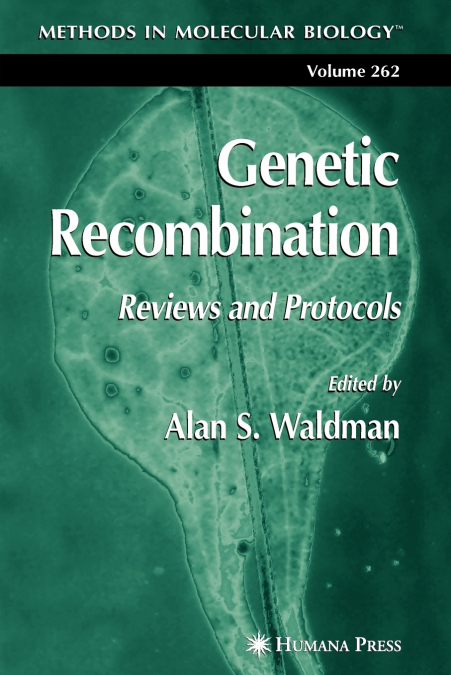

Genetic Recombination

Genetic Recombination

Alan S. Waldman

184,17 €
IVA incluido
Disponible
Editorial:
Springer Nature B.V.
Año de edición:
2010
Materia
Biología celular (citología)
ISBN:
9781617374425
184,17 €
IVA incluido
Disponible

Selecciona una librería:

  • Librería Samer Atenea
  • Librería Aciertas (Toledo)
  • Kálamo Books
  • Librería Perelló (Valencia)
  • Librería Elías (Asturias)
  • Donde los libros
  • Librería Kolima (Madrid)
  • Librería Proteo (Málaga)

Genetic recombination, in the broadest sense, can be defined as any process in which DNA sequences interact and undergo a transfer of information, producing new 'recombinant' sequences that contain information from each of the original molecules. All organisms have the ability to carry out recombination, and this striking universality speaks to the essential role recombination plays in a variety of biological processes fundamentally important to the maintenance of life. Such processes include DNA repair, regulation of gene expression, disease etiology, meiotic chromosome segregation, and evolution. One important aspect of recombination is that it typically occurs only between sequences that display a high degree of sequence identity. The stringent requirement for homology helps to ensure that, under normal circumstances, a cell is protected from deleterious rearrangements since a swap of genetic information between two nearly identical sequences is not expected to dramatically alter a genome. Recombination between dissimilar sequences, which does happen on occasion, may have such harmful consequences as chromosomal translocations, deletions, or inversions. For many organisms, it is also important that recombination rates are not too high lest the genome become destabilized. Curiously, certain organisms, such as the trypanosome parasite, actually use a high rate of recombination at a particular locus in order to switch antigen expression continually and evade the host immune system effectively.
Artículos relacionados

  • Sex and the Origins of Death
    William R. Clark
    ...
    Disponible

    56,65 €

  • The Way of the Cell
    Franklin M. Harold
    ...
    Disponible

    29,88 €

  • Haematopoietic and Lymphoid Cell Culture
    Margaret J. Dallman / Margaret JDallman
    ...
    Disponible

    81,61 €

  • Mitochondria
    Douglas C Wallace / Richard J Youle
    'A subject collection from Cold Spring Harbor perspectives in biology.' ...
  • Organelle and Molecular Targeting
    Drugs must be delivered to the target tissue or, better yet, the target organelles. A more specific target minimizes toxicity and side effects and maximizes therapeutic effect. This book is a comprehensive review of Organelle Targeting. ...
  • How Life is Different
    Vitaly Shubin
    The book examines basic principles of the structure and organization of living organisms and their differences from objects of inanimate nature. It is shown how a single program-information structure permeates all evolutionary stages of life, including the cell, multicellular organisms and humans. ...

Otros libros del autor

  • Genetic Recombination
    Alan S. Waldman
    Genetic recombination, in the broadest sense, can be defined as any process in which DNA sequences interact and undergo a transfer of information, producing new 'recombinant' sequences that contain information from each of the original molecules. All organisms have the ability to carry out recombination, and this striking universality speaks to the es...