
Inicio > Matemáticas y ciencia > Física > > Astrofísica > Gauge Theory and the Early Universe
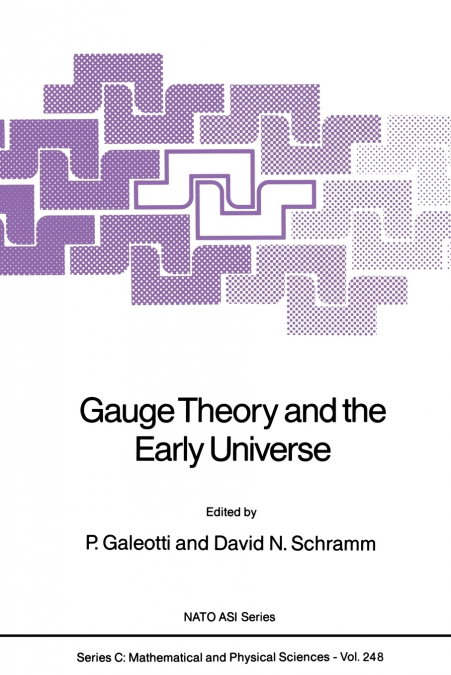
Gauge Theory and the Early Universe

Gauge Theory and the Early Universe


65,80 €
IVA incluido
Disponible
Editorial:
Springer Nature B.V.
Año de edición:
2011
Materia
Astrofísica
ISBN:
9789401078764
65,80 €
IVA incluido
Disponible

Selecciona una librería:

  • Librería Samer Atenea
  • Librería Aciertas (Toledo)
  • Kálamo Books
  • Librería Perelló (Valencia)
  • Librería Elías (Asturias)
  • Donde los libros
  • Librería Kolima (Madrid)
  • Librería Proteo (Málaga)

P. de Bernardis, S. Masi , G. Moreno Dipartimento di Fisica, Universita’ 'La Sapienza' 00184 Roma Italy ABSTRACT. Anisotropy measurement techniques and results are reviewed, with special attention given to experimental problems. The cosmological relevance of the dipole anisotropy, the only anisotropy truly detected in the Cosmic Background Radiation, is discussed. 1. INTRODUCTION Anisotropy of the Cosmic Background Radiation at 2.7 K (CBR hereafter) is a cosmological topic with a wide range of applications. In order to define anisotropy let us consider fig. 1 a, where the celestial sphere is shown with two beams A and B, with beamwidth 0 and angular separation e. We define the anisotropy of CBR at angular scale e in terms of the difference i’2,1 between the CBR flux I(ex,u) measured in the two beams. At small angular scales (el° a deterministic approach is preferred, and the CBR flux I(ex, S) is expressed as a sum of spherical harmonics (2) I (ex, S) = I ~ aIm Y (ex, S) lm I,m The alm coefficients give the dipole, quadrupole and higher order components of the anisotropy. 257 P. Galeotti and D. N. Schramm (eds.), Gauge Theory and the Early Universe, 257-282.

Artículos relacionados

  • Mars Colonization
    Randy Jones
    Life as we know it has always been confined to our single blue planet called earth. But will it always be that way? Discover just how close we are to changing life as we know it forever, and what it will take to push humanity into a new era of exploration and discovery. Find out how the next steps for our future will be unlike anything civilization as we know it has experienced...
    Disponible

    16,03 €

  • Predicting the Eclipse
    Stephen Wolfram
    Total eclipses of the Sun are rare and dramatic--and on April 8, 2024, one will cross the US. But when exactly will it happen? In this short but richly illustrated book, prominent scientist and computation pioneer Stephen Wolfram tells the triumphant and hard-won story--spanning more than two thousand years--of how science, mathematics and computation have brought us to the poi...
    Disponible

    13,52 €

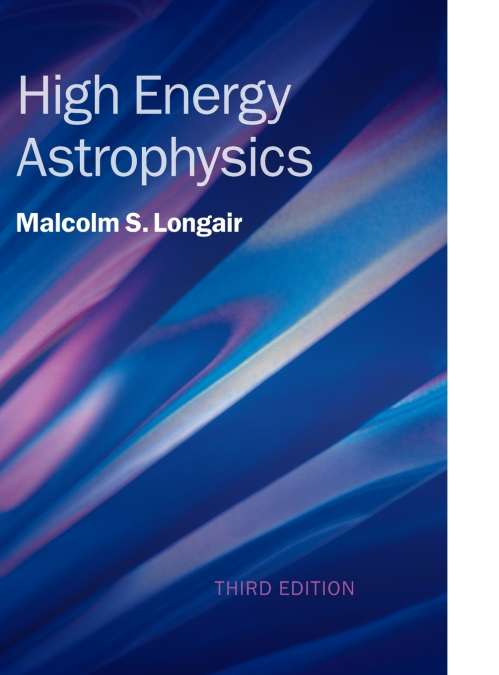
  • High Energy Astrophysics
    Malcolm S. Longair
    Providing students with an in-depth account of the astrophysics of high energy phenomena in the Universe, the third edition of this well-established textbook is ideal for advanced undergraduate and beginning graduate courses in high energy astrophysics. Building on the concepts and techniques taught in standard undergraduate courses, this textbook provides the astronomical and ...
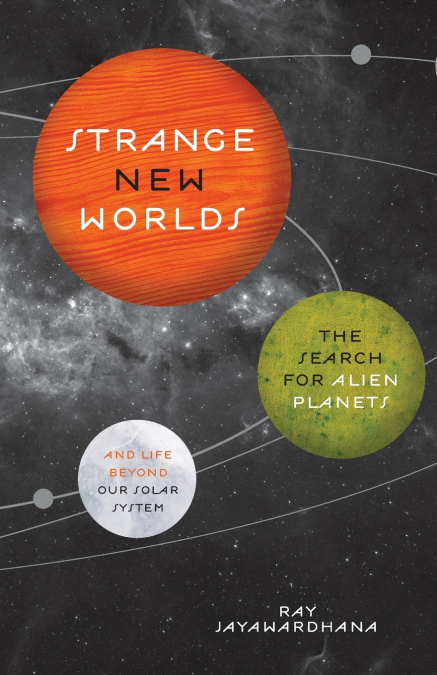
  • Strange New Worlds
    Ray Jayawardhana
    An insider’s look at the cutting-edge science of today’s planet huntersIn Strange New Worlds, renowned astronomer Ray Jayawardhana brings news from the front lines of the epic quest to find planets-and alien life-beyond our solar system. Only in the past two decades, after millennia of speculation, have astronomers begun to discover planets around other stars-thousands in fact....
    Disponible

    29,12 €

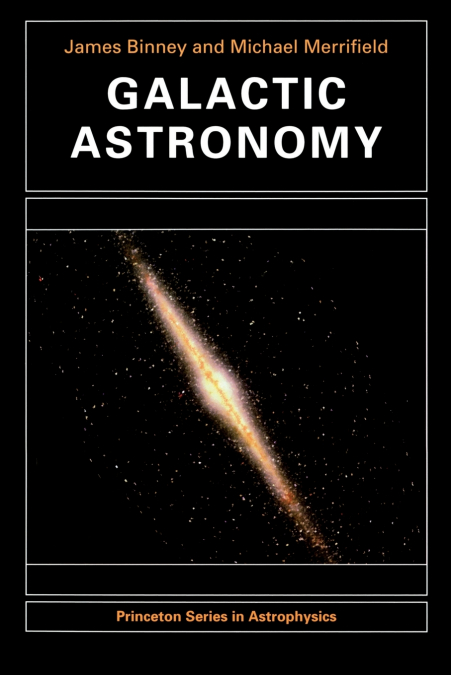
  • Galactic Astronomy
    James Binney / Michael Merrifield
    This is the definitive treatment of the phenomenology of galaxies--a clear and comprehensive volume that takes full account of the extraordinary recent advances in the field. The book supersedes the classic text Galactic Astronomy that James Binney wrote with Dimitri Mihalas, and complements Galactic Dynamics by Binney and Scott Tremaine. It will be invaluable to researchers an...
    Disponible

    155,26 €

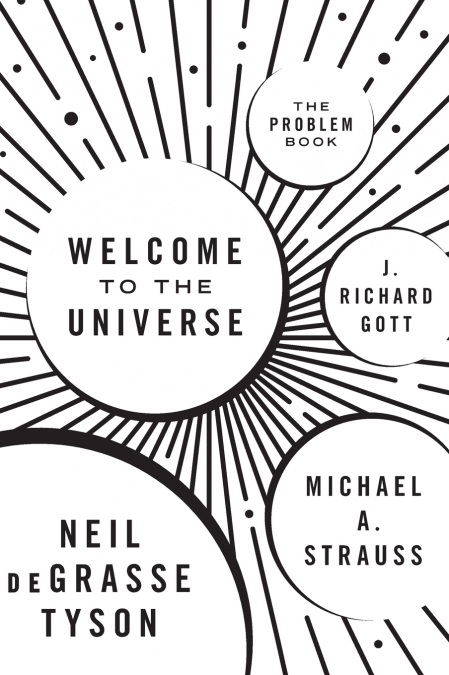
  • Welcome to the Universe
    J. Richard Gott / Michael A. Strauss / Neil deGrasse Tyson
    An essential companion to the New York Times bestseller Welcome to the UniverseHere is the essential companion to Welcome to the Universe, a New York Times bestseller that was inspired by the enormously popular introductory astronomy course for non science majors that Neil deGrasse Tyson, Michael A. Strauss, and J. Richard Gott taught together at Princeton. This problem book fe...