
From the Banana Zones to the Big Easy

From the Banana Zones to the Big Easy

From the Banana Zones to the Big Easy

Glenn A Chambers

48,72 €
IVA incluido
Disponible
Editorial:
Louisiana State University Press
Año de edición:
2019
Materia
Historia de América
ISBN:
9780807170496
48,72 €
IVA incluido
Disponible

Selecciona una librería:

  • Librería Samer Atenea
  • Librería Aciertas (Toledo)
  • Kálamo Books
  • Librería Perelló (Valencia)
  • Librería Elías (Asturias)
  • Donde los libros
  • Librería Kolima (Madrid)
  • Librería Proteo (Málaga)

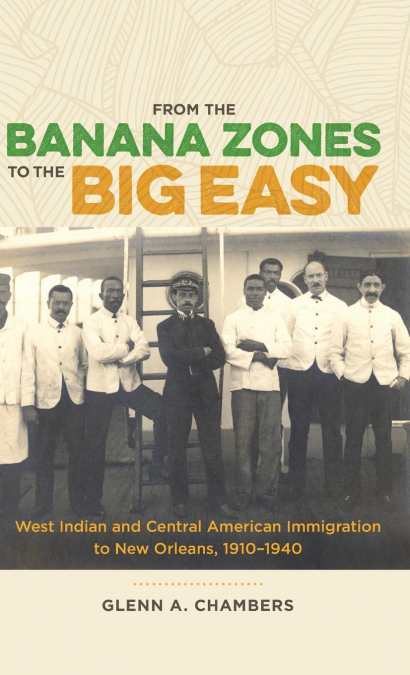
From the Banana Zones to the Big Easy focuses on the immigration of West Indians and Central Americans--particularly those of British West Indian descent from the Caribbean coastal areas--to New Orleans from the turn of the twentieth century to the start of World War II. Glenn A. Chambers discerns the methods by which these individuals of diverse racial and ethnic backgrounds integrated into New Orleans society and negotiated their distinct historical and ethnoracial identities in the Jim Crow South. Throughout this study, Chambers explores two central questions: What did it mean to be 'West Indian' within a context in which the persons migrating--or their parents, in some cases--were not born in the West Indies? And how did Central Americans grapple with this 'West Indian' cultural identity when their political identity (citizenship) was Honduran, Costa Rican, or Panamanian? Chambers maintains that a distinct West Indian culture did not emerge in New Orleans. Rather, newly arrived West Indian practices intertwined with existing African American traditions, a process intensified in New Orleans's established climate of incorporating, and often absorbing, new peoples and cultures.The West Indian population in early twentieth-century New Orleans was truly transnational, multinational, multilingual, diasporic, and constantly evolving. These newcomers to New Orleans remained conscious of their West Indian roots but were not bound by them. Their experiences spanned nations but were not politically internationalist, as was the case with the larger West Indian communities in the northeastern United States. The ways in which individuals and families transitioned into U.S. constructions of race were at times the result of conscious decisions. In other instances, race was determined by the realities of everyday life in the Jim Crow South, in which whiteness translated into access and opportunity and all other ethnicities were relegated to a subordinate position. Many West Indians and Central Americans impacted by this system learned to navigate it in such a way that their ethnic and national identity all but disappeared from the historical record.Through an analysis of arrest records, ships' passenger records, foreign consulate reports, draft registrations, declarations of intent to apply for citizenship, naturalization applications, and city directories, Chambers recovers the lives of a small but significant population of immigrants who challenged the racial status quo.

Artículos relacionados

  • Pan-Africanism and Education
    Kenneth J. King / Kenneth JKing
    This is an analysis of the complex links between Black America and Africa in the period of 1880 to 1945. It examines an extended white attempt to pattern politics and education in colonial Africa upon the example of the U.S. South. This export of United States race relations to Africa was resisted by Black intellectuals in the United States and many of the early nationalists in...
    Disponible

    24,60 €

  • The Native American Cookbook Recipes From Native American Tribes
    G.W. Mullins
    Light Of The Moon Publishing along with Author G.W. Mullins and Illustrator / Artist C.L. Hause have joined together to explore Native American Indian Cooking.  More than just a cookbook, this Native American recipe collection offers a look into a forgotten past.  'The Native American Cookbook Recipes From Native American Tribes,' offers a large collection of recipes from and i...
    Disponible

    24,56 €

  • A Public Spirit
    George H. Atkinson
    George Henry Atkinson (1819-89) was a son of New England who arrived in the Oregon Territory in 1848, sent by the American Home Missionary Society. Although his commission from the Society specified that his work was to be ecclesiastical and educational, he took an approach to that assignment which went well beyond his mandate. Well-informed and energetic, he made an impact on ...
    Disponible

    10,45 €

  • North Carolina Women of the Confederacy
    Lucy London Anderson
    Long out of print, this volume of recollections, stories, and verse provides a glimpse of women's lives on the home front-and sometimes in the thick of battle-during the War between the States. Nearly fifty years after the American Civil War, Lucy Worth London Anderson (Mrs. John Huske Anderson) of Fayetteville, N.C., compiled one of the first memorial collections honoring the...
    Disponible

    17,20 €

  • Freedom by a Thread
    Freedom by a Thread: The History of Quilombos in Brazil brings together some of the best scholars in the world working on the history of quilombos (maroon societies) in Brazil from a variety of perspectives and approaches. Over 40 percent of the total volume of captive Africans arrived in Brazil during a 400-year period of legal and contraband transatlantic slaving. If slavery ...
    Disponible

    36,71 €

  • Nashville Baseball History
    Bill Traughber
    Nashville is a Big League city despite never having been home to a major league team. From the Civil War era, to star-studded exhibitions, to outstanding Negro Leagues teams, to some of the great minor league franchises of all time, few cities have as rich a baseball tradition as Nashville, Tennessee.Nashville sports historian Bill Traughber, who has been writing about baseball...
    Disponible

    13,15 €