 Librería Samer Atenea
 Kálamo Books
 Librería Elías (Asturias)
 Librería Kolima (Madrid)
 Librería Proteo (Málaga)
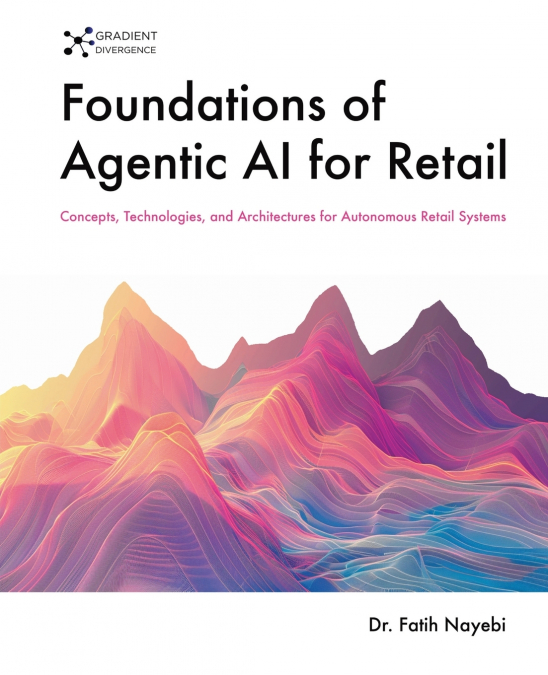
Master Retail’s Autonomous Future - Foundations of Agentic AI for Retail (Full-Color Edition)This book is the definitive, end-to-end playbook showing you how to design, code, and deploy autonomous agents that think, learn, and act in real time-transforming every aspect of your retail business.What makes this book indispensable?- Full‑Color Visuals: 75+ diagrams, flowcharts, and architecture blueprints rendered in vivid color, making complex concepts, data flows, and decision loops crystal-clear.- 50+ Real‑World Retail Use Cases: Explore detailed blueprints and discussions covering demand forecasting, dynamic pricing, conversational merchandising, autonomous store operations, supply chain optimization, and many more-illustrating agent capabilities across the retail landscape.- 28 Code Examples: Get hands-on with complete, Python listings covering: BDI agents, OODA loops, MDP, Reinforcement Learning pipelines, LLM-powered ReAct chains, MCP-based negotiations, A2A multi-agent orchestration, and beyond.- Retail‑Focused, Industry‑Agnostic Foundations: Master the core math, decision frameworks (like MDPs, Bayesian methods), and reference architectures applicable to any industry, then dive deep into specialized adaptations proven in retail.- Rigor + Cutting‑Edge Tech: Bridge foundational AI (optimization, planning) with the latest breakthroughs: Large Language Models (LLMs), OpenAI’s Agents SDK, transformer agents, retrieval-augmented generation (RAG), and modern open multi-agent protocols like Anthropic’s MCP and Google’s A2A.Inside you’ll learn to:1. Architect autonomous retail systems using layered reference models, event-driven patterns, and API-first design.2. Orchestrate multi-agent ecosystems that collaborate, negotiate, and self-optimize across pricing, supply chain, marketing, and customer service.3. Embed Large Language Models as reasoning engines for complex decision-making and natural-language interactions.4. Implement robust feedback loops & guardrails ensuring agents are safe, explainable, and aligned with AI governance standards.5. Scale from Proof-of-Concept to enterprise deployment with proven CI/CD pipelines, observability dashboards, and effective rollout strategies.Who should read this book?- Retail Executives & Strategists: Gain a clear, actionable roadmap for AI-driven transformation and competitive advantage.- Software Architects & ML Engineers: Acquire hands-on guidance to design and build next-generation agentic platforms.- Researchers & Advanced Students: Use this as a rigorous yet practical reference on developing and deploying autonomous systems.- AI Enthusiasts: Get a front-row seat to the convergence of LLMs, computer vision, causal inference, and sensor networks in the dynamic world of retail.Why buy now?The retail winners of tomorrow are moving today-transitioning from siloed analytics to fully autonomous, continuously learning agentic ecosystems.Whether you’re reinventing an established brand or launching the next disruptor, this comprehensive, full-color guide delivers the complete toolkit.About AuthorDr. Fatih Nayebi is VP of Data & AI at ALDO Group, steering the retailer’s AI strategy and product innovation. A post-doctoral specialist in Machine Learning and HCI, he has spent six years at McGill University teaching Data Science, ML Engineering, Deep Learning, and Agentic AI.