 Librería Samer Atenea
 Kálamo Books
 Librería Elías (Asturias)
 Librería Kolima (Madrid)
 Librería Proteo (Málaga)
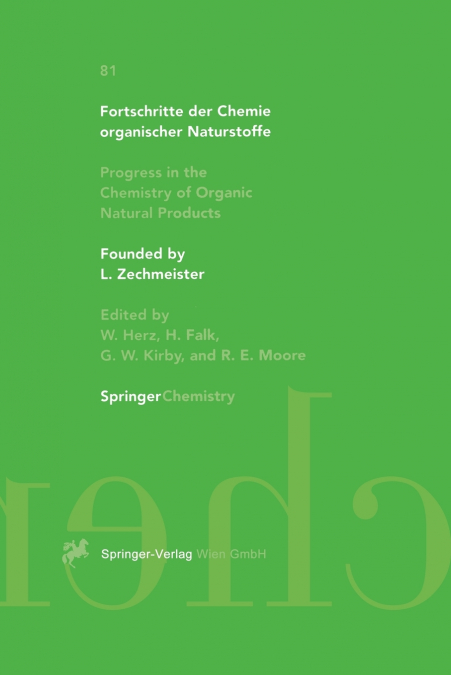
New Results on the Chemistry of Lichen Substances.- Abbreviations.- 1. Introduction.- 2. Methods for Identification and Structure Elucidation of Lichen Substances.- 2.1. Spot Tests.- 2.2. Thin Layer Chromatography (TLC).- 2.3. High Performance Liquid Chromatography (HPLC).- 2.4. Droplet Counter-Current Chromatography.- 2.5. NMR Spectroscopy.- 2.6. Mass Spectrometry.- 2.7. X-ray Analysis.- 2.8. Cathodoluminescence and X-ray Microanalysis.- 2.9. Laser Microprobe Mass Spectrometry (LAMMA).- 2.10. Fluorescence Microscopy.- 2.11. Computer Program for Identification of Lichen Substances(WINTABOLITES).- 3. General Methods for Derivatization and Regeneration of Lichen Substances.- 3.1. Carboxyl Groups.- 3.1.1. Methylation.- 3.1.2. Benzylation and Debenzylation.- 3.1.3. Carboxylation and Decarboxylation.- 3.2. Alcoholic and Phenolic Groups.- 3.2.1. Acetylation.- 3.2.2. Methylation and Demethylation.- 3.2.3. Isopropylation and Deisopropylation.- 3.2.4. Benzylation and Debenzylation.- 3.2.5. Oxidation of Alcohols.- 3.3. Substitution at Aromatic Rings.- 3.3.1. Halogenation and Dehalogenation.- 3.3.2. Hydroxylation.- 3.4. Synthesis of Aldehydes.- 3.4.1. Reduction of Aldehydes.- 3.4.2. Oxidation of Aldehydes.- 3.5. Cleavage and Formation of the Depside Ester Bond.- 4. Structure Elucidation and Synthesis of Lichen Substances.- 4.1. Nitrogen Containing Compounds.- 4.2. Phosphorus Containing Compounds.- 4.3. Polyols, Mono- and Polysaccharides and Carbohydrates.- 4.4. Aliphatic and Cycloaliphatic Compounds.- 4.4.1. Hydrocarbons.- 4.4.2. Aliphatic Alcohols.- 4.4.3. Aliphatic Acids and Esters.- 4.4.4. Aliphatic Tricarboxylic Acids.- 4.4.5. ?-Lactonic Acids.- 4.4.6. Macrocyclic Lactones and Bis-Lactones.- 4.4.6.1. Aspicilin.- 4.4.6.2. Lepranthin.- 4.4.7. Anhydrides.- 4.5. Aromatic Compounds.- 4.5.1. Aromatic Units.- 4.5.2. Biphenyls.- 4.5.3. Terphenyls.- 4.5.4. Diphenylmethanes.- 4.5.5. Diphenyl Ethers (Pseudodepsidones).- 4.5.6. Depsides.- 4.5.7. Depsidones.- 4.5.8. Depsones.- 4.5.9. Chromanes and Chromones.- 4.5.10. Xanthones.- 4.5.11. Benzofurans.- 4.5.12. Dibenzofurans.- 4.5.13. Usnic Acid and Related Compounds.- 4.5.14. Naphthopyrans.- 4.5.15. Quinones.- 4.5.15.1. Benzofuranoquinones and Benzoquinones.- 4.5.15.2. Naphthaquinones and bis-Naphthaquinones.- 4.5.15.3. Anthraquinones.- 4.5.15.4. Phenanthroquinones.- 4.5.15.5. Phenanthroperylenequinones.- 4.5.15.6. Perylenequinones.- 4.5.16. Pulvinic Acid Derivatives.- 4.6. Terpenoids.- 4.6.1. Monoterpenoids.- 4.6.2. Sesquiterpenoids.- 4.6.3. Diterpenoids.- 4.6.4. Sesterterpenoids.- 4.6.5. Triterpenoids.- 4.6.6. Steroids.- 4.6.7. Carotenoids.- 5. Culture and Chemistry of Lichen Symbionts and Cell Culture of Lichens.- 5.1. Culture of Mycobionts.- 5.2. Lichen Tissue Cultures and their Metabolites.- 5.3. Culture of Lichen Phycobionts.- 5.4. Metabolites from Lichen Phycobionts.- 6. Biosynthesis of Lichen Substances.- 7. Chemotaxonomy of Lichens.- 8. Biological Activities of Lichen Substances and Lichens.- 8.1. Activity against Microorganisms.- 8.1.1. Antiviral Activity.- 8.1.2. Activity Against Bacteria and Fungi.- 8.2. Activity Against Algae.- 8.3. Activity on Bryophytes.- 8.4. Activity on Higher Plants.- 8.5. Activity on Animals.- 8.6. Activity on Man.- 8.7. Tumour and Anti-Tumour Activity.- 8.8. Inhibition of Enzymes.- 8.9. Antioxydant Activity.- 9. Harmful Effects of Lichens.- 10. Commercial Uses of Lichens and Lichen Substances.- 10.1. Uses in Perfume Production and in Cosmetics.- 10.2. Lichens as Biomonitors.- 10.3. Lichens for Dyeing.- Acknowledgement.- Notes Added in Proof.- References.- Author Index.