 Librería Samer Atenea
 Kálamo Books
 Librería Elías (Asturias)
 Librería Kolima (Madrid)
 Librería Proteo (Málaga)
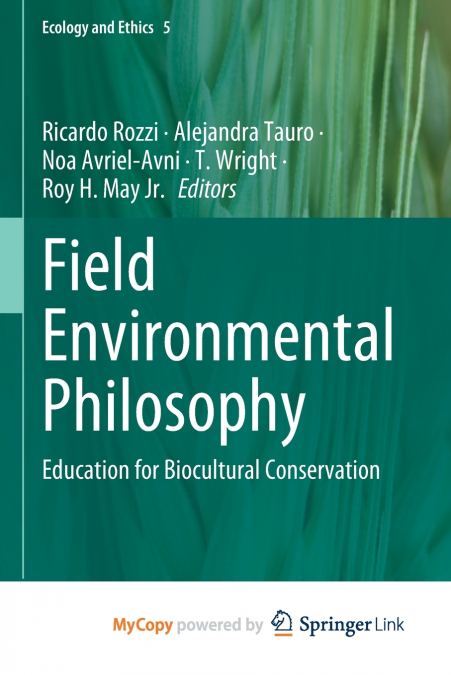
This fifth volume in the Ecology and Ethics series integrates key concepts of the previous four volumes by addressing biocultural conservation through novel educational methods. In Field Environmental Philosophy (FEP), the authors undertake two complementary tasks. First, they address a problematic facet of education as an indirect driver of a global change and biocultural homogenization. Second, they contribute to solve the former problems by introducing the FEP method as well as other educational approaches from around the world that value and foster conservation of biological and cultural diversity. A particular emphasis is therefore on the integration of sciences, arts, humanities, and ethics into educational practices that involve the participation of local communities with their diverse forms of ecological knowledge and practices. The book is divided into four parts. Part I introduces FEP concepts and practices that involve a 4-step cycle of transdisciplinary research, poeticcommunication through composition of metaphors, design of field activities guided with an ecological and ethical orientation, and participation in biocultural conservation activities. Part II exposes problems as well as solutions in formal education (from preschool to higher education) and non-formal education to respect biocultural diversity. Parts III & IV provide case studies developed at long-term socio-ecological research (LTSER) sites, botanical gardens, and other platforms for non-formal education that contribute to biocultural conservation.This book supports a paradigm shift addressing still understudied indirect drivers of global change to foster the conservation of biological and cultural diversity. It is a valuable asset for scientists and practitioners in science and humanities education.